
Research Highlights
Oceanus Magazine

Jordan Kennedy combines Indigenous knowledge, engineering, and observation to rethink how coastal landscapes are studied and restored. Her work on clam gardens and autonomous mapping systems explores how revitalizing these ancient systems can also reclaim knowledge and relationships between people, place, and practice.
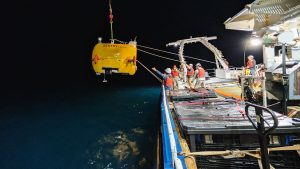
AUV Sentry leads the way in mapping and monitoring methane bubbling from the seafloor
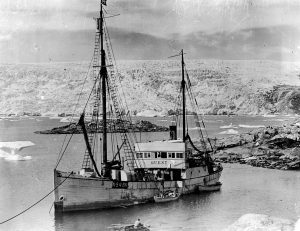
40 years after helping reveal the Titanic, Alvin returns to the North Atlantic to document two other legendary shipwrecks
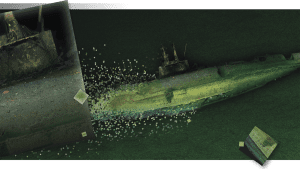
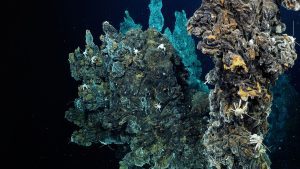
News Releases
Archaeologists excavating the famous ancient Greek shipwreck that yielded the Antikythera mechanism have recovered more than 50 items including a bronze armrest (possibly part of a throne), remains of a bone flute, fine glassware, luxury ceramics, a pawn from an ancient board game, and several elements of the ship itself.
“This shipwreck is far from exhausted,” reports project co-Director Dr. Brendan Foley, a marine archaeologist with the Woods Hole Oceanographic Institution (WHOI). “Every single dive on it delivers fabulous finds, and reveals how the ‘1 percent’ lived in the time of Caesar.”
The shipwreck dates to circa 65 B.C., and was discovered by Greek sponge fishermen in 1900 off the southwestern Aegean island of Antikythera. They salvaged 36 marble statues of mythological heroes and gods; a life-sized bronze statue of an athlete; pieces of several more bronze sculptures; scores of luxury items; and skeletal remains of crew and passengers. The wreck also relinquished fragments of the world’s first computer: the Antikythera Mechanism, a geared mechanical device that encoded the movements of the planets and stars and predicted eclipses.
The 2015 expedition is part of a long-term research program at the site, which began in 2014. It was the first scientific excavation of the wreck, and launched the first comprehensive study of all of its artifacts. During the new multi-year program the team expects to recover artifacts and ancient artwork still buried in the seafloor, and recreate the history of the ship’s exquisite cargo and its final voyage.
The waters off Greece’s Santorini are the site of newly discovered opalescent pools forming at 250 meters depth. The interconnected series of meandering, iridescent white pools contain high concentrations of carbon dioxide (CO2) and may hold answers to questions related to deepsea carbon storage as well as provide a means of monitoring the volcano for future eruptions.
New England’s spring and summer red tides will be similar in extent to those of the past three years, according to the 2015 Gulf of Maine red tide seasonal forecast. The forecast is the eighth seasonal Gulf of Maine red tide forecast funded by NOAA and issued by scientists from the Woods Hole Oceanographic Institution and North Carolina State University.
The forecast is part of a larger NOAA effort to deliver ecological forecasts that support human health and well-being, coastal economies, and coastal and marine stewardship.
Red tide, a type of harmful algal bloom (HAB) caused by the alga Alexandrium fundyense, produces a toxin that can lead to paralytic shellfish poisoning, which can result in serious or even fatal illness in humans who eat contaminated shellfish. In 2005, an unusually large red tide event caused $23 million in lost shellfish sales in Massachusetts and Maine.
The Woods Hole Oceanographic Institution (WHOI) announces that the Human Occupied Vehicle (HOV) Alvin has achieved certification from the U. S. Naval Sea Systems Command (NAVSEA) for operations to its rated depth of 4,500 meters (approx. 2.8 miles). Two dives were conducted in the waters off Arica, Chile, on January 26-27 from the research vessel Atlantis, demonstrating vehicle performance in accordance with the specified metrics required for certification. NAVSEA representatives were on hand to monitor the process and participate in the dives.
News & Insights
NSF program fosters collaboration between indigenous communities and traditional scientists, allowing WHOI’s autonomous vehicles to shed light on a changing Arctic
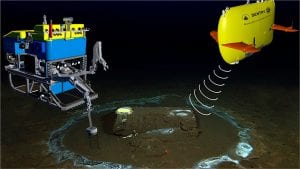
An investigative report this week in the LA Times features the work of WHOI’s marine geochemistry lab in identifying the discarded barrels and analyzing samples from the discovery.