
R/V Atlantis
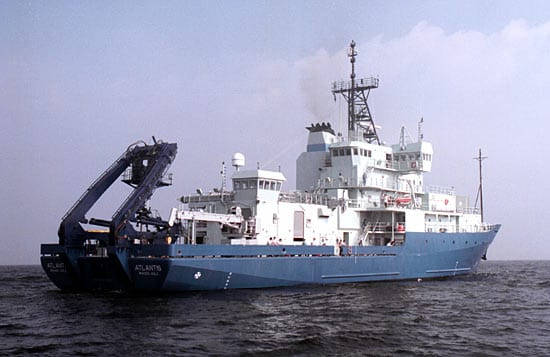
The research vessel (R/V) Atlantis is owned by the U.S. Navy and operated by WHOI for the oceanographic community. It is one of the most sophisticated research vessels afloat, and it is specifically outfitted for launching and servicing the Alvin human occupied submersible.
Delivered to Woods Hole in April 1997, Atlantis was built with six science labs and storage spaces, precision navigation systems, seafloor mapping sonar, and satellite communications. The ship’s three winches, three cranes, machine shop, and specialized hangars were specifically designed to support Alvin and other vehicles of the National Deep Submergence Facility.
The ship carries a complement of 36 crew members, science technicians, deep submergence group members, as well as a scientific party of 24 men and women for as long as 60 days. Because Atlantis is constantly going where Alvin is needed for exploration, the ship operates in all of the world’s oceans and is rarely seen in Woods Hole. In recent years, the ship and sub have spent most of their time exploring underwater volcanoes and hydrothermal vents in the Pacific Ocean.
Atlantis is part of a class of similar Navy-owned research vessels designed and built by Halter Marine of Pascagoula, Mississippi. Her sister ships are R/V Thomas G. Thompson, operated by the University of Washington, and R/V Roger Revelle, operated by the Scripps Institution of Oceanography. Atlantis is the only vessel designed to support both Alvin and general oceanographic research.
Atlantis is the namesake of WHOI’s first research vessel, a 142-foot, steel-hulled, ketch-rigged ship that sailed 299 cruises and more than 700,000 miles for ocean science from 1931 to 1966. The Institution’s flagship and symbol was the first American ship built specifically for research in marine biology, marine geology, and physical oceanography. The space shuttle Atlantis was named for the original WHOI research vessel.
More about R/V Atlantis
Recent News
The Heroic Age Expedition, led by the Royal Canadian Geographical Society in partnership with Woods Hole Oceanographic Institution, reveals the famed Antarctic explorer’s last ship, Terra Nova in stunning detail
U.S. Navy certification permits sub to resume operations to 6,500 meters after routine overhaul
The Royal Canadian Geographical Society, in partnership with WHOI, will undertake “once-in-a-generation” expedition to survey Sir Ernest Shackleton’s Quest and Captain Robert Falcon Scott’s Terra Nova
The interdisciplinary mission included team members from the U.S Navy, Naval History and Heritage Command, National Science Foundation.
WHOI’s Science RoCs aims to equip commercial vessels with sensors to measure physical, chemical, and biological characteristics of the ocean along the world’s major shipping routes
Multimedia
Slideshow: R/V Atlantis
Photos of the research vessel and some of the science performed onboard.
Slideshow: Atlantis Returns
On Sept. 6, 2010, R/V Atlantis returned to Woods Hole after more than four years away.