Skip to content

Research Highlights

Oceanus Magazine
From Mars to the deep

April 28, 2021

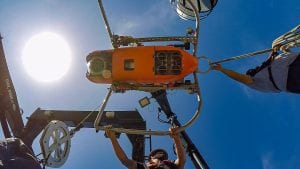
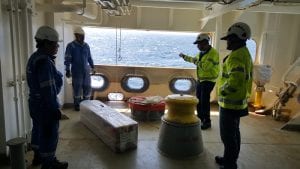
Navigation technology that helped NASA’s Perseverance rover land safely on Mars could guide robots in another unexplored terrain that’s much closer to home: the deepest trenches of the ocean.

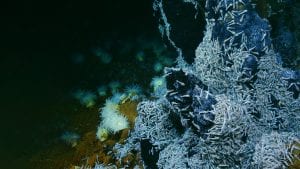
Methane seep

Microbial Methane – New Fuel for Ocean Robots?

March 8, 2021

Researchers are developing on an energy harvesting platform that converts marine methane to electricity. The system could be an answer to power-hungry robots that are being asked to explore increasingly larger swaths of the ocean.

Photo of Susan and Coleman Burke

Gift enables new investments in ocean technologies

November 7, 2020

A grant from the Coleman and Susan Burke Foundation has allowed WHOI to make crucial investments in remote technology that enhance research innovation at sea. New video monitors aboard the R/V Neil Armstrong will allow scientists and crew to video conference throughout the ship or with colleagues on shore.

A REMUS-600 autonomous underwater vehicle (AUV) communicates with an ocean-bottom seismograph (OBS) via a WHOI-developed optical modem link during lab testing. This link enables REMUS vehicles to act as "seismic data mules" whereby they offload data OBS stations without the need for ships or human intervention. (Photo by Dara Tebo, © Woods Hole Oceanographic Institution)

Can seismic data mules protect us from the next big one?

October 7, 2020

Researchers look to new seafloor earthquake detection systems for better detection and warning of seismic risk

the sea ahead

Sea Ahead

July 27, 2020

Once upon a time, ocean scientists hung up cans on up a tree on Bikini Atoll to measure wave height in the Marshall Islands during nuclear weapons testing. Today, ocean technologies and data harvesting are heading somewhere big, from swarming bots, to more autonomous submersibles, and the miniaturization of ocean sensors

News Releases

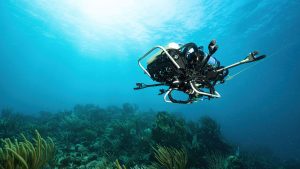
CUREE autonomous underwater vehicle

Autonomous underwater robot discovers hidden coral reef “hotspots”

May 13, 2026

New underwater robot opens new possibilities in coral reef conservation by autonomously identifying biodiversity “hotspots”

WHOI Scientist Catherine Walker Joins NASA-Selected EDGE Satellite Mission

February 12, 2026

Satellite measuring land, polar, and coastal regions could launch by 2030

Sargassum Patch

Study reveals dramatic decline in historic sargassum populations, with WHOI scientists helping unravel basin-scale changes

December 4, 2025

The findings point to warming ocean temperatures, shifting nutrient regimes, and changing circulation patterns as likely contributors to this emerging basin-scale redistribution of Sargassum.

International research team discovers a potential source of abiotic methane in the Arctic Ocean

November 21, 2025

A distinctive oceanic core complex releasing hot fluids has been identified at a depth of 2,700 meters on the Arctic Ocean’s floor.

WHOI’s Jennifer Johnson receives Fulbright Specialist Award

August 7, 2025

Research Associate will complete a project at the National Fisheries and Marine Research Institute in Angola.

News & Insights

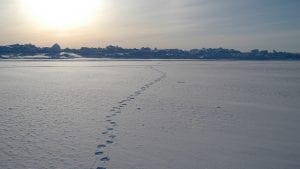
WHOI builds bridges with Arctic Indigenous communities

February 10, 2021

NSF program fosters collaboration between indigenous communities and traditional scientists, allowing WHOI’s autonomous vehicles to shed light on a changing Arctic
WHOI-assisted study finds ocean dumping of DDT waste was “sloppy”

October 29, 2020

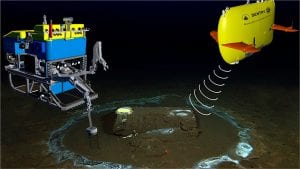
An investigative report this week in the LA Times features the work of WHOI’s marine geochemistry lab in identifying the discarded barrels and analyzing samples from the discovery.

Scroll To Top