
Autonomous underwater robot discovers hidden coral reef “hotspots”
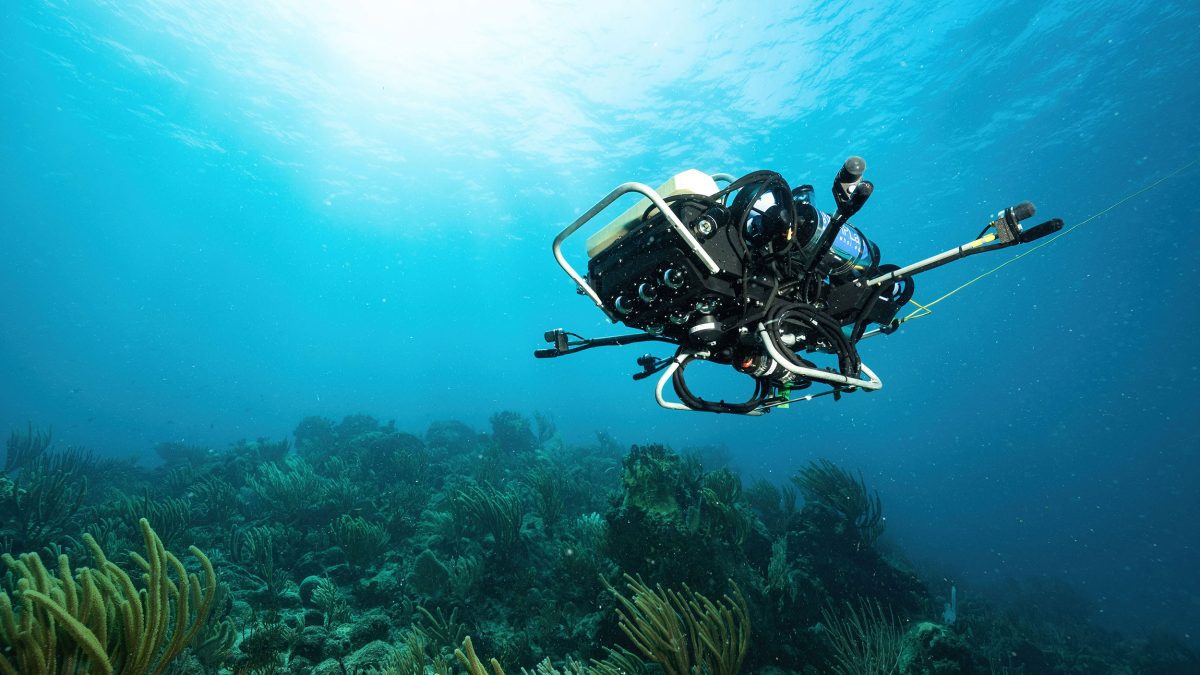 CUREE (Curious Underwater Robot for Ecosystem Exploration) autonomous underwater vehicle navigates using information from its cameras and outstretched hydrophones to gather audio and visual information about a coral reef environment. (Photo by Austin Greene, © Woods Hole Oceanographic Institution)
 May 13, 2026
Vehicle opens new possibilities for reef conservation
Images and video available for use with credit can be found here.
Woods Hole, Mass. (May 13, 2026)—Researchers have developed an autonomous system for seeking out and mapping hotspots of biodiversity on coral reefs with unprecedented precision, offering a powerful new tool for studying and protecting some of the ocean’s most valuable ecosystems. The work, published in Science Robotics, demonstrates how combining audio and visual data in a single autonomous system can reveal where marine life concentrates and why.
The researchers used CUREE (the Curious Underwater Robot for Ecosystem Exploration), a robotic vehicle developed as a part of the WHOI Reef Solutions Initiative, and combined CUREE’s cameras, hydrophones, and powerful on-board computers to analyze audio and visual signals in real-time, enabling it to autonomously identify areas of higher biological activity at unprecedented resolution. Their work combines different types of observations—direct (mapping audio and visual detection of animals) and indirect (what can be inferred from environmental soundscapes or behavior of sentinel species)—to identify where biological hotspots are most likely to be located. The system represents a breakthrough in the ability to identify, map, and monitor the fine-scale structure of reef biodiversity, a key part of understanding reef health and resilience.
“We know that biodiversity on reefs isn’t distributed uniformly,” said Seth McCammon, a WHOI roboticist and lead author of the study. “But until now we haven’t really been able to reliably quantify that by finding these patchy hotspots, mapping them at the centimeter scale, and measuring just how active they really are. Developing this capability is going to be critical to helping biologists get a deeper understanding of reef ecology moving forward.”
Coral reefs, which occupy less than 0.01% of the ocean, yet support roughly one quarter of all marine species, are under mounting stress from warming ocean water, disease, overfishing, and coastal development. This biodiversity clusters in localized hotspots—areas of intense biological activity that are critical for feeding, shelter, and reproduction. By resolving biodiversity patterns at sub-meter scales and linking them to habitat features such as reef structure, scientists will be better positioned to understand the processes that sustain reef ecosystems.
WHOI scientist and WARP Lab lead Yogesh Girdhar tests the CUREE (Curious Underwater Robot for Ecosystem Exploration) autonomous underwater vehicle in the U.S. Virgin Islands in November 2021. Members of the WARP Lab designed CUREE to navigate and sense complex coral reef environments autonomously to identify biodiversity hotspots. (Photo by Dan Mele © Woods Hole Oceanographic Institution)
Unlike traditional reef surveys conducted by trained divers, which are costly, limited in coverage, and potentially hazardous, CUREE can operate autonomously for hours at a time, precisely localize itself on the reef, and collect rich datasets over larger areas and longer periods. “That does not mean CUREE is a replacement for human observation of a reef,” said Yogesh Girdhar, the project principal investigator and a roboticist who led the development of CUREE at WHOI’s WARP Lab. “Instead, it’s meant to augment those capabilities and do things a human simply can’t.”
The robot uses a novel framework that integrates these multiple sensing techniques through four complementary behaviors: visual fish surveys, acoustic mapping, sound-guided homing, and tracking of key “sentinel” species. Together, these behaviors allow the system not only to map where biodiversity is concentrated, but also to actively seek out new hotspots—even in unexplored and highly complex reef environments.
In field trials conducted over three expeditions between 2022 and 2024 to a healthy reef in the U.S. Virgin Islands known as Joel’s Shoal, the robot consistently identified the same hotspot: an area surrounding a large pillar coral structure. Visual surveys of the reef, which is named after Joel Llopiz, the WHOI biologist who discovered the reef and who passed away in January, revealed fish densities nearly 25 times higher near the feature compared to the rest of the reef, while acoustic data confirmed elevated biological activity over a much larger area.
In particular, the study highlights the power of combining audio and visual information underwater. Passive acoustic sensing can detect animal activity tens of meters away—even when organisms are hidden or camouflaged, but the reef environment is very noisy, making it difficult to make precise maps of biological activity using sound alone. Cameras provide detailed, species-level information, but only over short ranges. By combining these data streams, the robot can detect distant activity with sound and then verify that with close-up visual observations. “In some sense, they’re almost a perfect compliment for each other,” said McCammon. “Passive acoustics gives you a broad sense of the environment, while vision is short range, but is this really information-rich data stream” said McCammon.
The system can also home in on specific biological sounds, such as snapping shrimp or species of fish known to make distinct calls, allowing it to navigate directly toward areas of interest without prior knowledge of the reef. In controlled experiments, the robot successfully tracked sound sources from distances of up to 80 meters and autonomously converged on natural reef hotspots over distances of 30 meters.
In another demonstration, the robot followed a barracuda—a top predator critical to the health of the reef ecosystem—as it moved through its environment to identify a hotpot. Researchers propose this method of autonomously observing where the sentinel species repeatedly returns, as another way to identify the locations of ecological importance, offering insights into how predators interact with their surroundings.
Ultimately, the researchers envision fleets of such robots deployed globally to explore and monitor reefs that remain largely uncharted. By rapidly finding and characterizing biodiversity hotspots, the technology could help guide conservation decisions, prioritize protection efforts, and track ecosystem changes in a warming ocean.
“As coral reefs face unprecedented challenges, we need smarter, faster ways to understand where life persists and why so conservationists and resource managers can focus their attention where it’s needed most,” said Girdhar. “Autonomous systems like this can help us find—and protect—the most vital parts of these ecosystems before it’s too late.”
###
About Woods Hole Oceanographic Institution
Woods Hole Oceanographic Institution (WHOI) is a private, non-profit organization on Cape Cod, Massachusetts, dedicated to marine research, engineering, and higher education. Founded in 1930, its mission is to understand the ocean, its interactions with the Earth, and its role in a changing global environment. WHOI’s pioneering discoveries arise from a unique blend of science and engineering that has made it one of the world’s most trusted leaders in ocean research and exploration. Known for its multidisciplinary approach, advanced ship operations, and unmatched deep-sea robotics, WHOI also operates the most extensive suite of ocean data-gathering platforms worldwide. More than 800 concurrent projects—driven by top scientists, engineers, and students—push the boundaries of knowledge to inform people and policy for a healthier planet. Behind the scenes, ship captains, mates, craftsmen, marine operations, and other skilled professionals provide essential support that makes this work possible. Learn more at whoi.edu.
Key Takeaways
- Researchers created an autonomous robot, CUREE, to accurately map biodiversity hotspots on coral reefs, potentially revolutionizing conservation efforts.
- CUREE combines audio and visual data to identify areas of high biological activity, providing deeper insights into reef ecosystems and species' behavior.
- The robot operates autonomously for extended periods, allowing it to cover larger areas and gather comprehensive datasets efficiently and with minimal risk.
- By resolving biodiversity patterns at sub-meter scales, CUREE links these patterns to habitat features, information that is crucial for understanding reef health.
- Researchers envision deploying fleets of these robots worldwide to monitor uncharted reefs, guiding targeted conservation strategies amidst growing environmental threats.