Alvin Upgrade
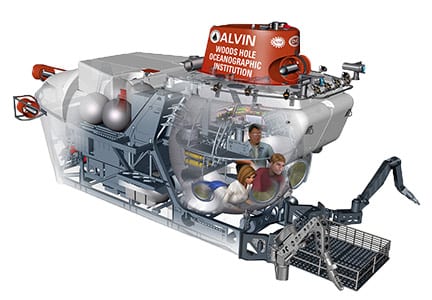
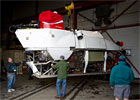
Alvin is the world’s longest-operating deep sea submersible. It was launched in 1964 and has made more than 4,700 dives, along the way participating in some of the most iconic discoveries in the deep ocean. Throughout 2011, 2012 and into 2013, Alvin received a comprehensive overhaul and upgrade funded by the National Science Foundation that greatly expanded its capabilities and will eventually put almost the entire ocean floor within its reach.
The upgrade is taking place in two stages. After Stage 1 was completed in 2013, Alvin boasted several new improvements, including:
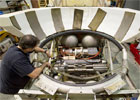
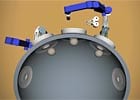
- A new, larger personnel sphere with an ergonomic interior designed to improve comfort on long dives
- Five viewports (instead of three) to improve visibility and provide overlapping fields of view for the pilot and two observers
- New lighting and high-definition imaging systems
- New syntactic foam providing buoyancy
- Improved command and control system
Several of these and other improvements to the sub have been designed to withstand descents to 6,500 meters—the remainder will be upgraded later. As a result, Alvin will initially maintain its current depth rating of 4,500 meters. In Stage 2, the entire sub will be upgraded to 6,500 meters depth. In addition, new batteries will be introduced to enable the submersible to stay at depth longer, giving scientists more time to work in unexplored parts of the ocean and putting 98 percent of the seafloor within their reach.
Specifications
Previous
Length: 23.3 feet
Breadth: 8.1 feet
Height: 12.0 feet
Operating depth: 4500 meters
Normal dive duration: 6-10 hours
Gross weight: 35,200 pounds
Science basket payload: 200 pounds
Personnel sphere volume: 144 cubic ft.
Current (Stage 1)
Length: 23.1 feet (7 meters)
Breadth: 8.4 feet (2.6 meters)
Height: 12.1 feet (3.68 meters)
Operating depth: 4500 meters
Normal dive duration: 6-10 hours
Gross weight: 45,000 pounds (20.4 metric tons)
Science basket payload: 400 lbs. (181.4 kilograms)
Personnel sphere volume: (169.5 cubic feet ) 4.8 cubic meters
- Manipulator-mounted camera: 12 MPix/HDTV hybrid digital still/video
- Optional mapping sensor: Reson 7125 multibeam system
Alvin will also continue to host a complete suite of established (both standard and optional) scientific subsystems as follows:
Exisiting Operational Subsystems
- Altimeter
- Sonars
- Depth measuring systems
- Gyrocompass, magnetic compass and attitude
- Hydraulic system
- Manipulators
- Navigation & tracking
- Propulsion system
- Trim system
- Underwater telephone & echosounder
- Variable ballast system
- VHF radio
Existing Optional Scientific Samplers
- Bioboxes
- Elevators
- Magnetometer
- Major water samplers
- Portable CTD
- Push corers
- Scoop nets
- Small capacity slurp samplers
- Large capacity slurp samplers
- Temperature measuring devices