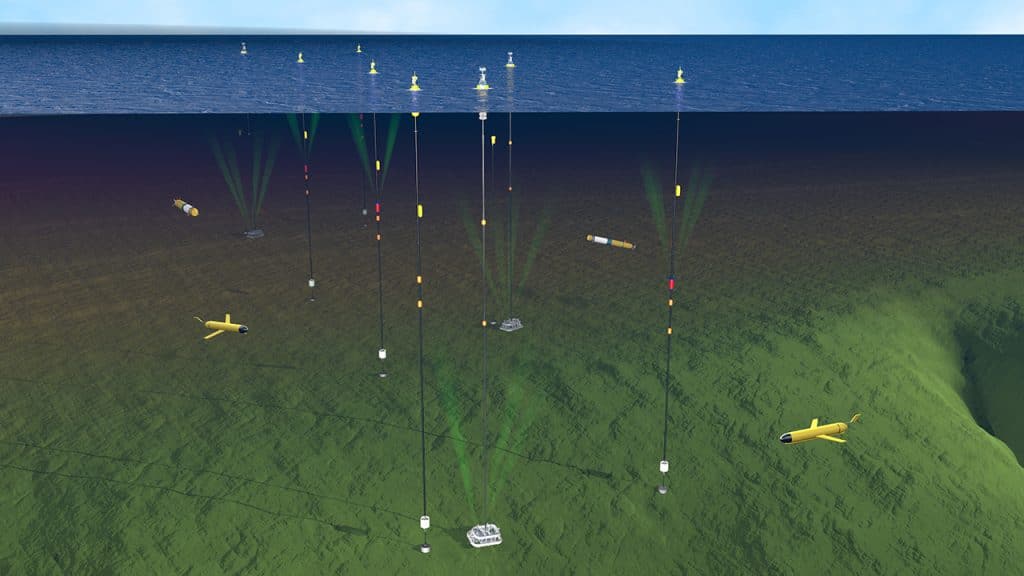
Citizens, sailors, and scientists have observed the seas for centuries, first from the shore, then from ships and submersibles, and recently from satellites. Along the way, scientists and engineers learned that they could sometimes leave instruments in the ocean, secured by wires, buoys, weights, and floats. Each new attempt has advanced our understanding of the ocean system and its interaction with the rest of the planet.
The next big leap will take the form of ocean observatories—suites of instruments and sensors with long-term power supplies and permanent communications links that can feed data to scientific laboratories in real-time.
Motivated by advances in computing, telecommunications, and marine architecture, researchers no longer want to just observe the ocean for short periods in small places. They are thinking big—tectonic plate big, ocean basin big, global system big—and long-term.
 Illustration
Scope and benefits of a “Coastal Carbon Observing Network”
WHOI scientists are working with fishing communities toward a coastal carbon observing network made up of fishing vessels with the latest ocean technologies.
 Illustration
Diagram demonstrating how a Slocum glider operates in the water column
An ocean glider moves up and down in the water column collecting data, surfacing to get a GPS reading on its position and to exchange data with scientists back on shore.
 Illustration
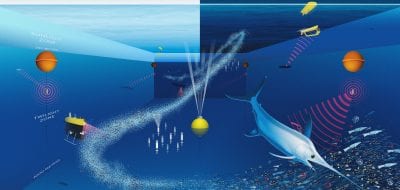
Acoustic Sensing Cube in the Ocean Twilight Zone
An ocean network could provide a comprehensive view of the twilight zone, or mesopelagic, using several different technologies including moored buoys equipped with acoustic survey systems
Ocean observatories are designed to ask fundamental questions about how the planet works. They will use novel technologies and techniques such as satellite communications, acoustic modems, and fiber-optic cables stretching hundreds of miles across the seafloor to ask questions of the planet that cannot be posed by short-term expeditions.
Ocean scientists plan to maintain their observations over months and years to study how the Earth, ocean, and atmosphere evolve and interact. They want to ask questions that cross scientific boundaries, such as how ocean chemistry affects biology or how the geology on the seafloor affects the physics of flowing water.
Observatories will allow scientists to adjust their experiments and talk to their instruments from hundreds of miles away in shore-based laboratories. This capability will also allow researchers to share what they learn in real-time with scientific colleagues, policymakers, educators, students, and the public.
Related Initiative
Ocean Observatories Initiative (OOI)
A science-driven ocean observing network that delivers real-time data from more than 900 instruments to address critical science questions regarding the world's oceans.

More topics like this
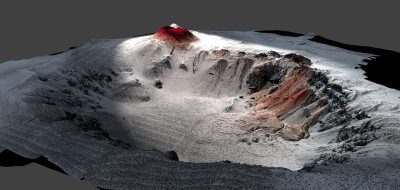
Acoustics
A strong understanding of how sound behaves in different conditions in the ocean helps scientists answer fundamental questions about the planet, the ocean, and marine life.
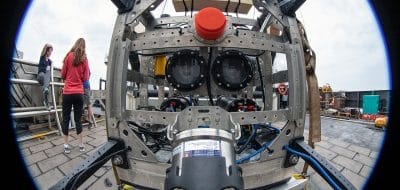
Imaging
Underwater imaging continues to advance in technology, allowing research to be conducted in the pressure-filled, extreme environments of the ocean.
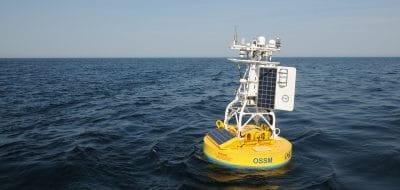
Moorings & buoys
An oceanographic mooring consists of a long cable with an anchor at one end, a float at the other, and instruments attached to the line in between or to a float.
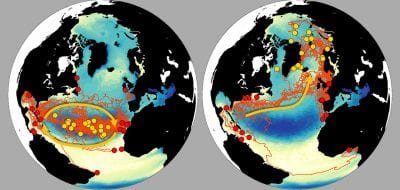
Ocean modeling
Ocean models are mathematical models of ocean properties and circulation, which helps us to better understand the ocean's influence on weather and climate.
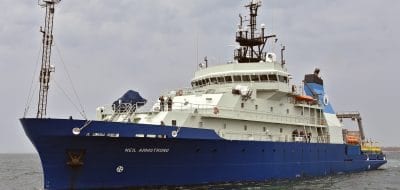
Ships
Oceanographers rely on sophisticated ships to get a firsthand look at the ocean environment and to carry their tools and instruments into it.
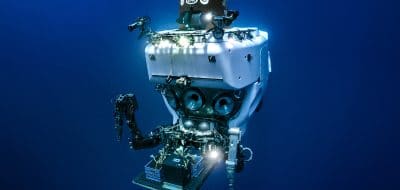
Underwater vehicles
Oceanographic observing tools has grown to include human-occupied submersibles, remote-controlled vehicles, and autonomous robots.
Oceanus magazine
[ ALL ]In-depth research on Ocean observatories







WHOI News Room
[ ALL ]Press releases
Ocean Observatories Initiative‘s Pioneer Array Relocating to Southern Mid-Atlantic Bight
OSU Assumes Cyberinfrastructure Responsibility for OOI
Get the ocean in your inbox
Fresh discoveries, research, and stories from WHOI — free, every week.