In this section
Ocean Topics
- Climate & weather
- How the ocean works
- Ocean & human lives
- Ocean life
- Sustainable ocean
- Ocean tech

(Woods Hole Oceanographic Institution)
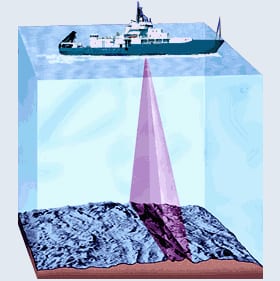
Multibeam bathymetry is based on the fact that more beams are better than one. About 30 years ago, the US Navy developed a system that could send out many beams of sound simultaneously to get a series of water depth readings along the line of a moving vessel.
Instead of just one transducer pointing down, “multibeam bathymetry systems” have arrays of 12 kHz transducers, sometimes up to 120 of them, arranged in a precise geometric pattern on ships’ hulls. The swath of sound they send out covers a distance on either side of the ship that is equal to about two times the water depth. The sound bounces off the seafloor at different angles and is received by the ship at slightly different times.
All the signals are then processed by computers on board the ship, converted into water depths, and automatically plotted as a bathymetric map with an accuracy of about 10 meters.
In this way, ships traveling at speeds over 10 knots can produce a swath, rather than a line, of water-depth information. Multibeam bathymetry systems are now routinely used during research cruises to map areas of seafloor as large as thousands of square kilometers.

Articles Related to Multibeam Bathymetry
From Oceanus Magazine
[ ALL ]Lux in abyssum
Whale aware!
A polar stethoscope
How WHOI helped win World War II
News Releases
[ ALL ]WHOI discovers the oldest known whale recordings, dating to 1949
WHOI’s Jennifer Johnson receives Fulbright Specialist Award
Sonic Youth: Healthy Reef Sounds Increase Coral Settlement
News & Insights
[ ALL ]Could listening to the deep sea help save it?
For Mark Baumgartner, Whale Safe is the natural evolution of WHOI’s work with passive acoustics
Listening to fish with passive acoustics
WHOI in the News
[ ALL ]New technology tries to protect whales
Humpback whale songs provide insight to population changes
Sea Ahead
Acoustics of the deep sea tell us about biodiversity
Features
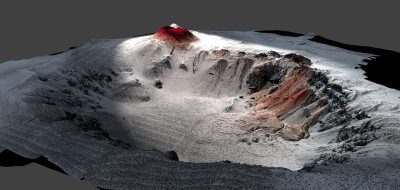
A strong understanding of how sound behaves in different conditions in the ocean helps scientists answer fundamental questions about the…
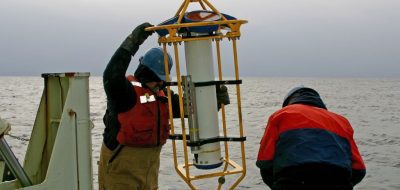
An Acoustic Doppler Current Profiler (ADCP) uses sound waves to measure water current speed at multiple depths, helping scientists study…
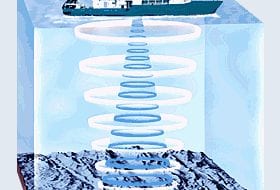
Echo sounding uses sound waves bounced off the ocean bottom to calculate depth. The faster the sound waves return, the…
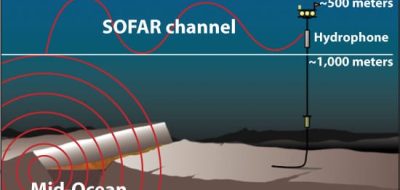
Hydrophone arrays "hear and record sound waves generated by seismic events, submarines, or whales, and are installed in places that…