In this section
Ocean Topics
- Climate & Weather
- How the Ocean Works
- Ocean & Human Lives
- Ocean Life
- Sustainable Ocean
- Ocean Tech

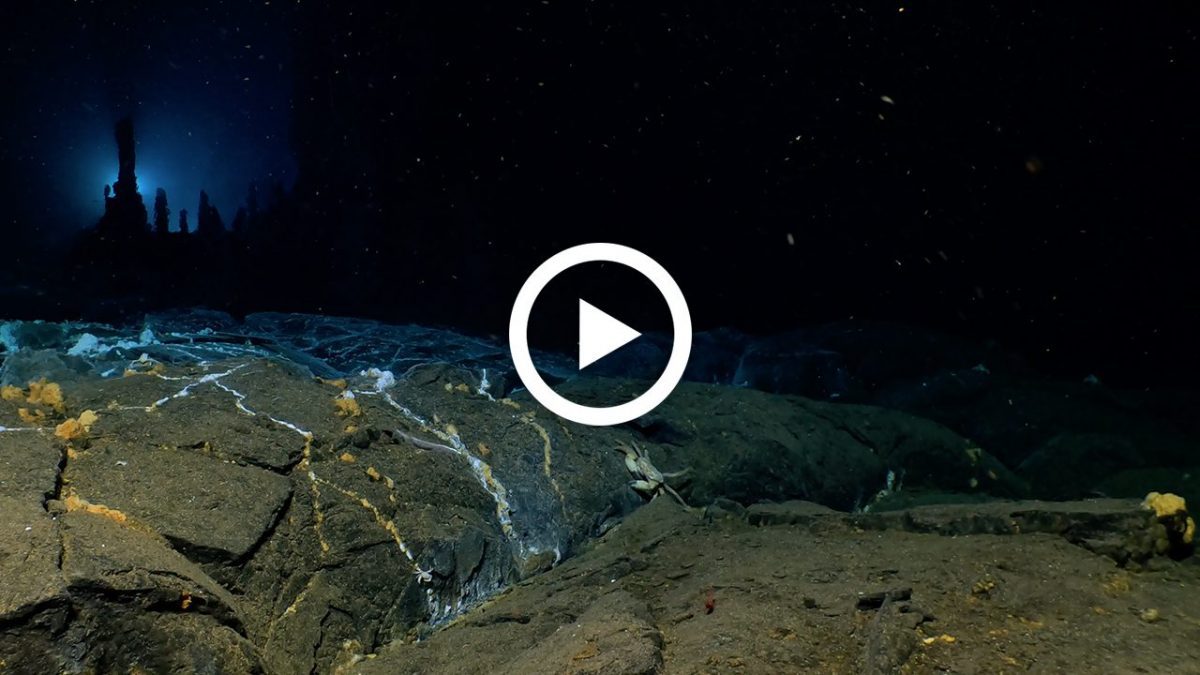
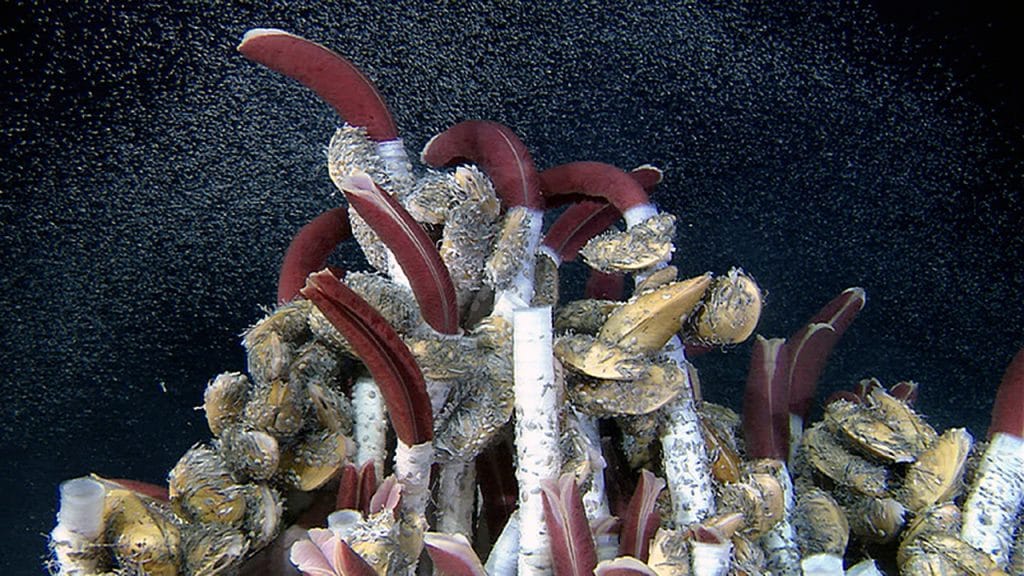
Tubeworms, clams, and crabs at a hydrothermal vent site. (Woods Hole Oceanographic Institution)
What is Life at Vents and Seeps?
Hydrothermal vents and cold seeps are places where chemical-rich fluids emanate from the seafloor, often providing the energy to sustain lush communities of life in some very harsh environments. Cold seeps and hydrothermal vents differ from one another in the underlying conditions that form and drive them. This has implications for the kinds of animals that are able to survive at each.
On land and near the ocean surface, sunlight provides the energy that allows photosynthetic plants to convert carbon dioxide and water into the organic carbon, the fundamental source of nutrients for animals higher up the food chain. Below the photic zone—the sunlit, upper reaches of the ocean—many microbes have evolved chemosynthetic (instead of photosynthetic) processes that create organic matter by using oxygen in seawater to oxidize hydrogen sulfide, methane, and other chemicals present in vent and seep fluids.
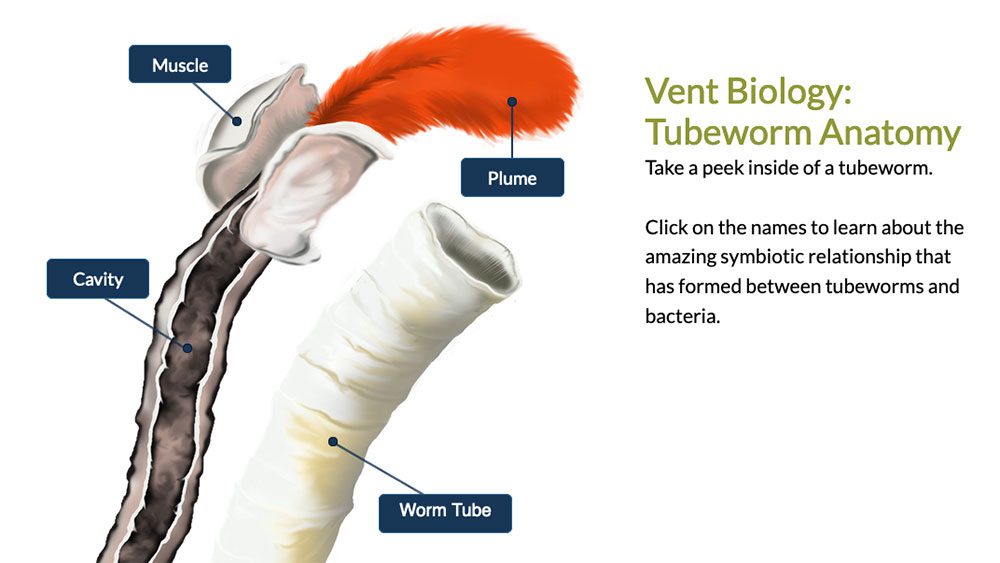
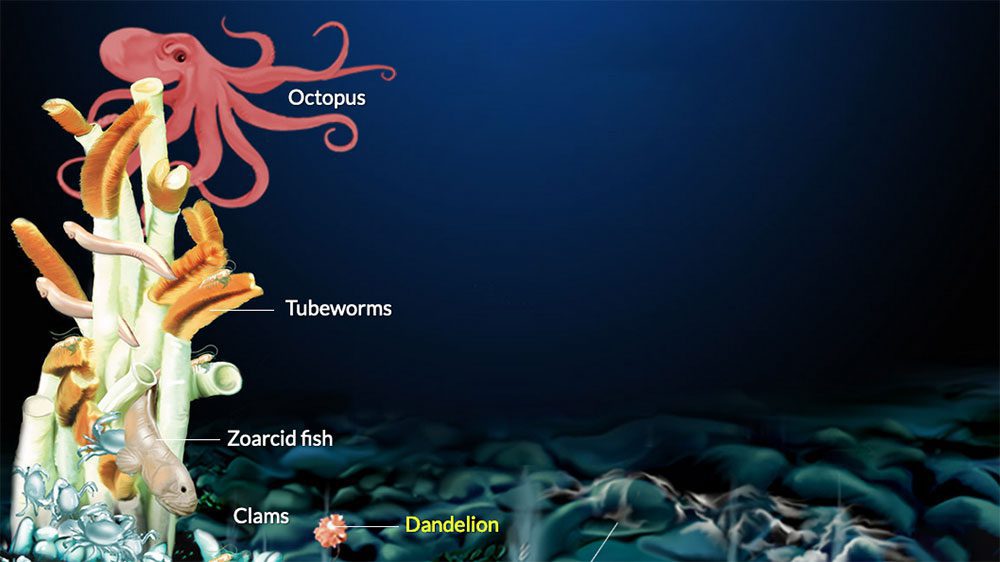
Animals such as clams, mussels, snails, and shrimp feed on the microbes, and in turn, provide food for fish and other predators. Some vent and seep animals, such as tubeworms and shrimp, also host chemosynthetic microbes on or within their bodies, providing a place for the microbes to live in exchange for nutrients produced by the microbes.
Hydrothermal vents are driven by heat from volcanism beneath the seafloor. In this environment, chemical reactions take place as seawater percolates through cracks in the seafloor to produce hot (more than 400°C or 750°F), acidic fluids that eventually rise back to the seafloor. Vents, and the ecosystems they support, are created and destroyed as underlying volcanic activity waxes and wanes over tens or hundreds of years. Cold seeps, on the other hand, are less ephemeral and volatile.
They produce a diffuse flow of lower-temperature fluids, often composed of natural gas and a mixture of hydrocarbons, at slower rates for longer periods. Some seeps may be thousands of years old.
What is Life at Vents and Seeps?
The discovery of life at vents and seeps revolutionized understanding of how and where life can exist on Earth. The organisms that thrive at deep-sea vents and seeps have to survive freezing cold, perpetual darkness, high-pressure, and toxic chemicals. For this reason, they are often called extremophiles for the extreme nature of their living conditions.
Studying these organisms expands understanding of how life first took hold and slowly evolved on our planet as well as where it might exist elsewhere in the solar system and beyond. In addition, previously unknown enzymes, molecules, and metabolic processes discovered in extremophiles offer great potential for development into valuable and life-saving biomedical and commercial applications. Enzymes from vent microbes are already being used to enhance the flow of oil extracted from deep reservoirs, for example, and ice-nucleating proteins found in deep-sea organisms are used to make ice cream.
Another example are DNA polymerases isolated from vent life, which can withstand alternating cycles of heat and cold. These enzymes were used to create the polymerase chain reaction, or PCR, the revolutionary process that has allow scientists to quickly generate millions of copies of DNA from a single strand.
Articles Related to Life at Vents & Seeps
From Oceanus Magazine
5 unlikely ocean friendships
Sniffing out methane in the deep sea
Five extreme places to do ocean research
Finding answers in the ocean
Bringing a Lab to the Seafloor
Big Questions About Tiny Bacteria
Alvin‘s Animals
Deep-sea Vents Yield New Species
Symbiosis in the Deep Sea
Searching for Life on the Seafloor
Life and Death in the Deep Sea
A Hunt for Unusual Seafloor Animals and Vents
What’s Living in the Ocean?
The Mysterious Movements of Deep-Sea Larvae
The Promise and Perils of Seafloor Mining
News Releases
New Deep-Sea Worm Discovered at Methane Seep Off Costa Rica Named after Alvin Pilot Bruce Strickrott
New Museum Exhibit Explores Deep Ocean Environment
Online Science Expedition Brings Deep Sea Vents to the Computer Screen
WHOI Researchers, Collaborators Receive $1.4 Million to Study Life in Ocean’s Greatest Depths
Long-Distance Larvae Speed to New Undersea Vent Homes
Seafloor bacteria are multi-tasking with the carbon cycle
New Technology for New Exploration of Hydrothermal Vents
Diving to the Rosebud Vents – Galápagos Rift
News & Insights
Finding medical answers in the ocean
Falling in love with foraminifera
How do you study marine metamorphosis?
Seal Spy
WHOI in the News
Unexpected new species discovered in a deep-sea hydrothermal vent provides a deeper understanding of bacterial evolution
Scientists discover a labyrinth of life hidden in the deep
Under a hellish ocean habitat, bizarre animals are lurking
New Species Of Deep-Sea Fish Discovered Off Costa Rica
Explorer Robert Ballard’s memoir finds shipwrecks and strange life forms in the ocean’s darkest reaches
Where do you park when you dive thousands of feet into the ocean?
NASA eyes the ocean: How the deep sea could unlock outer space
In the Ocean, a Preview of Life on Enceladus?
LOOKING FOR ALIENS IN THE ARCTIC
Remnants of Life Found Half a Mile Below the Seafloor
Deep Sea Wonders
Features
Benthic animals live on the sea floor and are typically invertebrates, such as sea anemones, sponges, corals, sea stars, sea…
Ocean ecosystems are found in polar regions, coastal waters, coral reefs, hydrothermal vents, the abyssal plain, and at the bottom…
By human standards, they are extreme environments. Yet life not only persists in the poles...it thrives.
The narrow region where land and ocean meet includes salt marshes, mangroves, wetlands, estuaries, reefs, and bays often linked in…
A salp is a barrel-shaped, planktic tunicate that moves by pumping water through its gelatinous body, and can be seen…
Related Links
Dive & Discover: Dark Life at Deep-sea Vents
In the winter of 2014, Expedition 15 ventured into the Pacific Ocean to examine life in some of the most extreme environments on Earth—deep-sea hydrothermal vents.
OASES 2012: Return to the Cayman Rise
January 6 to 27, 2012
Join researchers as they study the biology, geology, and chemistry of some of the deepest hydrothermal vents on Earth.
Vent Larvae Cruises
A blog following the Mullineaux Lab’s research cruises to study larvae at deep-sea hydrothermal vents.
Oases for Life on the Mid-Cayman Rise
October 7 to November 6, 2009
Follow researchers as they explore one of the deepest points in the Caribbean Sea, searching for life in extreme seafloor environments.
Dive and Discover: Return to Galápagos Rift
May 20 to June 3, 2005
Dive and Discover: Juan de Fuca Ridge
May 24 to June 10, 2004
Dive and Discover: Galápagos Rift
May 24 to June 4, 2002
Dive and Discover: Indian Ocean
March 27 to May 1, 2001
Dive and Discover: East Pacific Rise 2
March 24 to May 10, 2000
Dive and Discover: East Pacific Rise
January 27 to February 28, 2000
Dive and Discover: Guaymas Basin
January 12 to 22, 2000
Deeper Discovery: Hydrothermal Vents
From Dive and Discover
Molecular Ecology & Evolution Lab
From Dive and Discover
Mullineaux Lab
From Dive and Discover
Sievert Lab for Microbial Ecology & Physiology
From Dive and Discover
Life without Sunlight at Deep-sea Hot Springs
Sunday, August 27, 2017 • 6 to 8 p.m.