Ocean Topics

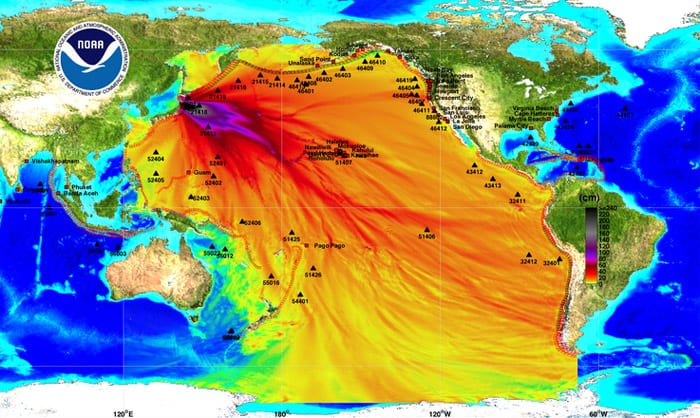
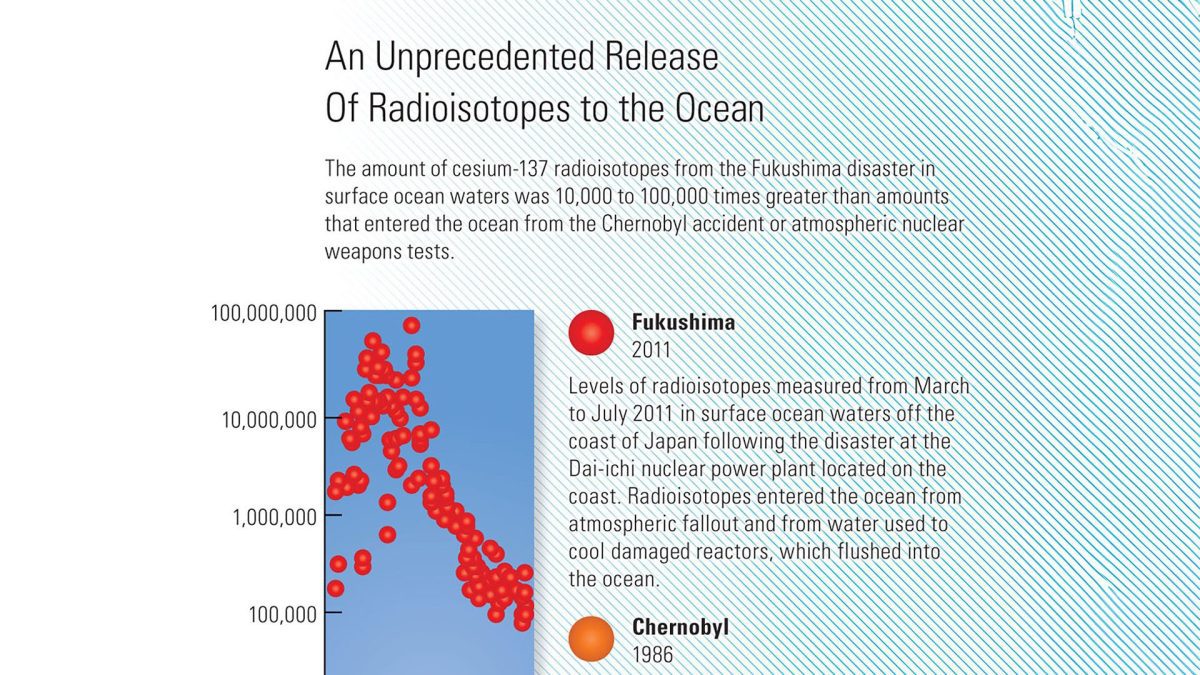
Maximum wave amplitude from the March 11, 2011 tsunami off of Japan. (NOAA)
Frequently Asked Questions
What caused the earthquake?
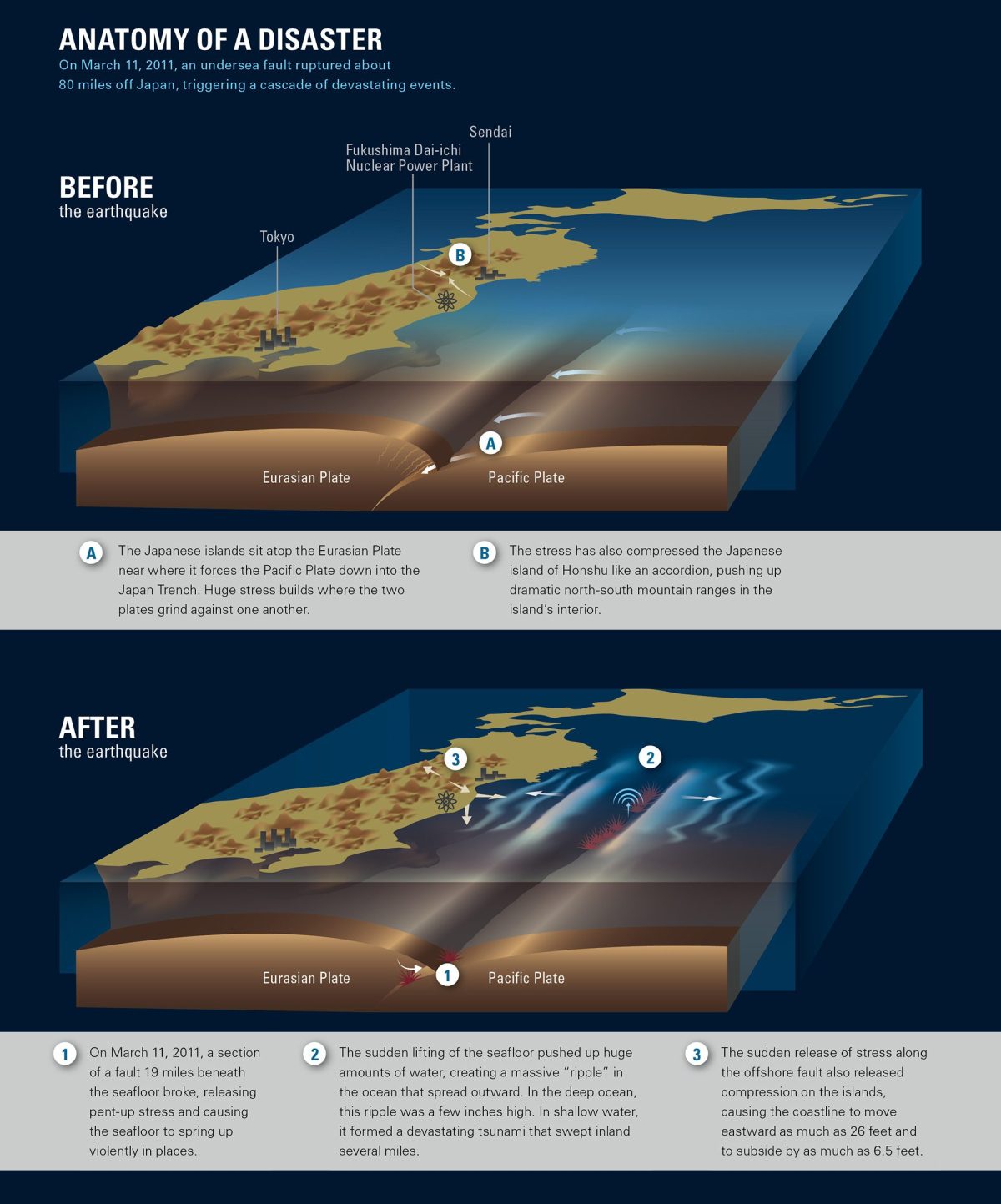
The magnitude 9.0 earthquake that occurred 80 miles east of the island of Honshu, Japan, on March 11, 2011 was the result of thrust faulting common to the area. In that region of the world, the tectonic plate that underlies the Pacific Ocean is forced under Japan and western Asia at a rate of about 3 inches (80mm) per year. That motion creates stress along the plate boundary that is occasionally released —suddenly and without warning—as an earthquake. The larger an area that ruptures in the earthquake, the more energy is released into the surrounding rock and the larger its magnitude.
Was this earthquake unique?
This earthquake was unique primarily for its size—it is currently one of the top five ever recorded. In all other aspects that scientists measure (location, depth, mechanism), this earthquake was typical for its location and fault type.
Was there any warning that an earthquake of this size was likely to happen?
There was no immediate warning that it would occur on March 11, but a similar earthquake and tsunami (the Jogan tsunami) hit the region in 869 AD, and similar events are expected to occur about every 1,000 years based on evidence from sediments deposited by tsunamis in the past. There had been tectonic activity in the area recently, particularly a magnitude 7.2 earthquake on March 9 that had an ongoing aftershock sequence which may have helped trigger today’s quake. However, there were also events of magnitude 7.8 in 1994 and 7.7 in 1978 nearby that did not result in a follow-on event the size of the March 11 earthquake.
What caused the tsunami?
Although the details are still unclear, it is likely that the earthquake, which occurred approximately 15 miles (24.5km) beneath Earth’s surface, caused a large portion of the ocean floor to lift suddenly. The water that this motion displaced created a deep wave reaching from the sea surface to the bottom and moving extremely fast through the ocean. (Tsunamis in the open ocean can reach speeds of 500 mph.) When a tsunami reaches shallower water near land, it increases in height, expands outward, and slows, but the momentum of the moving water can cause it to sweep inland great distances. Tsunamis can also be caused by large underwater slumps and avalanches or by meteor strikes in water.
Was the tsunami a surprise?
The fault that ruptured is a type (thrust fault) known to cause tsunamis if the earthquake is large enough or shallow enough to displace large amounts of water. Records indicate that, since 1900, about ten tsunamis occur worldwide each year, but that only about one on average causes any fatalities. Despite this, the risks of tsunamis are well known by the Japanese people (the word tsunami itself is a Japanese term meaning “harbor wave”) and there are extensive warning systems and public awareness campaigns in coastal regions of the country.
The aspect of this event that took many people by surprise, and that likely caused many of the fatalities, was the fact that the wave arrived very soon after the earthquake. This is because the earthquake occurred only about 80 miles from shore, leaving very little time for people to move to safety before the wave swept ashore. In addition to the Jogan event, one of the areas hit by this tsunami, Sanriku, has been hit by previous tsunamis, including one caused by a magnitude 8.1 event in 1933 that killed nearly 3,000 people, as well as the tsunami caused by the magnitude 8.8 earthquake in Chile in 2010.
How do we know when and where a tsunami will strike?
Once an earthquake is detected and located, it can be evaluated for its likelihood of having generated a tsunami and the coastlines most at risk. At the same time, measurements from a network of buoys and seafloor sensors watch for the signs indicating that a tsunami is on the move across one of the world’s ocean basins. All of this happens quickly and mostly automatically, but the best course of action against tsunamis is, if you are near sea level along the coast and you feel an earthquake, even a small one, immediately move towards higher ground.