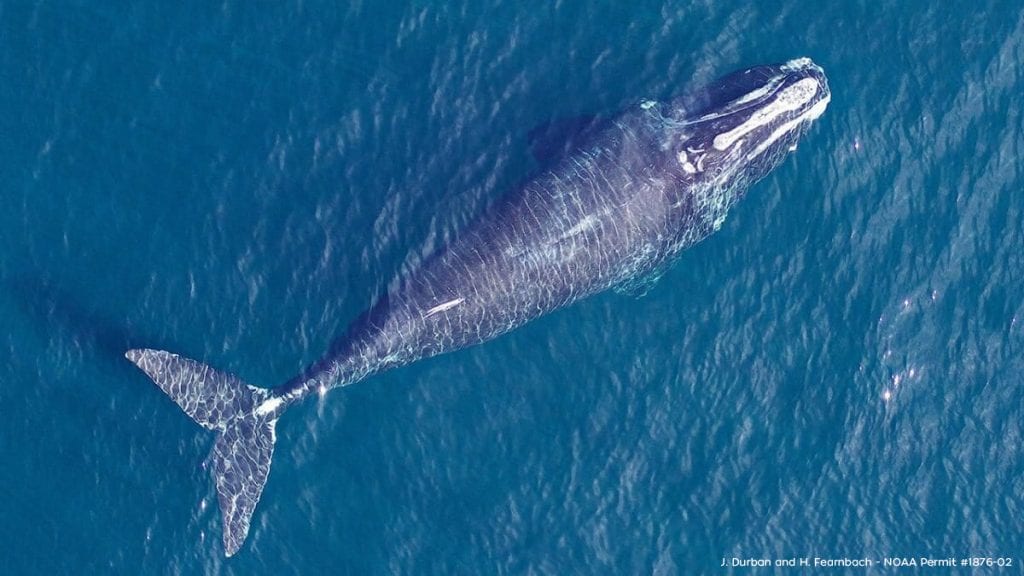
What are North Atlantic right whales?
The North Atlantic right whale (NARW) (Eubalaena glacialis) is one of the most critically endangered whales in the world—approximately 384 of these majestic marine mammals remain, including less than 80 breeding females. NARWs are predominantly found on the Continental Shelf of the East Coast of the United States and Canada, making them especially vulnerable to human activities. The species is protected under the U.S. Endangered Species Act, the Marine Mammal Protection Act, and Canada's Species at Risk Act.
Frequently asked questions
FAQs about the North Atlantic right whale
The North Atlantic right whale is one of the most endangered whales in the world—approximately 384 remain.
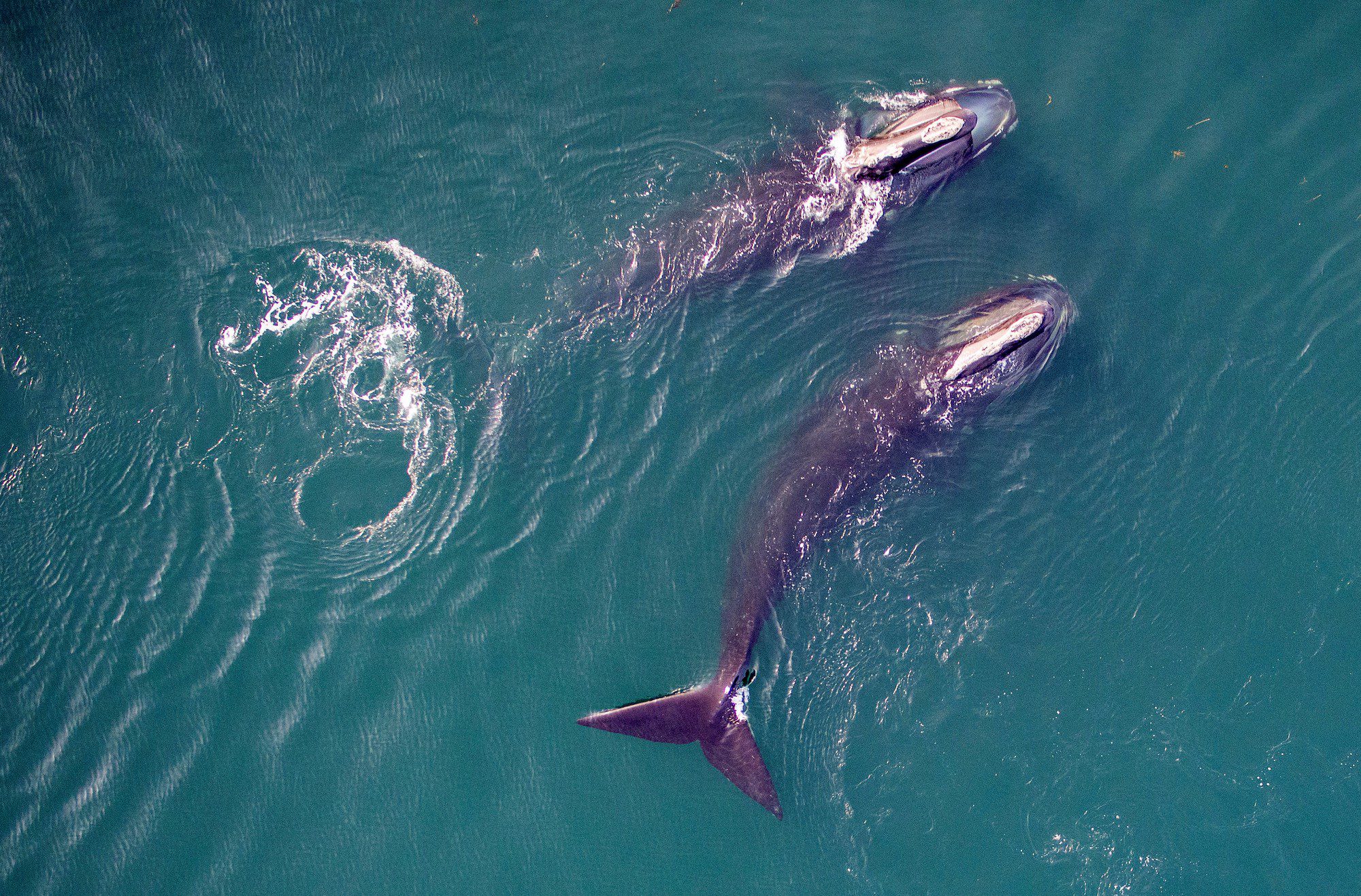
Why are they important?
Right whales play important roles in ocean ecology. They help keep the marine ecosystem healthy and productive by redistributing nutrients from the ocean from the bottom to the surface through their fecal matter. After they die, their carcasses serve as food for other organisms.
While critically important to the ocean's health, the number of North Atlantic right whales is dwindling to dire levels. With less than 80 breeding females, the number of calves being born each year cannot keep pace with the number of human-caused deaths. The threats to NARW, as well as their precipitously low numbers, are directly related to human causes: fishing gear entanglement, ship strikes, and climate change.
 Illustration
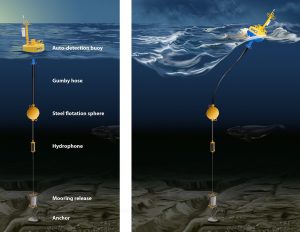
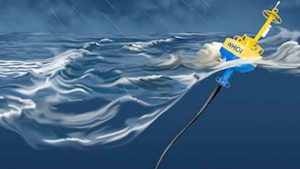
Right whale detection mooring operation
To quiet noisy recordings in rough seas, WHOI engineers created a two-tiered mooring. A bungee-like top line absorbs motion, keeping the hydrophone stable below.
 Illustration
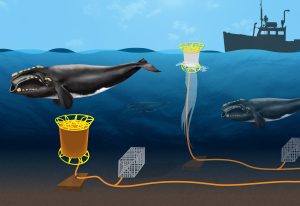
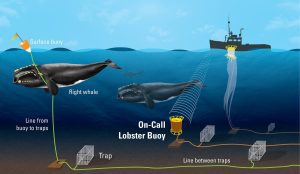
Ropeless fishing technology to release a trap line entangling a right whale
WHOI engineers created a ropeless fishing system that releases lines using acoustic signals—now moving from successful land tests to at-sea trials and refinements.
 Illustration
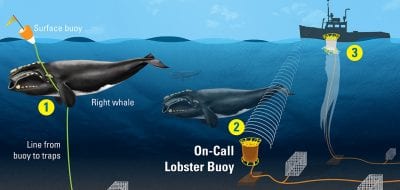
The "on-call" buoy
Whales risk fatal entanglement in vertical ropes from lobster traps. The "on-call" buoy coils lines on a buoyant spool, eliminating dangerous vertical lines.
 Illustration
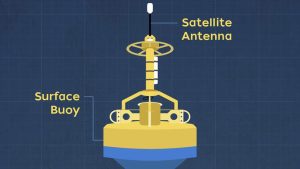
Illustration of a whale-detection DMON buoy system
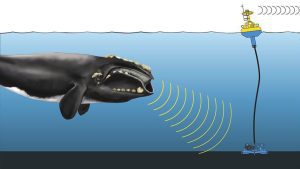
This whale detection system transmits information about whale sounds to shore in near real time.
 Illustration
How Right whale buoy detection system works
The DMON buoy detects whale calls, sends data via satellite to scientists in near-real time, helping identify species and reduce ship-whale collisions.
What are scientists doing to protect right whales?
Actions are being taken by the scientific community and concerned organizations to ensure the long-term survival of this critically endangered species.
1. Preventing entanglements:
- According to the most recent U.S. stock assessment, entanglement in fishing gear is the leading cause of death; it also contributes to poor reproductive health for North Atlantic right whales in Canadian and U.S. waters. Most right whale mortalities are unobserved and the fishing gear is usually not found with whales determined to have died by entanglement. As a result, more than 90% of entanglements cannot be linked to a specific gear type, and only 12% of entanglements can be linked to a specific location.
- Ocean scientists and engineers have developed and are refining On-Demand (also known as ropeless or buoyless) fishing technology providing a possible solution that could be both safe for the North Atlantic right whale and may offer opportunities for the Atlantic fishing industry. One device currently in use replaces the vertical line in the water column with a bottom-stowed coiled rope and buoy in a weighted cage. Fishers can send an acoustic signal , which sends the buoy to the surface and fishers can immediately haul the attached traps aboard. Efforts to reduce the cost of these systems are ongoing.
- Disentanglement efforts have been successful at freeing hundreds of large whales that have become caught in fishing gear but can only reach a small proportion of the affected animals. Disentanglement operations along the East Coast of the U.S. are spearheaded by the Atlantic Large Whale Disentanglement Network, which comprises highly-trained emergency responders from 20 public and private organizations.
- For the North Atlantic right whale to recover, NOAA determined that less than one whale per year can be seriously injured or killed. Data shows that North Atlantic right whale mortalities from fishing entanglement continue to occur at levels five times higher than the species can withstand. Furthermore, unless sub-lethal trauma from entanglements can be substantially reduced, and thereby calving success improved, recovery will not occur.
 Video
Video
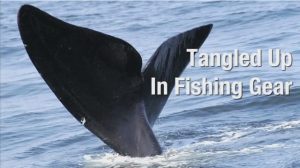
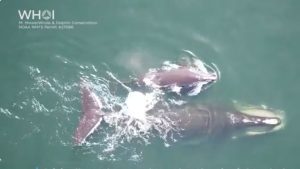
Tangled Up in Fishing Gear
What scientists learned from a right whale named Eg 3911.
 Video
Video
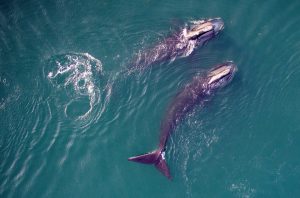
Researching North Atlantic right whales in Cape Cod Bay
As these critically-endangered marine mammals migrate from their southern breeding grounds, WHOI researchers head out to observe them.
 Video
Video
North Atlantic right whale population leveled off in 2022
There are 356 North Atlantic right whales left, with births balancing deaths—but their critically endangered status remains urgent.
 Video
Video
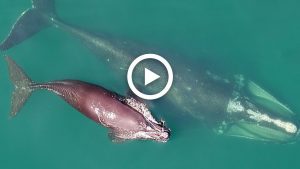
Swim alongside a Right Whale and her calf
A rare video shows right whale Spindle nursing her calf—one of just ~340 left in this endangered species.
 Video
Video
We are all Whalers: a reading and conversation
Join us for a virtual conversation and book reading with author and WHOI veterinarian and marine scientist, Dr. Michael Moore.
 Video
Video
Collaborating to Save the Right Whale
To protect the 400 remaining North Atlantic Right Whales, teams are testing ropeless fishing gear to reduce deadly entanglements in buoy lines.
 Video
Video
North Atlantic right whale rare drone footage
Drone footage captured rare, intimate moments of endangered right whales in Cape Cod Bay—offering hope for their recovery and a reminder of the need to protect them.
 Video
Video
Ocean Encounters: Saving the North Atlantic Right Whale
With only ~366 left, North Atlantic right whales face extinction. Learn how science, industry, and policy aim to save them.
 Video
Video
A win for lobstermen and right whales
A WHOI study finds lobster fishers can catch the same with less gear and time—offering a win-win for right whale protection and a sustainable fishery.
 Video
Video
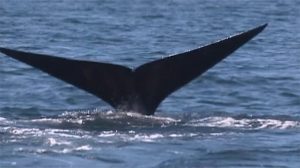
Buoys Help Avert Whale-Ship Collisions
Smart buoys help detect endangered right whales in real time—alerting ships to slow down and avoid deadly collisions.
 Video
Video
North Atlantic Right Whale
Dr. Michael Moore talks about the North Atlantic Right Whale and what the future may hold for this endangered charismatic species.
2. Preventing ship collisions:
- Marine biologists and engineers have developed a device that listens for and identifies the sounds whales make underwater. Known as the digital acoustic monitoring (DMON) instrument, the device is equipped with underwater microphones called hydrophones and can be deployed on fixed buoys or autonomous underwater vehicles called gliders. Information collected by the DMON is transmitted every two hours via satellite back to a lab at WHOI. The data are then reviewed by an analyst and posted on the publicly accessible website, robots4whales.whoi.edu. More recently, these data have been used by Whale Safe, which monitors for ships and a variety of whale species-including the endangered blue whale-near Santa Barbara and San Francisco, California. On the east coast, acoustic buoys are located in highly trafficked migration routes, including in the Northeast, and off the coast of Savannah, Ga. and Norfolk, Va.
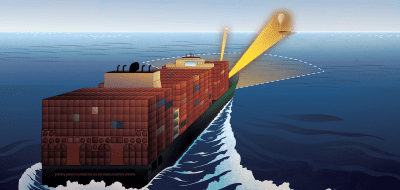
- Scientists are working to develop next-generation whale detection systems that use thermal infrared (IR) cameras to monitor for the presence of whales in shipping lanes. When mounted high enough above sea level-such as on offshore wind turbines-these systems can detect whales up to 10 kilometers (6.2 miles) away. Installed on ships, the systems can automatically alert shipping captains to the presence of whales up to a three-kilometer (1.8 miles) distance to allow most vessels to slow down or change course.
- Vessel speed restrictions: Recently, NOAA Fisheries announced proposed changes to vessel speed regulations to further protect North Atlantic right whales from death and serious injuries resulting from collisions - part of a multifaceted approach to stabilize and recover this endangered population. The changes would expand the current mandatory seasonal speed restrictions of 10 knots or less in designated areas of the ocean and extend to most vessels measuring 35 feet or greater in length.
3. Reducing underwater noise pollution:
- Right whales communicate with one another through vocal calls, which can be heard over distances of more than 20 miles when the ocean is quiet. The calls let whales stay in touch, share information about food, help mates find each other, and keep groups together while traveling. However, rising levels of ocean noise are interfering with their ability to communicate.
- Innovative alternative techniques for probing geological structures beneath the ocean floor are being tested by scientists and industry. Traditionally, loud pulses are created by releasing air that is under extremely high pressure. A potential alternative is marine vibroseis, which uses the same energy but is spread over a longer duration. This eliminates the sharp "rise time" (rapid increase in loudness) and high peak pressure (maximum volume) of traditional techniques-the two characteristics of sound thought to be the most injurious to whales and other marine life. Additionally, efforts are also being focused on how to reduce the sound level from ship traffic, which is steadily increasing, and offshore infrastructure, such as wind turbine construction.
Ocean Encounters: Saving the North Atlantic Right Whale
Join us as we examine the top threats facing North Atlantic right whales, and discuss the crucial efforts by the scientific community, fishing industry, and policymakers to develop the most effective and viable solutions to ensure the long-term survival of this critically endangered species. [Recorded February 10, 2021]
 Image
Image
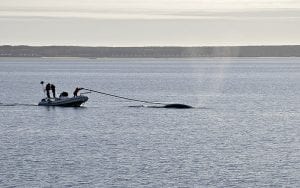
Endangered Species Day 2015
May 15 is Endangered Species Day. In 2010, a team that included experts from WHOI placed non-invasive DTAGs on one of the largest endangered species, and one that frequents the waters near the Institution: the North Atlantic right whale. With fewer than 500 individuals remaining in the wild they are one of the most endangered animals...
 Image
Image
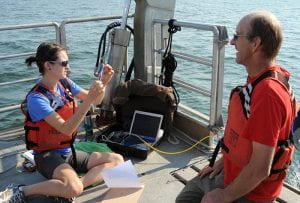
A Tangled Problem
MIT/WHOI Joint Program student Julie van der Hoop and marine biologist Michael Moore confer during a recent expedition on R/V Tioga. The pair was using a tensiometer to measure drag forces created by 15 sets of fishing gear that had been removed from entangled right whales. Over the last 40 years, at least 31 right whales have died as a...
 Image
Image
Form for Function
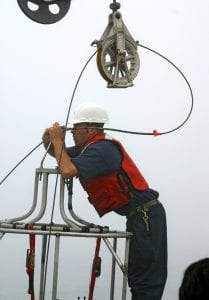
Engineer Chris Lumping (left) and welder Tony Delane examine the mooring anchor framework they built for a “multifunction node” (MFN) and buoy system that will help researchers monitor whale activity. Built for the National Oceanic and Atmospheric Administration, the MFN was deployed last week off the coast of Jacksonville, Florida, where North Atlantic right whales...
 Image
Image
Detour for a Good Cause
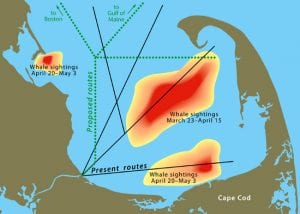
Endangered right whales congregate in Cape Cod Bay, particularly from December through May, while an average of seven passenger or cargo vessels pass through the area each day. Using five years of data on right whale sightings (red indicates more frequent sightings), researchers proposed seasonal changes to shipping lanes to reduce ship-whale collisions. Solid lines...
 Image
Image
Up Close and Personal
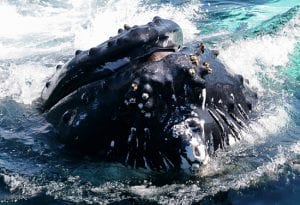
WHOI researchers had a close encounter with this humpback whale (Megaptera novaeangliae)during an expedition on Stellwagen Bank, off the coast of Massachusetts. Biologists have been tagging humpbacks and right whales with short-term radio tags (lasting 1-3 hours before falling off) in order to monitor their dives and behavior and how it related to water conditions...
 Image
Image
Secure that Line
Deck hand Ian Hanley secures equipment on R/V Tioga during attempted right whale tagging off Georges Bank with biologist Mark Baumgartner. (Photo by Amy Nevala, Woods Hole Oceanographic Institution)
 Image
Image
Poolside Science
2005 Summer Student Fellow Derek Cavatorta works on a laptop in front of a test tank, where different types of rope are being tested to help disentangle right whales from fishing gear. (Photo by Tom Kleindinst, Woods Hole Oceanographic Institution)
Recent News
What Will It Cost to Create a Safer Ocean for Endangered Right Whales?
Learn more from the blog above and new report
Conservation Law Foundaton
March 8, 2023
US budget riders compromise conservation
Michael Moore’s letter in Science
February 23, 2023
One Planet: We are all whalers—The plight of whales and our responsibility
Michael Moore interviewed on NPR/KALW radio program
January 30, 2023
Robotic buoys developed to keep Atlantic right whales safe
Mark Baumgartner and acoustic buoys featured in this Associated Press story
May 28, 2022
We Must Save the North Atlantic Right Whale to Save Ourselves
Michael Moore in this opinion piece in TIME magazine
January 11, 2023
Dead Whales and tough economics bedevil Biden's massive wind energy push
Michael Moore in this Washington Post feature
January 25, 2023

The North Atlantic Right Whale Consortium shares annual report on critically endangered species. Read the release here.
References
Special report: Saving the North Atlantic Right Whale
Download it here
More topics like this
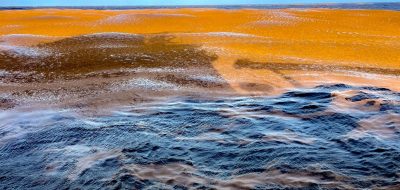
Sargassum
Sargassum sustains ocean life, but massive blooms increasingly threaten coastal ecosystems, economies, and human health.
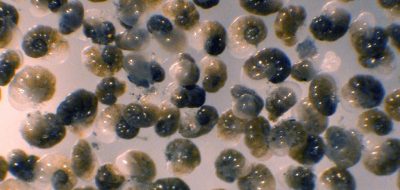
Benthic life
Benthic animals live on the sea floor and are typically invertebrates, such as sea anemones, sponges, corals, sea stars, sea urchins, worms, mussels, crabs, and more.
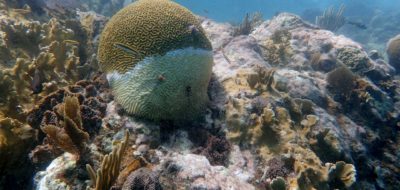
Coral stressors
Stressors can affect organisms living on the reef or they can affect the corals, themselves. When corals die, other organisms must relocate or struggle to survive.
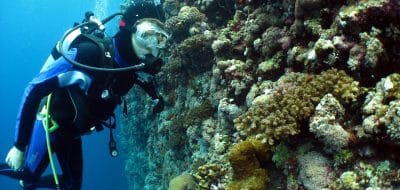
Corals
Many people think of coral as hard, rock-like formations that attract abundant, diverse marine life. In fact, corals are tiny marine animals called polyps that live together in colonies.
Emperor penguins
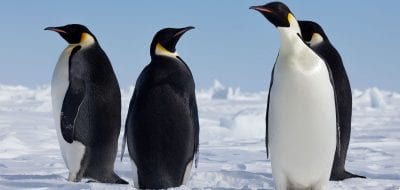
The emperor penguin is the largest living penguin species standing around 115 centimeters tall. Once they have found a partner, they work together to keep their young fed and safe.

Coastal ecosystems
The narrow region where land and ocean meet includes salt marshes, mangroves, wetlands, estuaries, reefs, and bays often linked in a network of physical, chemical, and biological interchanges.
Ecosystems
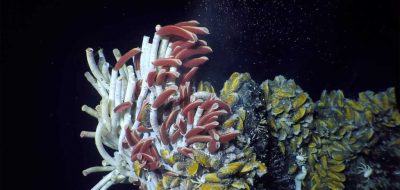
Ocean ecosystems are found in polar regions, coastal waters, coral reefs, hydrothermal vents, the abyssal plain, and at the bottom of the sea.

Environmental DNA (eDNA)
Environmental DNA (eDNA) is essentially DNA collected from the environment. As animals swim through the ocean, they're constantly releasing DNA as they shed skin or scales into the water column.
Phytoplankton
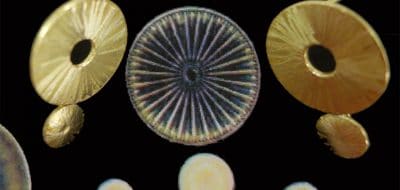
Phytoplankton are primary producers of the ocean—the organisms that form the base of the food chain. WHOI explores the microscopic, single-celled organisms.
Reef ecosystems
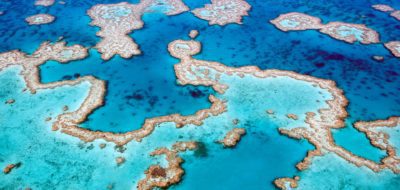
A healthy reef protects coastlines from wave damage, plays a critical role in providing food, boosts the economy, and provides materials for pharmaceuticals.
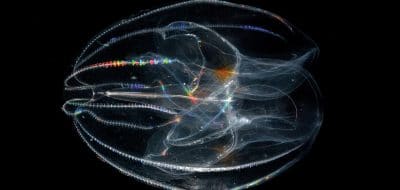
Jellyfish & other zooplankton
These animals live all or part of their life suspended and drifting in fresh or salt water, rarely come in contact with hard surfaces.
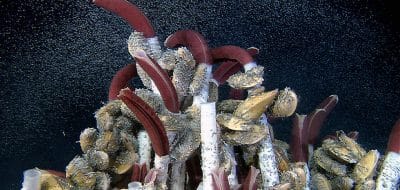
Life at vents & seeps
Hydrothermal vents and cold seeps are places where chemical-rich fluids emanate from the seafloor, often providing the energy to sustain lush communities of life in some very harsh environments.
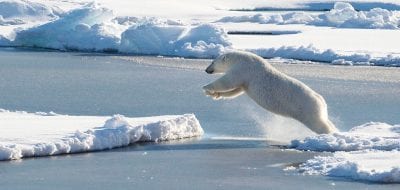
Polar life
By human standards, they are extreme environments. Yet life not only persists in the poles...it thrives.
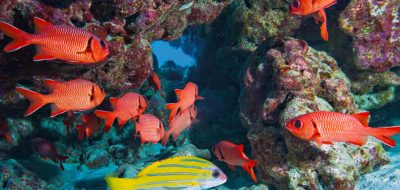
Reef fish
Fish that inhabit a coral reef play essential roles in the reef ecosystem, and reefs without fish struggle to recover from bleaching or other events that damage the coral.
Seagrass meadows
Seagrass meadows are plants adapted to live a completely submerged life in the salty shallows.
Marine microbes
Microbial life can be found throughout the ocean, from rocks and sediments beneath the seafloor, across the vast stretches of open water, to intertidal and surf zones.
Ocean plants
Ocean plants are critical to marine life—they are an important food source, they provide oxygen to surrounding marine life, and they supply refuge and nursery grounds.
Seabirds
Seabirds have adapted to life in an ocean environment. There are many species of seabirds, and they vary greatly in behavior and physiology
Sharks & other fish
Fish are vital to healthy ecosystems and economies, serving as predators and prey while maintaining balanced food webs and protecting habitats like coral reefs and mangroves.
Shellfish
An aquatic animal, such as a mollusk or crustacean, that has a shell or shell-like exoskeleton.
Oceanus magazine
[ ALL ]In-depth research on Right whales
Whale aware!
For right whales, a dwindling food source is causing concern
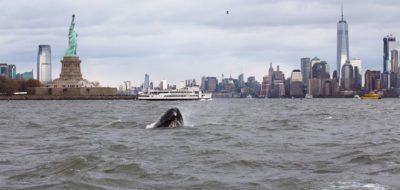
Keeping an ear out for whales
Whale Safe
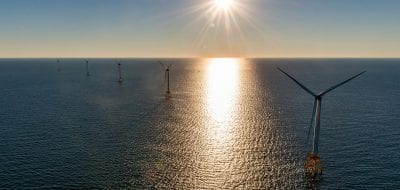
Harnessing the Power
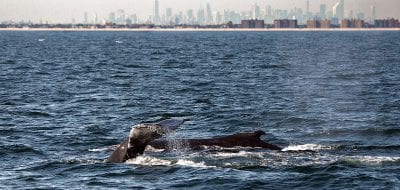
Eavesdropping on Whales
How Would ‘On-Call’ Buoys Work?
A Telescope to Peer into the Vast Ocean
Call of the Whales
Frequency Ranges of Marine Animal Sounds

The Great South Channel
Whale Heads and Tales

WHOI News Room
[ ALL ]Press releases
What can a whale’s breath tell us? According to a new study, a lot about its health
Ship-mounted camera systems increase protections for marine mammals
Get the ocean in your inbox
Fresh discoveries, research, and stories from WHOI — free, every week.