
Applied Ocean Physics & Engineering
A Laser Light in the Ocean Depths
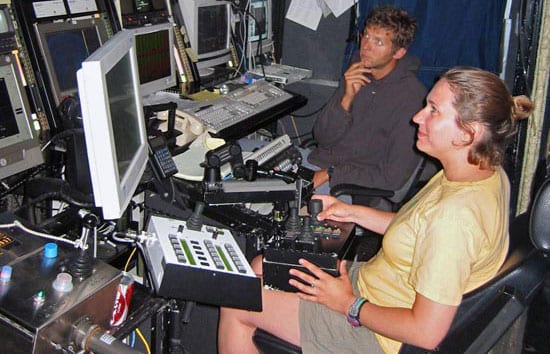
Graduate student Anna Michel is adapting laser technology to the murky fluid environment and crushing pressures at depths of 11,000 feet. The goal is to develop an instrument that can directly measure the many elements spewing from hydrothermal vents just as they emerge from Earth?s crust.
Read MoreBuilding a Computer Model to Forecast Red Tides
The algae Alexandrium fundyense are notorious for producing a toxin that accumulates in shellfish such as clams, mussels, and oysters, leading to paralytic shellfish poisoning in humans. The microscopic plants…
Read MoreABE—The Autonomous Benthic Explorer
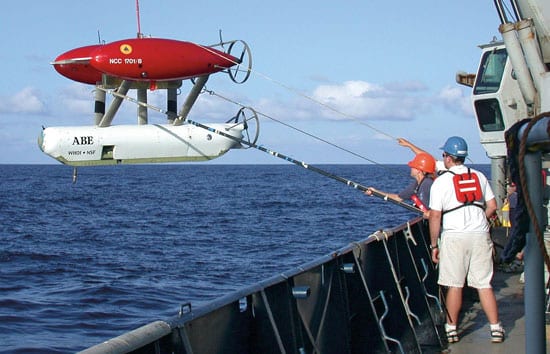
The pioneering deep-submergence vehicle, now 10 years old, continues to demonstrate its versatility on each new cruise.
Read MoreNew Sonar Method Offers Window into Squid Nurseries
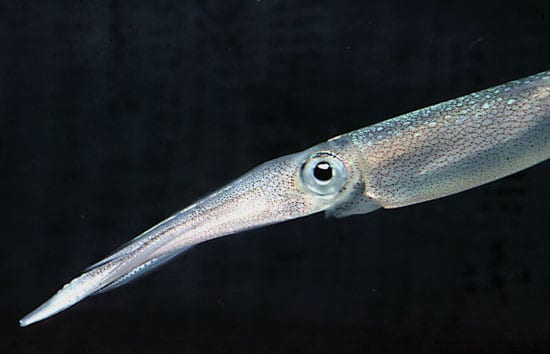
Squid fishing has increased substantially in the past decade, with no way to assess the continuing viability of the stock?until now.
Read MoreDust Busters for the Oceans
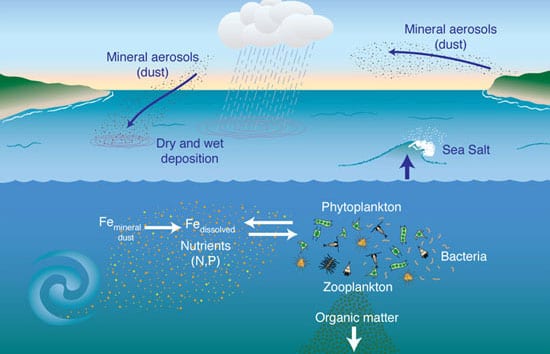
Like most living things, microscopic marine plants need iron and other minerals to live and grow. On land, soil provides a ubiquitous source of minerals, but how do essential nutrients…
Read MoreGoing Wireless in the Deep Blue
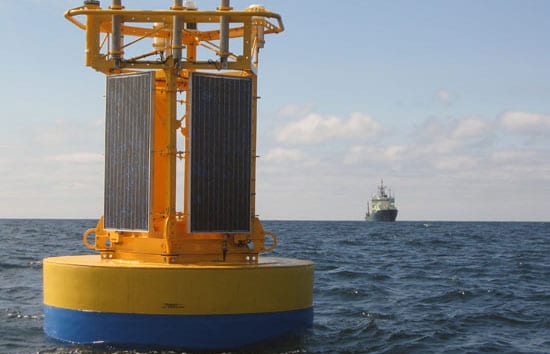
How do you get long-term ocean measurements from any spot on the globe, with day by day feedback and low costs? If you are Dan Frye of the WHOI Advanced Engineering Laboratory, you take an old oceanographic concept?the moored buoy?and bring it into the 21st century with wireless technology.
Read MoreAction, Camera … Lights
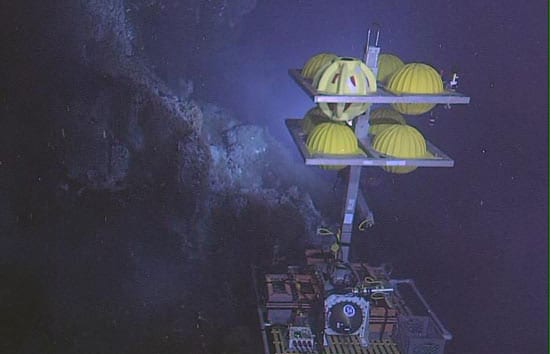
Exploring the sunless seafloor can be like using a flashlight to find something in a dark basement. Now Woods Hole Oceanographic Institution scientists and engineers have built a portable light system to illuminate the depths, essentially transforming areas of the deep sea into a photography studio.
Read MoreScientists Find a New Twist in How Squids Swim
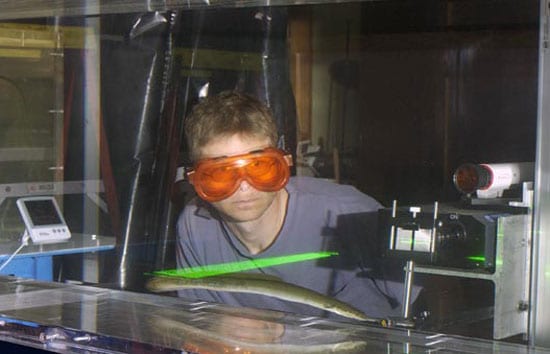
Erik Anderson was vexed by some scientific papers he read during his first year of graduate studies. Engineers had asserted that squids likely propelled themselves through water by creating vortex rings. Anderson begged to differ. Together with Mark Grosenbaugh, he set up a series of experiments to check the theories against some observational evidence.
Read MoreAn Experiment to Dye For
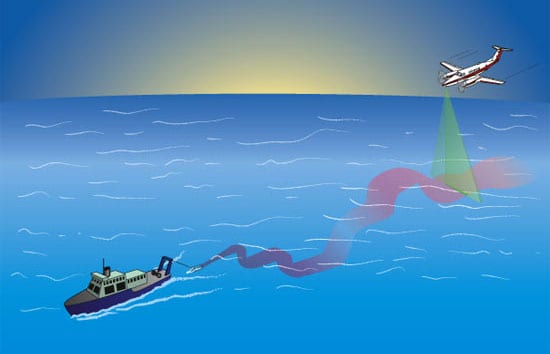
WHOI scientists are exploring an experimental technique to track the complex movements of water in the oceans using harmless fluorescent dyes and airplanes equipped with Light Detection and Ranging instruments. To detect motion, LIDAR uses pulses of laser light, which cause the flowing dye to fluoresce.
Read MoreMeet the Class of 2005-2007
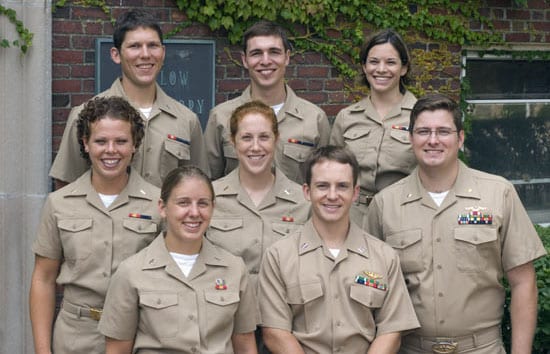
Nine U.S. Navy officers are pursuing graduate degrees in the MIT/WHOI Joint Program in Oceanography/Applied Ocean Science and Engineering through a special arrangement between the institutions.
Read MoreDouble Duty for Ensign/Student Allison Berg
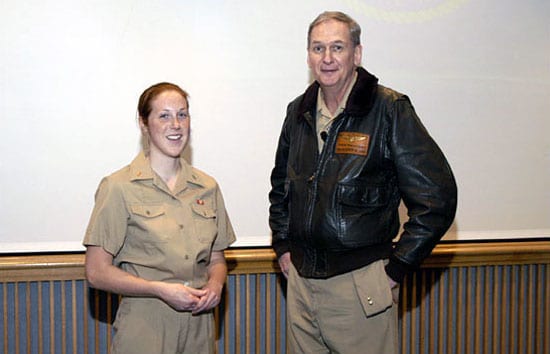
Ensign Allison Berg won the first Pittenger Fellowship for naval officers in MIT/WHOI Joint Program. In collaboration with WHOI Research Specialist Eugene Terray, Berg will conduct a field experiment using Sonic Detection and Ranging (SODAR) systems to study winds near the ocean?s surface.
Read MoreAt the River’s End
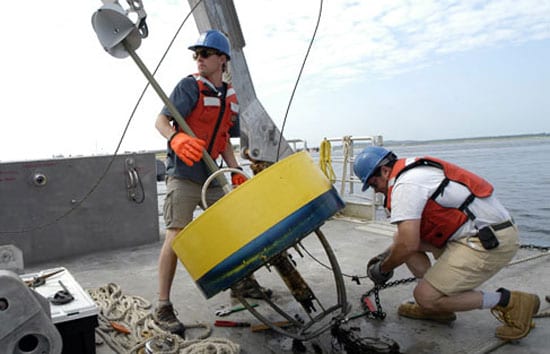
In science, some of the most confounding and interesting questions come from the borderlands, where one physical world collides with another. In marine science, one of the most dynamic environments…
Read MoreWhat Is the Alvin Training Program Like?
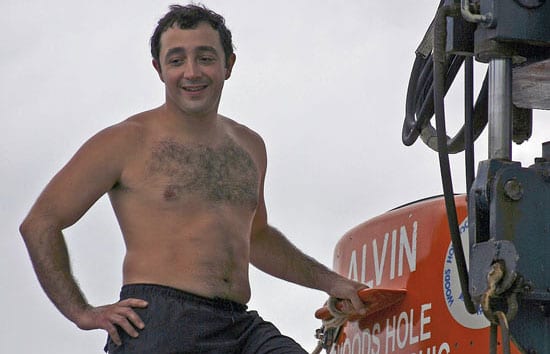
Like many boys who spend their youths throwing baseballs in Massachusetts parks, Tarantino dreamed of playing for the Red Sox. When not pitching, he liked to take apart his toys…
Read MoreAlvin‘s Pilots
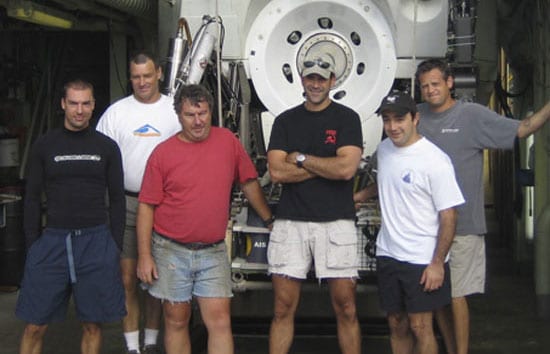
Forty summers ago in the Bahamas, two men climbed inside a 23-foot white submarine named Alvin and drove it to a depth 6,000 feet, a dive that certified them as…
Read MoreRed TideGone for Now, But Back Next Year?
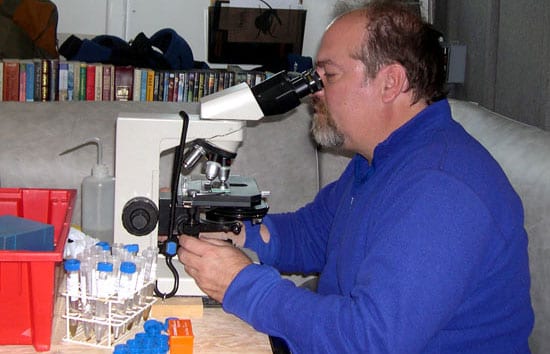
The historic bloom of toxic algae that blanketed New England’s waters and halted shellfishing from Maine to Martha’s Vineyard in the spring of 2005 is over. But scientists are now wondering if there will be an encore.
Before departing, the algae likely left behind a colonizing population that may promote blooms in southern New England for at least the next few years.
Seeing Red in New England Waters
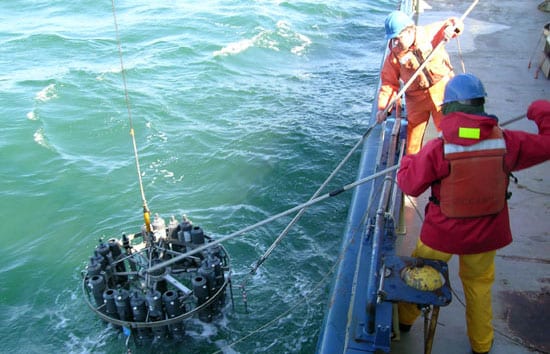
Coastal resource managers shut down shellfish beds in three New England states in mid-May—including rare closures of Massachusetts Bay and Cape Cod Bay—because of an intense bloom of the toxic algae Alexandrium fundyense. Researchers from the Woods Hole Oceanographic Institution saw the ‘red tide’ coming before its toxic effects reached the shore.
Read MoreRisks and Remedies from the Sea
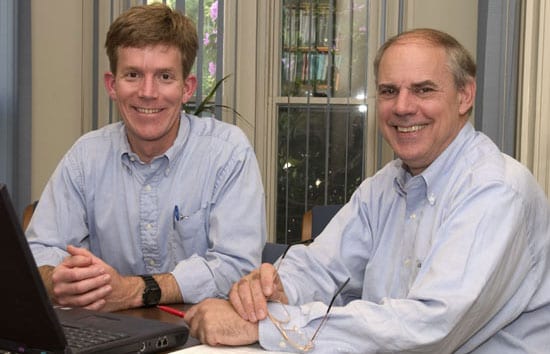
Researchers from Woods Hole Oceanographic Institution, the Marine Biological Laboratory (MBL), and the Massachusetts Institute of Technology (MIT) have embarked on a novel collaboration to investigate harmful algal blooms, ocean-borne pathogens, and potential pharmaceuticals from marine sources.
Read MoreRobo-Sailors
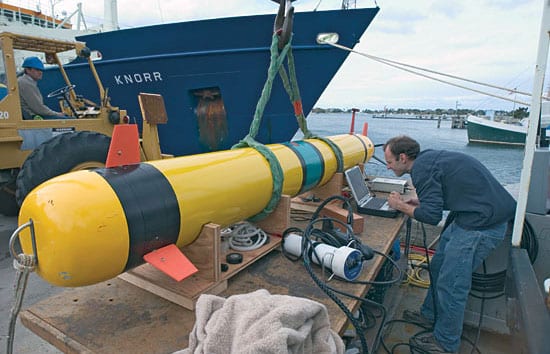
In the mid-1990s, the Navy began funding research for small, robotic vehicles to perform unmanned reconnaissance in coastal waters. At WHOI, that helped spark the development of REMUS (Remote Environmental Monitoring UnitS), designed and built by Chris von Alt, Ben Allen, and colleagues in the Oceanographic Systems Laboratory.
Read MoreWhere Are Mines Hiding on the Seafloor?
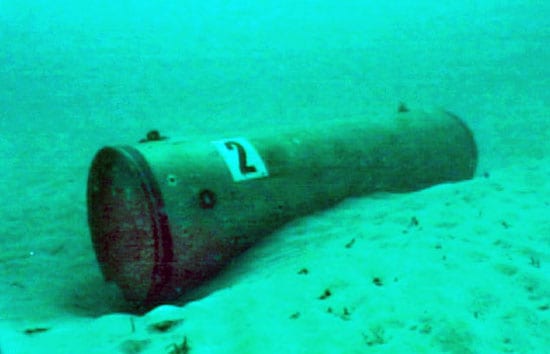
Eternally and incessantly, waves and currents stir up sand from the seafloor near the coast. Sediments get suspended in the ocean, carried onshore and off, and deposited elsewhere. In the process, objects on the seafloor—natural and unnatural—can get buried and uncovered.
Read MoreThe New Wave of Coastal Ocean Observing
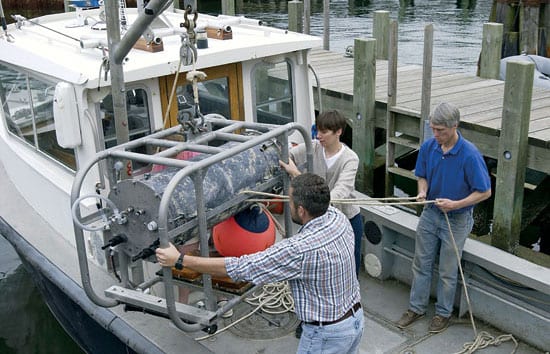
Estuaries are the borderlands between salt and freshwater environments, and they are incredibly diverse both biologically and physically. The diversity and the high energy of the ecosystem make estuaries remarkably resilient. With a better understanding of these systems, we can reverse
their decline and restore the ecological richness of these valuable, albeit muddy, environments.
Read MoreFive WHOI Researchers Recognized for Contributions to Science and Education
Five researchers have been recognized by the Woods Hole Oceanographic Institution (WHOI) for their contributions to ocean sciences research and education. All will receive funding provided by the endowed awards…
Read MoreShaping the Beach, One Wave at a Time
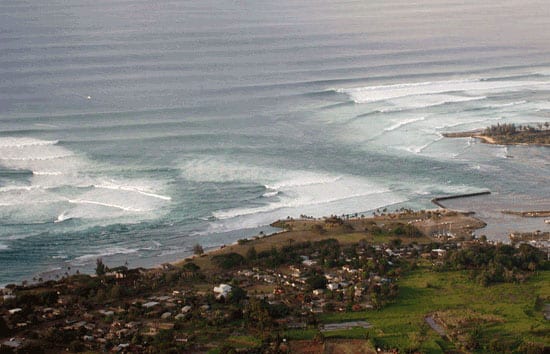
For years, scientists who study the shoreline have wondered at the apparent fickleness of storms, which can devastate one part of a coastline, yet leave an adjacent part untouched. How can this be? The answer lies in the physics of the nearshore region?the stretch of sand, rock, and water between the dry land behind the beach and the beginning of deep water far from shore.
Read MoreSeeding the Seafloor with Observatories
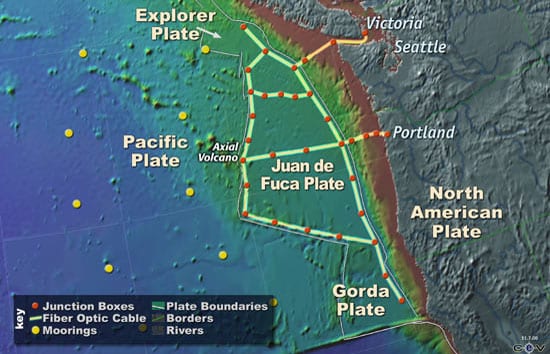
Scientists extend their reach into the deep with pioneering undersea cable networks
H2O (Hawaii-2 Observatory) – In 1998, scientists used the remotely operated vehicles (ROV) Jason and Medea to create the pioneering long-term seafloor observatory called H2O (Hawaii-2 Observatory). They spliced an abandoned submarine telephone cable into a termination frame. The frame relays power and communications to a junction box, which serves as an electrical outlet for scientific instruments.
NEPTUNE: A Fiber-Optic ‘Telescope’ to Inner Space
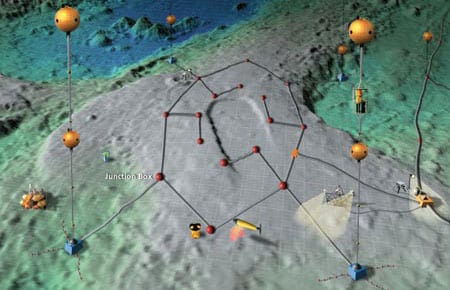
NEPTUNE is a proposed system of high-speed fiber- optic submarine cables linking a series of seafloor nodes supporting thousands of assorted measuring instruments, video equipment, and robotic vehicles that could upload power and download data at undersea docks. Unlike conventional telephone cables, which supply power from shore in a straight line, end to end, NEPTUNE would operate like a power grid, distributing power simultaneously and as needed throughout the network. Working much like a campus data network (with nodes analogous to buildings and each instrument like a workstation), NEPTUNE would provide real-time transmission of data and two-way communications.
Read More