
News Releases
Researchers from WHOI and MBL Receive $1.2 Million Grant for Collaborative Salt-Marsh Study
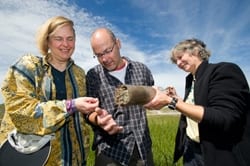
Scientists from the Marine Biological Laboratory (MBL) and the Woods Hole Oceanographic Institution (WHOI) were recently awarded a $1.2 million collaborative grant from the National Science Foundation (NSF) for studies on the role of sulfur-oxidizing bacteria in salt marsh nitrogen and carbon cycling. The fieldwork will be conducted at the Plum Island Ecosystem Long-Term Ecological Research (LTER) site on the North Shore of Boston.
Read MoreNewly Discovered Icelandic Current Could Change North Atlantic Climate Picture
An international team of researchers, including physical oceanographers from the Woods Hole Oceanographic Institution (WHOI), has confirmed the presence of a deep-reaching ocean circulation system off Iceland that could significantly influence the oceans response to climate change in previously unforeseen ways.
Read MoreStudy Assesses Nations’ Vulnerabilities to Reduced Mollusk Harvests from Ocean Acidification
Changes in ocean chemistry due to increased carbon dioxide (CO2) emissions are expected to damage shellfish populations around the world, but some nations will feel the impacts much sooner and more intensely than others, according to a study by scientists at Woods Hole Oceanographic Institution (WHOI).
Read MoreNauset Marsh Estuary Red Tide Study to Begin
A three-year study into the cause of local area red tides is set to begin March 21. A team of researchers from the National Park Service, U.S. Geological Survey, and…
Read MoreNovel Ocean-Crust Mechanism Could Affect World’s Carbon Budget
The Earth is constantly manufacturing new crust, spewing molten magma up along undersea ridges at the boundaries of tectonic plates. The process is critical to the planet?s metabolism, including the cycle of underwater life and the delicate balance of carbon in the ocean and atmosphere. Now, scientists at the Woods Hole Oceanographic Institution (WHOI) have observed ocean crust forming in an entirely unexpected way?one that may influence those cycles of life and carbon and, in turn, affect the much-discussed future of the world?s climate.
Read MoreWHOI scientists find ancient asphalt domes off California coast
They paved paradise and, it turns out, actually did put up a parking lot. A big one. Some 700 feet deep in the waters off California?s jewel of a coastal resort, Santa Barbara, sits a group of football-field-sized asphalt domes unlike any other underwater features known to exist. About 35,000 years ago, a series of apparent undersea volcanoes deposited massive flows of petroleum 10 miles offshore. The deposits hardened into domes that were discovered recently by scientists from the Woods Hole Oceanographic Institution (WHOI) and UC Santa Barbara (UCSB).
Long-Distance Larvae Speed to New Undersea Vent Homes
Working in a rare, ?natural seafloor laboratory? of hydrothermal vents that had just been rocked by a volcanic eruption, scientists from the Woods Hole Oceanographic Institution (WHOI) and other institutions have discovered what they believe is an undersea superhighway carrying tiny life forms unprecedented distances to inhabit the post-eruption site.
Read MoreInternational Group of Scientists Collaborate to Communicate about Ocean Acidification
Climate change is a well-known problem resulting from the burning of fossil fuels and the subsequent release of carbon dioxide (CO2) into the atmosphere. But a separate, lesser-known problem resulting…
Read MoreWHOI contributes to special seamount issue of Oceanography magazine
Woods Hole Oceanographic Institution (WHOI) biologist Timothy M. Shank is among five guest editors of a newly published special edition of the research journal Oceanography on the oceans? seamounts, submerged isolated mountains in the sea. Shank is also a contributor to the special Oceanography edition.
Read MoreTeam finds subtropical waters flushing through Greenland fjord
Waters from warmer latitudes — or subtropical waters — are reaching Greenland’s glaciers, driving melting and likely triggering an acceleration of ice loss, reports a team of researchers led by…
Read MoreWHOI-Operated ROV Jason Images the Discovery of the Deepest Explosive Eruption on the Sea Floor
Oceanographers using the remotely operated vehicle (ROV) Jason discovered and recorded the first video and still images of a deep-sea volcano actively erupting molten lava on the seafloor. Jason, designed…
Read MoreIn CO2-rich Environment, Some Ocean Dwellers Increase Shell Production
In a striking finding that raises new questions about carbon dioxide?s (CO2) impact on marine life, Woods Hole Oceanographic Institution (WHOI) scientists report that some shell-building creatures?such as crabs, shrimp and lobsters?unexpectedly build more shell when exposed to ocean acidification caused by elevated levels of atmospheric carbon dioxide (CO2).
Read MoreCO2 Emissions Continue Significant Climb
The annual rate of increase in carbon dioxide emissions from fossil fuels has more than tripled in this decade, compared to the 1990s, reports an international consortium of scientists, who paint a bleak picture of the Earth?s future unless ?CO2 emissions [are] drastically reduced.?
Read MoreRising acidity levels could trigger shellfish revenue declines, job losses
Changes in ocean chemistry — a consequence of increased carbon dioxide (CO2) emissions from human industrial activity — could cause U.S. shellfish revenues to drop significantly in the next 50…
Read MoreHybrid Remotely Operated Vehicle Nereus Reaches Deepest Part of the Ocean
A new type of deep-sea robotic vehicle called Nereus has successfully reached the deepest part of the world’s ocean, reports a team of U.S. engineers and scientists aboard the research…
Read MoreStudy Finds Surprising New Pathway for North Atlantic Circulation
Oceanographers have long known that the 20-year-old paradigm for describing the global ocean circulation– called the Great Ocean Conveyor – was an oversimplification. It’s a useful depiction, but it’s like…
Read MoreNatural Petroleum Seeps Release Equivalent of 8-80 Exxon Valdez Oil Spills
A new study by researchers at Woods Hole Oceanographic Institution (WHOI) and the University of California, Santa Barbara (UCSB) is the first to quantify the amount of oil residue in…
Read MoreCarbon Acts Like Rustoleum Around Hydrothermal Vents
The cycling of iron throughout the oceans has been an area of intense research for the last two decades. Oceanographers have spent a lot of time studying what has been…
Read MorePhytoplankton Cell Membranes Challenge Fundamentals of Biochemistry
Get ready to send the biology textbooks back to the printer. In a new paper published in Nature, Benjamin Van Mooy, a geochemist with the Woods Hole Oceanographic Institution (WHOI),…
Read MoreOcean Islands Fuel Productivity and Carbon Sequestration Through Natural Iron Fertilization
An experiment to study the effects of naturally deposited iron in the Southern Ocean has filled in a key piece of the puzzle surrounding iron’s role in locking atmospheric carbon…
Read MoreDanube Delta Holds Answers to Noah’s Flood Debate
Did a catastrophic flood of biblical proportions drown the shores of the Black Sea 9,500 years ago, wiping out early Neolithic settlements around its perimeter? A geologist with the Woods…
Read MoreStudy links swings in North Atlantic Oscillation variability to climate warming
Using a 218-year-long temperature record from a Bermuda brain coral, researchers at the Woods Hole Oceanographic Institution (WHOI) have created the first marine-based reconstruction showing the long-term behavior of one…
Read MoreCold Water Corals Conference to be Held in Woods Hole
On October 24, 2008, scientists from North America and Europe will meet at the Woods Hole Oceanographic Institution (WHOI) to develop the first coherent plan for studying and conserving cold-water…
Read MoreStudy Reveals Microbes Dine on Thousands of Compounds in Oil
Thousands of feet below the bottom of the sea, off the shores of Santa Barbara, CA, single-celled organisms are busy feasting on oil. Until now, nobody knew how many oily…
Read More