
News Releases
Steve Elgar Named National Security Science and Engineering Faculty Fellow
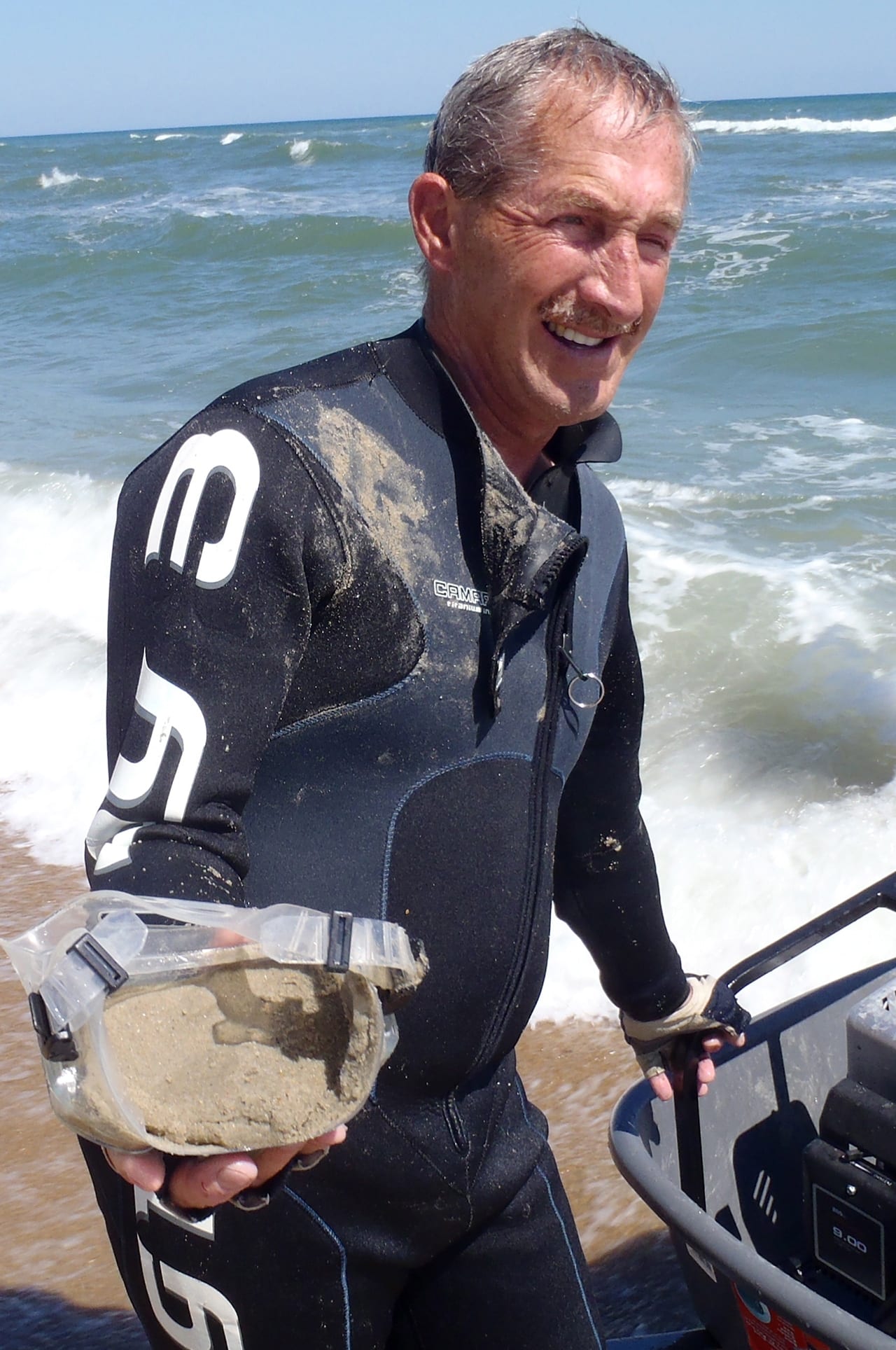
Steve Elgar, a senior scientist at Woods Hole Oceanographic Institution (WHOI), has been selected as a 2016 National Security Science and Engineering Faculty Fellow (NSSEFF) by the Department of Defense.
Read MoreSwarming Red Crabs Documented on Video
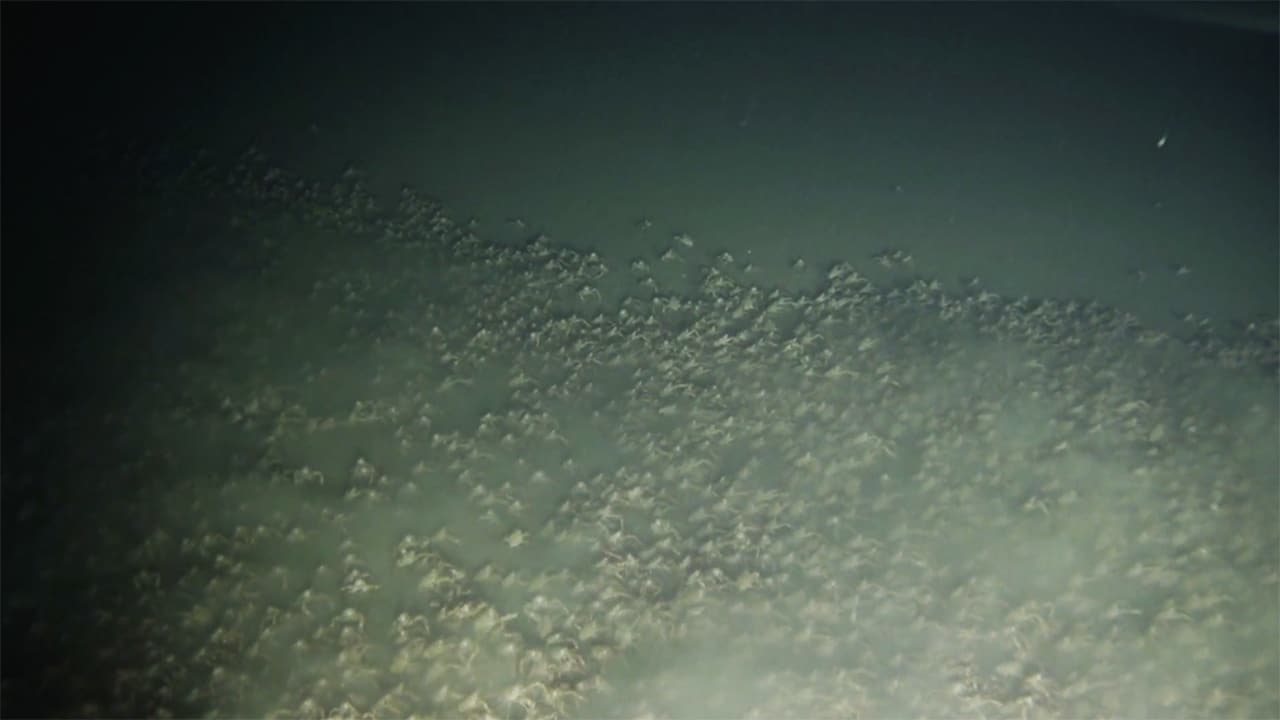
A research team studying biodiversity at the Hannibal Bank Seamount off the coast of Panama has captured unique video of thousands of red crabs swarming in low-oxygen waters just above the seafloor.
Read MoreFiamma Straneo Selected for Prestigious Sverdrup Lecture
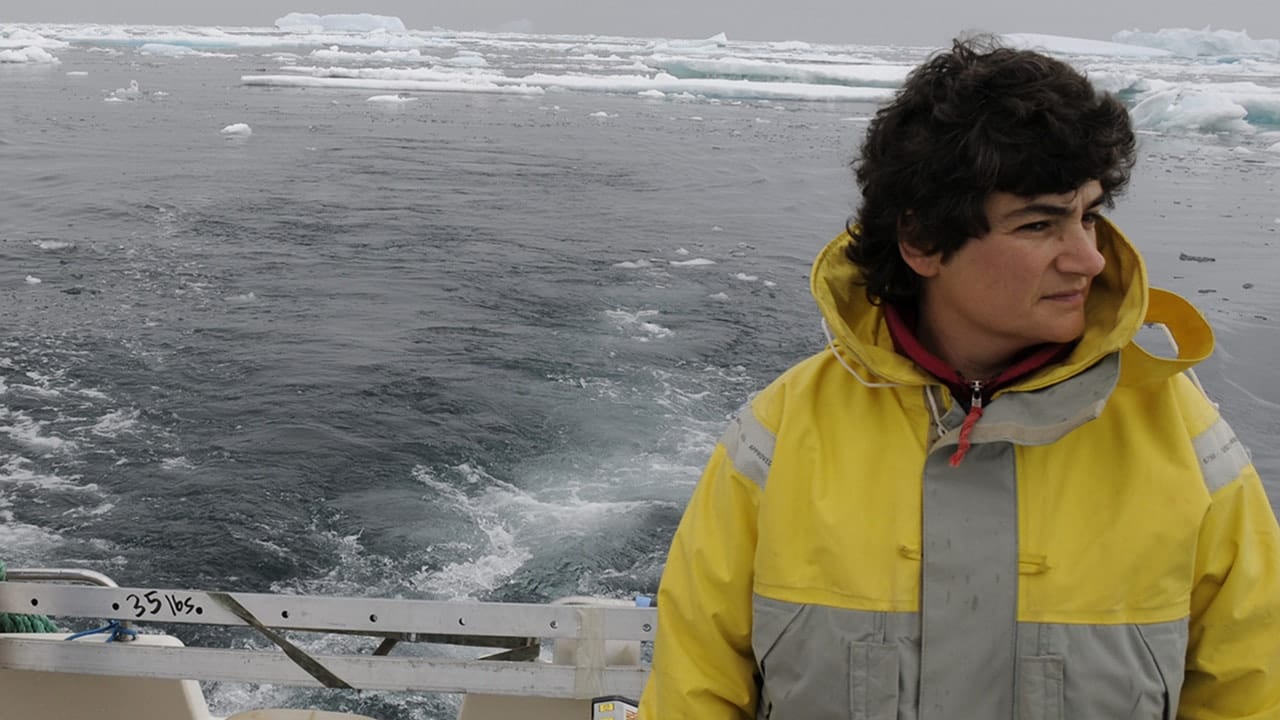
The American Geophysical Union (AGU) has chosen Fiamma Straneo, a physical oceanographer at Woods Hole Oceanographic Institution (WHOI), to deliver the Sverdrup Lecture at this year’s meeting of the Ocean Sciences section held in New Orleans from February 21-26, 2016. The lecture is one of the highest awards the section bestows on its members.
Read MoreStudy Reveals Climate Change Impacts on Buzzards Bay
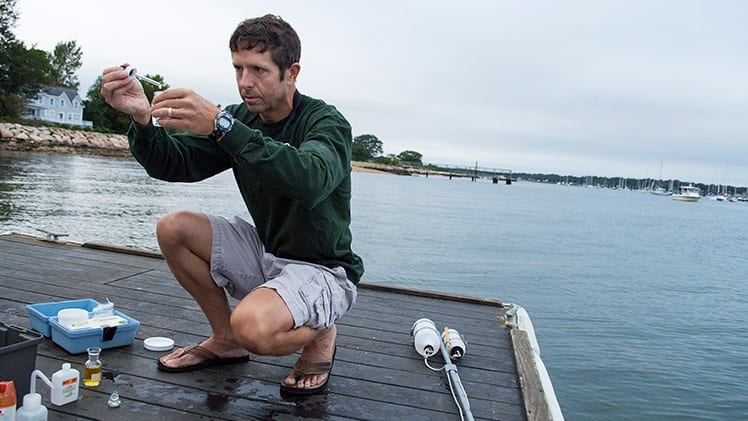
Utilizing 22 years of data collected by a network of citizen scientists, researchers from the Woods Hole Oceanographic Institution (WHOI) and their colleagues at the Buzzards Bay National Estuary Program, the Buzzards Bay Coalition, and the Marine Biological Laboratory found that average summertime temperatures in embayments throughout Buzzards Bay warmed by almost 2 degrees Celsius—roughly 4 degrees Fahrenheit.
Read MoreGalapagos Expedition Reveals Unknown Seamounts, New Species
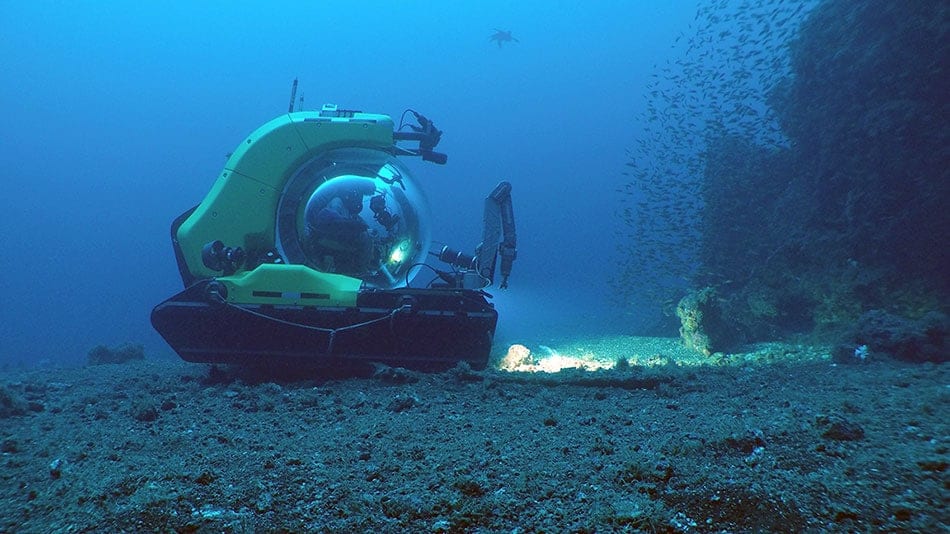
During a three-week expedition in August, an international team led by the Woods Hole Oceanographic Institution (WHOI), in partnership with the Charles Darwin Foundation for the Galápagos Islands and in close collaboration with the Galápagos National Park Directorate, conducted the first scientific expedition to map and characterize the seamounts on the Galápagos platform and the diverse marine life that these underwater mountains support.
Read MoreWarming Ocean Worsened Australia’s Fatal 2010/2011 Floods
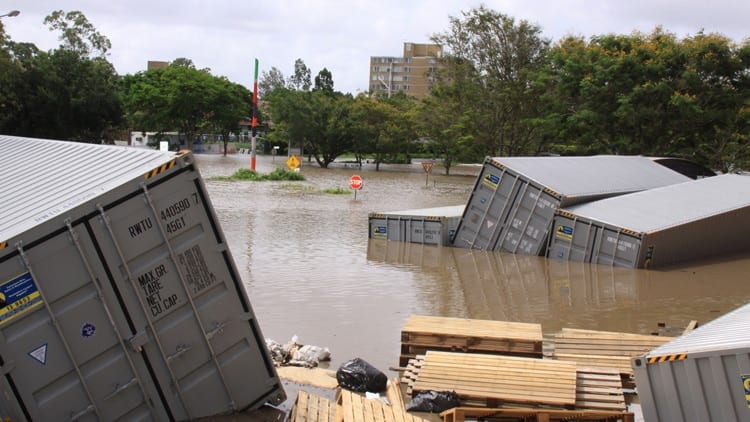
A study by a team of U.S. and Australian researchers shows that long-term warming of the Indian and Pacific oceans played an important role in increasing the severity of the devastating floods that struck Australia in 2010/2011. The study was published in Geophysical Research Letters.
Read MoreNew Study Projects That Melting of Antarctic Ice Shelves Will Intensify
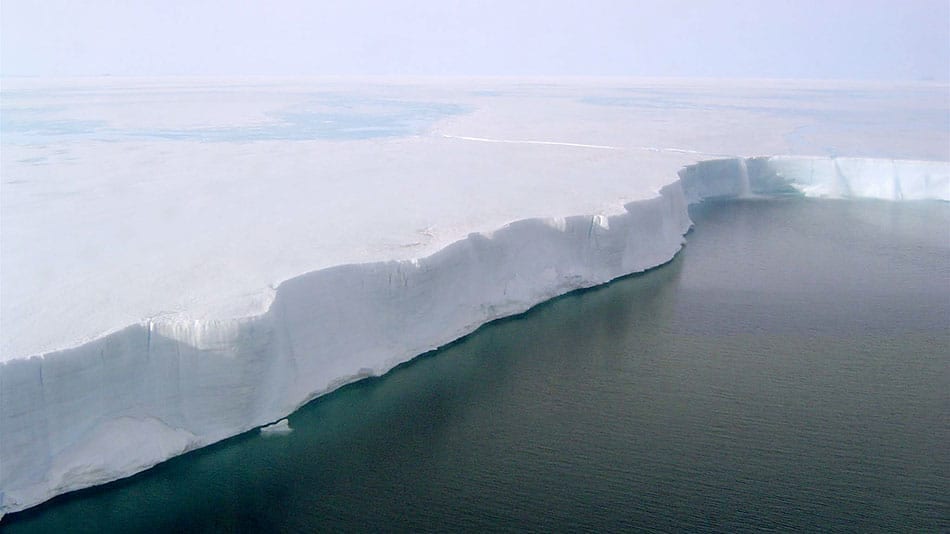
New research published today projects a doubling of surface melting of Antarctic ice shelves by 2050 and by 2100 may surpass intensities associated with ice shelf collapse, if greenhouse gas emissions from fossil fuel consumption continues at the present rate.
Ice shelves are the floating extensions of the continent’s massive land-based ice sheets. While the melting or breakup of floating ice shelves does not directly raise sea level, ice shelves do have a “door stop” effect: They slow the flow of ice from glaciers and ice sheets into the ocean, where it melts and raises sea levels.
Read MoreClimate Change Will Irreversibly Force Key Ocean Bacteria into Overdrive
A new study from University of Southern California and Woods Hole Oceanographic Institution (WHOI) shows that changing conditions due to climate change could send Tricho into overdrive with no way to stop – reproducing faster and generating lots more nitrogen. Without the ability to slow down, however, Tricho has the potential to gobble up all its available resources, which could trigger die-offs of the microorganism and the higher organisms that depend on it.
Read MoreEvidence of Ancient Life Discovered in Mantle Rocks Deep Below the Seafloor
Ancient rocks harbored microbial life deep below the seafloor, reports a team of scientists from the Woods Hole Oceanographic Institution (WHOI), Virginia Tech, and the University of Bremen. This new…
Read MoreWHOI, NEAQ Embark on Expedition to the Phoenix Islands
A research team led by the New England Aquarium (NEAQ) and Woods Hole Oceanographic Institution (WHOI) are heading out on a 6,000-mile expedition to one of the most remote places on Earth—the Phoenix Islands in the central Pacific Ocean. Throughout the month of September and in the midst of a strengthening Pacific El Nino, researchers will investigate the combined effects of climate change and human activity on the these vast coral reef ecosystems and the diversity of life they sustain.
Read MoreRiver Buries Permafrost Carbon at Sea
As temperatures rise, some of the carbon dioxide stored in Arctic permafrost meets an unexpected fate—burial at sea. As many as 2.2 million metric tons of carbon dioxide (CO2) per year are swept along by a single river system into Arctic Ocean sediment, according to a new study led by Woods Hole Oceanographic Institution (WHOI) researchers and published today in Nature. This process locks away the greenhouse gas and helps stabilize the earth’s CO2 levels over time, and it may help scientists better predict how natural carbon cycles will interplay with the surge of CO2 emissions due to human activities.
“The erosion of permafrost carbon is very significant,” says WHOI Associate Scientist Valier Galy, a co-author of the study. “Over thousands of years, this process is sequestering CO2 away from the atmosphere in a way that amounts to fairly large carbon stocks. If we can understand how this process works, we can predict how it will respond as the climate changes.”
Permafrost—the permanently frozen ground found in the Arctic and Antarctic and in some alpine regions—is known to hold billions of tons of organic material, including vast stores of CO2. Amid concerns about rising Arctic temperatures and their impact on permafrost, many researchers have directed their efforts to studying the permafrost carbon cycle—the processes through which the carbon circulates between the atmosphere, the soil and surface (the biosphere), and the sea. Yet how this cycle works and how it responds to the warming, changing climate remains poorly understood.
Galy and his colleagues from Durham University, the Institut de Physique du Globe de Paris, the NERC Radiocarbon Facility, Stockholm University, and the Universite Paris-Sud set out to characterize the carbon cycle in one particular piece of the Arctic landscape—northern Canada’s Mackenzie River, the largest river flowing into the Arctic Ocean from North America and that ocean’s greatest source of sediment. The researchers hypothesized that the Mackenzie’s muddy water might erode thawing permafrost along its path and wash that biosphere-derived material and the CO2 within it into the ocean, preventing the release of that CO2 into the atmosphere.
Read MoreShifting Winds, Ocean Currents Doubled Endangered Galapagos Penguin Population
New research suggests shifts in wind currents over the past three decades, possibly due to climate change and natural variability, have nudged the Equatorial Undercurrent north. The changing current expanded the nutrient-rich, cold water farther north along the coasts of the two islands, likely bolstering algae and fish numbers in the cold pool. This allowed the penguin population to double over the past 30 years, swelling to more than 1,000 birds by 2014, according to the new study.
Read MoreCarbon Dioxide Pools Discovered in Aegean Sea
The waters off Greece’s Santorini are the site of newly discovered opalescent pools forming at 250 meters depth. The interconnected series of meandering, iridescent white pools contain high concentrations of carbon dioxide (CO2) and may hold answers to questions related to deepsea carbon storage as well as provide a means of monitoring the volcano for future eruptions.
Read MoreWhere Iron and Water Mix
A new study by researchers from University of Washington (UW), Woods Hole Oceanographic Institution (WHOI), and the University of Southern California, demonstrates that chemical-laden plumes erupted from vents at one section of Mid Ocean Ridge in the SE Pacific can be traced all the way across the Pacific for more than 4000 kilometers. Further, the study shows how the iron transported by this process is ultimately brought to the surface oceans of Antarctica where it is serves as a key life-sustaining micro-nutrient supporting up to 30 percent of all the organic carbon uptake in that ocean.
Read MoreDeep-Sea Images Give New View of Arctic Ocean Methane Seeps
Working with colleagues from the Centre for Arctic Gas Hydrate, Environment and Climate (CAGE) in Norway, Dan Fornari from Woods Hole Oceanographic Institution’s (WHOI) Geology & Geophysics Department collected nearly 30,000 high definition images at known methane release sites in the Arctic Ocean north of Norway. The detailed images will provide new insights into the most remote areas of natural methane releases in the world.
Read MoreAnna Michel Receives Gulf Research Program Early-Career Research Fellowship

Anna Michel, an assistant scientist in theApplied Ocean Physics and Engineering Department at Woods Hole Oceanographic Institution (WHOI), was chosen by the National Academy of Sciences (NAS) to receive a 2015 Gulf Research Program Early-Career Research Fellowship.
Read MoreMaking Organic Molecules in Hydrothermal Vents in the Absence of Life
In 2009, scientists from Woods Hole Oceanographic Institution embarked on a NASA-funded mission to the Mid-Cayman Rise in the Caribbean, in search of a type of deep-sea hot-spring or hydrothermal vent that they believed held clues to the search for life on other planets. They were looking for a site with a venting process that produces a lot of hydrogen because of the potential it holds for the chemical, or abiotic, creation of organic molecules like methane – possible precursors to the prebiotic compounds from which life on Earth emerged.
For more than a decade, the scientific community has postulated that in such an environment, methane and other organic compounds could be spontaneously produced by chemical reactions between hydrogen from the vent fluid and carbon dioxide (CO2). The theory made perfect sense, but showing that it happened in nature was challenging.
Now we know why: an analysis of the vent fluid chemistry proves that for some organic compounds, it doesn’t happen that way.
New research by geochemists at Woods Hole Oceanographic Institution, published June 8 in the Proceedings of the National Academy of Sciences, is the first to show that methane formation does not occur during the relatively quick fluid circulation process, despite extraordinarily high hydrogen contents in the waters. While the methane in the Von Damm vent system they studied was produced through chemical reactions (abiotically), it was produced on geologic time scales deep beneath the seafloor and independent of the venting process. Their research further reveals that another organic abiotic compound is formed during the vent circulation process at adjacent lower temperature, higher pH vents, but reaction rates are too slow to completely reduce the carbon all the way to methane.
Read MoreDiverse Corals Persist, But Bioerosion Escalates in Palau’s Low-pH Waters
As the ocean absorbs atmospheric carbon dioxide (CO2) released by the burning of fossil fuels, its chemistry is changing. The CO2 reacts with water molecules, lowering ocean pH in a process known as ocean acidification. This process also removes carbonate ions, an essential ingredient needed by corals and other organisms to build their skeletons and shells.
Read MoreStudy Reveals How Rivers Regulate Global Carbon Cycle
Humans concerned about climate change are working to find ways of capturing excess carbon dioxide (CO2) from the atmosphere and sequestering it in the Earth. But Nature has its own methods for the removal and long-term storage of carbon, including the world’s river systems, which transport decaying organic material and eroded rock from land to the ocean.
While river transport of carbon to the ocean is not on a scale that will bail humans out of our CO2 problem, we don’t actually know how much carbon the world’s rivers routinely flush into the ocean – an important piece of the global carbon cycle.
But in a study published May 14 in the journal Nature, scientists from Woods Hole Oceanographic Institution (WHOI) calculated the first direct estimate of how much and in what form organic carbon is exported to the ocean by rivers. The estimate will help modelers predict how the carbon export from global rivers may shift as Earth’s climate changes.
Read MoreSecuring the Supply of Sea Scallops for Today and Tomorrow
Good management has brought the $559 million United States sea scallop fishery back from the brink of collapse over the past 20 years. However, its current fishery management plan does not account for longer-term environmental change like ocean warming and acidification that may affect the fishery in the future. A group of researchers from Woods Hole Oceanographic Institution (WHOI), NOAA’s National Marine Fisheries Service, and Ocean Conservancy hope to change that.
Read MoreOcean Bacteria Get ‘Pumped Up’
In a new study published April 27 in the Proceedings of the National Academy of Sciences, scientists at Woods Hole Oceanographic Institution (WHOI) and their colleague from Rutgers University discovered a surprising new short-circuit to the biological pump. They found that sinking particles of stressed and dying phytoplankton release chemicals that have a jolting, steroid-like effect on marine bacteria feeding on the particles. The chemicals juice up the bacteria’s metabolism causing them to more rapidly convert organic carbon in the particles back into CO2 before they can sink to the deep ocean.
Read More
WHOI Receives $150,000 Grant from Tower Foundation
The Peter and Elizabeth C. Tower Foundation has awarded the Woods Hole Oceanographic Institution (WHOI) a $150,000 grant that will help fund a three-year collaborative project with Cape Abilities—a nonprofit organization dedicated to finding good jobs for Cape Cod residents with disabilities.
Read MoreSwirling Currents Deliver Phytoplankton Carbon to Ocean Depths
A new paper published March 26 in the journal Science that highlights the significant role that swirling currents, or eddies, play in pushing non-sinking carbon to ocean depths.
Read MoreStudy Finds Deep Ocean is Source of Dissolved Iron in Central Pacific
A new study led by scientists at the Woods Hole Oceanographic Institution (WHOI) points to the deep ocean as a major source of dissolved iron in the central Pacific Ocean. This finding highlights the vital role ocean mixing plays in determining whether deep sources of iron reach the surface-dwelling life that need it to survive.
Read More