
Nobumichi “Nobu” Shimizu
;;;;;;;;;;;;;;;;;;;;;;;;;;;;;;;;;;;;;;;;;;;;;;;
The Woods Hole Oceanographic Institution announces with great sorrow the death of Scientist Emeritus Nobumichi “Nobu” Shimizu on November 2, 2025. He was 85.
Nobu was born in Tokyo on February 4th 1940, to Shigemichi Shimizu and Mitsuko Kohima. His parents’ literary background is reflected in their unusual character choice, 孚 (Unicode U+5B5A), for Nobu. As a child during WWII, Nobu was relocated to Hokkaido. He returned to the Tokyo suburb of Musashi Koganei after the war. Following his childhood in post-war Japan, Nobu did not eat fish for many years due to the scarcity of any other food during that period.
Nobu began his career as a geoscientist at the University of Tokyo in the 1960s, earning his BS (1959-1963), MSc (1963-1965), and PhD (1965-1968). His master’s thesis on biotite-bearing high-grade metamorphic rocks led to a 1964 paper with his advisor, Shohei Banno. His PhD advisors, Hisashi Kuno and Minoru Ozima, trained him in the isotopic analysis of mineral separates, leading to his early publications on Pb and Sr isotopes (Shimizu, 1968, 1969, 1970). Nobu also interacted with Shigeo Aramaki, Ikuo Kushiro, and Akiho Miyashiro, with whom he regularly corresponded for decades afterwards. For the Japanese geoscience community, these names are the giants of petrology.
Nobu was hired as an assistant professor at the University of Tokyo in 1968, during a time of widespread student protests. As the youngest faculty member, Nobu was ordered to attend a meeting organized by the student union representatives. Nobu later commented that “I was a student not a long time ago, then suddenly, these student leaders talked to me like an enemy.” At this time, it was common for Japanese scientists to leave Japan to expand their research horizons and the death of Prof. Kuno in 1969 freed Nobu of his moral obligation to stay at the university. Among Japanese petrologists, the story was often told that Nobu was in charge of chauffeuring Kuno every day between the university hospital and the lab during Kuno’s battle with terminal cancer.
In 1971, Nobu moved to the Department of Terrestrial Magnetism at the Carnegie Institution of Washington, USA, as a postdoctoral fellow. He stayed there until 1974, developing the research themes that would define much of his career: mineral trace element distributions, zonation, and partitioning, with a focus on applying these to mantle composition and evolution. Nobu’s work at Carnegie resulted in key early trace element datasets that were obtained through the dissolution of hand-picked mineral separates (e.g., Shimizu, 1973, 1975; Shimizu and Boyd, 1973; Shimizu and Hart, 1974; Shimizu and Arculus, 1975). Characteristically for the time, many of these publications were in the Carnegie Institution of Washington Year Books, a 1970’s treasure trove of mantle geochemistry literature. Nobu also adapted a column chemistry technique for the separation of eight rare earth elements – including Nd – that he combined with an isotope dilution technique to measure their abundances (Shimizu, 1974). This gave him the idea to further adapt the procedure for the measurement of Nd isotopes, resulting in his pioneering work with Pierre Richard and Claude Allègre. Their publication (Richard, Shimizu, and Allègre, 1976) – along with work by DePaolo and Wasserburg (1976) – provided the groundwork for the widespread use of Nd isotopes in mantle geochemistry. Years later, Nobu created a graphical Allègre-esque history of isotope geochemistry, producing a memorable poster for Claude’s 60th birthday.
Nobu’s research at Carnegie involved the incredibly painstaking process of handpicking mineral separates, followed by dissolution and column chemistry prior to analysis by mass spectrometer. Nobu inherited his advisor Kuno’s skill (and patience) with mineral picking, along with his foundational knowledge of magma differentiation. Kuno had estimated that if he picked a certain number of grains per day, he would have enough in 3 months, so he spent hours after work picking his daily grain quota. Nobu followed this regime both at Carnegie and decades later, with the only difference being that Nobu arrived early at work to pick his daily quota before anyone else arrived. Characteristically, Nobu believed that he had never reached Kuno’s skill level. To the rest of us, Nobu’s seminal approaches to geochemical research are rooted in the intellectual and technical training that he received from Kuno.
At Carnegie, Nobu collaborated with Ikuo Kushiro, who had been a year ahead of Nobu at the University of Tokyo and was now a scientist at Carnegie’s Geophysical Laboratory. After learning how to run high pressure piston cylinder experiments (Shimizu and Kushiro, 1973), Nobu developed an innovative differential dissolution technique to sequentially dissolve glass followed by minerals in tiny experiments (Shimizu and Hart, 1973). He used this to make some of the first high pressure measurements of partition coefficients between mantle minerals and melts (Shimizu, 1974; Shimizu and Kushiro, 1975). At the same time, this labor-intensive method led Nobu to search for a better technique to study trace elements in rocks.
Nobu first encountered secondary ion mass spectrometry (SIMS) in 1973 at a small workshop in Newport, RI, where Claude Allègre presented secondary ion images from the Cameca IMS 300. In 1974, Nobu joined Claude Allègre’s group at the Institut de Physique du Globe de Paris, France, where this first generation ion microprobe had been installed. During the next 4 years, Nobu learned French and as much as he could about the physics of secondary ion formation as he worked to develop a quantitative ion microprobe method. This led to his landmark paper on the energy filtering technique for in situ quantification of isotopes and trace elements in minerals (Shimizu, Semet, and Allègre, 1978).
By 1978, Cameca had developed the IMS 3f, with the first commercially produced instrument purchased in the USA by a MIT-Brown-Harvard consortium led by Stan Hart, Bruno Giletti, and Dick Holland. Stan and Nobu had known each other since their time at Carnegie, and Stan lured Nobu to the Massachusetts Institute of Technology as a Principal Research Scientist. The IMS 3f, eventually nicknamed Joy, arrived in November 1978, three months after Nobu’s arrival at MIT. Once installed and tested, Nobu led the creation of analytical protocols, resulting in a series of major papers establishing SIMS as an essential geochemistry technique for in situ trace element and isotopic analysis (Shimizu, 1981; Hart, Shimizu, and Sverjensky, 1981; Shimizu and Hart, 1982; Meddaugh, Holland, and Shimizu, 1982; Shimizu and Hart, 1982; Ray, Shimizu, and Hart, 1983; Sneeringer, Hart, and Shimizu, 1984).
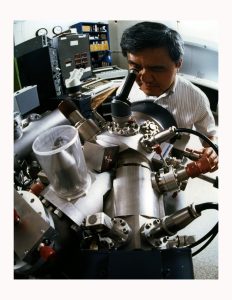
The IMS 3f moved to Woods Hole Oceanographic Institution in 1988 when Nobu joined the Department of Geology and Geophysics as a Senior Scientist. At that point, Joy was 10 years old, with zero value on paper according to accounting methods for depreciation. Yet Joy was just getting going and contributed groundbreaking results to geochemistry for another 30 years. In 1996, the new IMS1270 was installed at WHOI, providing much higher mass resolving power and eventually multi-collector capabilities. With the addition of this instrument, Nobu created a multi-user facility for in situ sample analyses across topics in both the Earth and ocean sciences. Originally named the Northeast National Ion Microprobe Facility (NENIMF), the facility was renamed the Nobu Shimizu National SIMS Facility (NSNSF) in 2026. Nobu remained at WHOI for the rest of his career, visiting regularly after he moved back to Lexington, MA following his 2013 retirement to Emeritus.
In his four-decade career with SIMS, Nobu made a series of ground-breaking contributions to mantle geochemistry. He analyzed garnet inclusions in diamonds to look at fluid-rock reactions during diamond growth (Shimizu and Richardson, 1987; Moore et al., 1991; Shimizu and N.V. Sobolev, 1995; Shimizu, N.V. Sobolev, and Yefimova, 1997; N.V. Sobolev et al., 1998; Tappert et al., 2005). He contributed to foundational datasets for diffusion and partition coefficients in minerals and melts (Shimizu and Kushiro, 1984, 1991; Kelemen, Shimizu, and Dunn, 1993; Van Orman, Grove, and Shimizu, 1998, 2001; Koga, Shimizu, and Grove, 1999; Rapp et al., 1999; Klein et al., 2000; Van Orman et al., 2002; Hirose et al., 2004; Lo Casio et al., 2008). He used peridotite xenoliths to explore the distribution of trace elements in mantle minerals (Salters and Shimizu, 1988; Hauri et al., 1993; Roden and Shimizu, 1993, 2000; Sen et al., 1993; Blusztajn and Shimizu, 1994; Ionov, Hofmann and Shimizu, 1994; Gregoire et al., 1994; Blusztajn et al., 1995; Shimizu et al., 1997). This led to the analysis of mantle melting and melt migration through studies of ophiolitic, orogenic, and abyssal peridotites (Johnson, Dick, and Shimizu, 1990; Frey et al., 1991; Vannucci et al., 1991, 1993; Takazawa et al., 1992, 1995; Kelemen, Shimizu, and Salters, 1995; Ozawa and Shimizu, 1995; Bodinier et al., 2004; Warren and Shimizu, 2010; Blusztajn et al., 2014). He studied the formation of the lower-most oceanic crust (Kelemen, Koga, and Shimizu, 1997; Suhr et al., 1998; Takazawa et al., 1999; Koga et al., 2001; Lissenberg et al., 2009). Nobu explored sulfur isotopes in magmatic systems using natural (Macfarlane and Shimizu, 1991; Nadeau et al., 2015) and experimental (Fiege et al., 2014, 2015) samples. Finally, Nobu’s drive for in situ analytical techniques proved essential to working on mineral-hosted melt inclusions (A.V. Sobolev and Shimizu, 1993; Schiano et al., 1994, 1995; Shimizu, 1998; Saal et al., 1998; Rose et al., 2001; K. Shimizu et al., 2009).
Nobu’s many scientific contributions extended beyond mantle geochemistry. In the late 1980s, he measured trace elements in lunar samples from the Apollo missions (Shearer et al., 1989, 1990, 1991; Galbreath et al., 1990). In the early 2000s, Nobu’s expertise was essential to establishing SIMS as a tool for paleoceanography though his work on the Sr/Ca temperature record in coral skeletons (Cohen et al., 2002) and Sr/Ca and B/Ca ratios in nannofossils (Stoll et al., 2007a, 2007b, 2007c; Stoll and Shimizu, 2009). Continuing his interest in magma crystallization from his student days, Nobu returned to traditional igneous petrology through studies of phenocrysts (Shimizu and le Roex, 1986; Shimizu, 1990; Blundy and Shimizu, 1991; Hattori, Hart, and Shimizu, 1996; Clift et al., 2001, 2003; Slater et al., 2001; Maclennan et al., 2003a, 2003b; Jackson et al., 2008). Reflecting his rigorous training by Japanese metamorphic petrologists, Nobu analyzed metamorphic garnet (Hickmott et al., 1987; Hickmott and Shimizu, 1990). He also looked at pegmatitic apatite (Jolliff et al., 1989), base metal ores (Macfarlane and Shimizu, 1991), detrital feldspars (Clift et al., 2000, 2001) and zircons (Thomas et al., 2002; 2003).
Nobu earned widespread recognition throughout his career, including becoming a Fellow of the American Geophysical Union in 1996, the WHOI W. Van Alan Clark, Sr. Chair for Excellence in Oceanography in 1997, Geochemistry Fellow of the Geochemical Society and European Association of Geochemistry in 1999, and Fellow of the American Association for Advancement of Science in 2007. In 2018, Nobu published a career retrospective in Geochemical Perspectives.
Nobu mentored generations of graduate students, postdocs and visiting scientists of all ages with deep empathy and compassion combined with tough love – providing sparse instructions to beginners and leaving them to learn how to make machines work by trial-and-error, and sometimes how to break them. His generosity is inscribed in countless thesis acknowledgements, such as the words of Glenn Ray in his 1980 MIT PhD thesis: “Dr. Nobu Shimizu not only trained me in the use of the ion microprobe, but he set a rare example of personal and scientific leadership.”
Beyond his many scientific contributions, Nobu was a beloved member of the WHOI community. Nobu loved to cook. He excelled in making risotto and enjoyed accompanying it with a glass of Pouilly Fuissé wine. His stay in France at the beginning of his career had given him an in-depth knowledge about wines and cheeses that he loved to share with friends. Nobu was a music lover and an excellent pianist himself. He once modestly admitted that he would have liked to pursue a career as a pianist, but felt his hands were too small to compete with other musical prodigies.
Soccer was another of Nobu’s passions. As far back as 1968, he was an avid participant, playing in a Department of Mining and Metallurgy match at the University of Tokyo Gotenshita sports grounds. At MIT, Nobu played on an excellent team alongside retired professional Brazilian players in a Boston-area amateur league. At WHOI, he played pick-up games two or three times a week for years. After finishing his active soccer career, Nobu became a referee – with the added benefit of giving him priority for tickets to the 1994 World Cup in the USA. Nobu was a devoted Barcelona FC fan, watching all their games.
Nobu is survived by his sons, Taku Shimizu of Tokyo, Japan, and Shu Shimizu of Lexington, MA. He was predeceased by his wife, Kazuko (Ogawa), in 2020.
This remembrance prepared by Jessica Warren (University of Delaware; former Shimizu student), Ken Koga (Université d’Orléans; former Shimizu student), Estelle Rose-Koga (Université d’Orléans; former Shimizu postdoc), Jurek Blusztajn (WHOI), and Mark Kurz (WHOI).