
Marine carbon dioxide removal is advancing, but questions remain about viability, says new digital report
September 17, 2026
WASHINGTON and Woods Hole, Mass. (Sept. 17, 2026)— Marine carbon dioxide removal (CDR) has advanced significantly, with growing research activity, technological development, private-sector involvement, and movement toward field testing, but major questions remain about whether these approaches can remove carbon dioxide at meaningful scales, how that removal can be reliably measured and verified, potential environmental effects, and how marine CDR should be governed, says a new digital report from the National Academies of Sciences, Engineering, and Medicine.
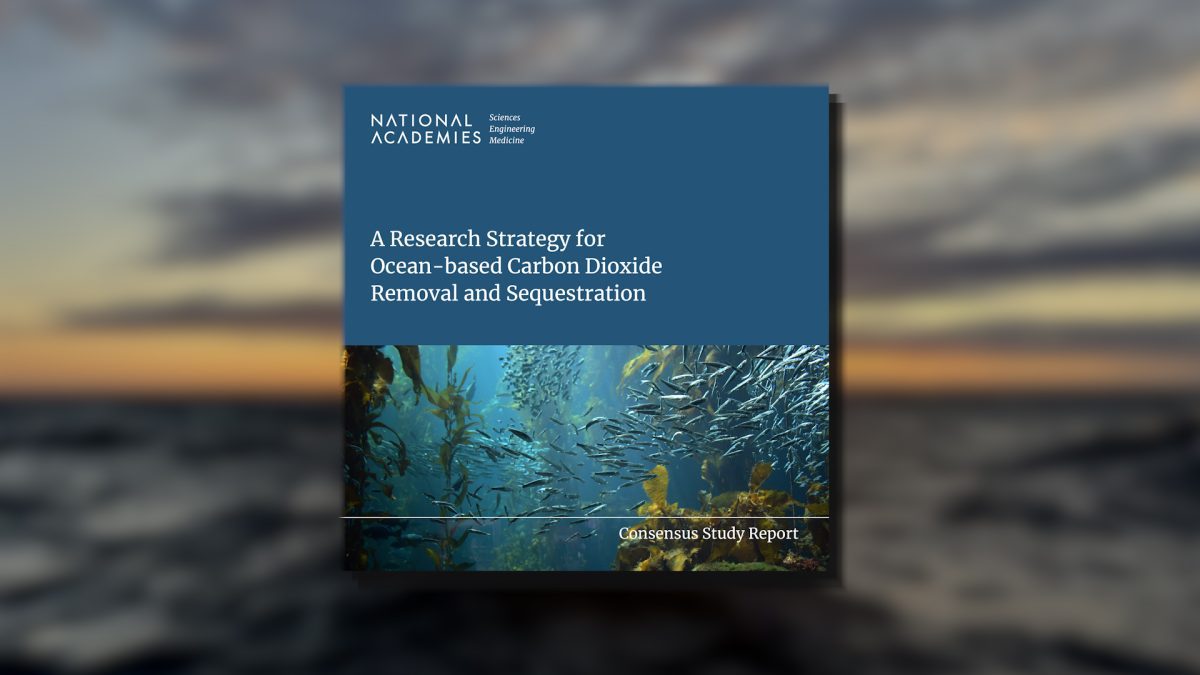
Part of a planned series, this report builds on a National Academies’ 2022 report, A Research Strategy for Ocean-Based Carbon Dioxide Removal and Sequestration, and is intended to provide an independent, peer-reviewed resource that can evolve as this fast-moving field develops. The 2026 update includes a new State of Marine CDR, 2026 module highlighting recent advances, emerging trends, and remaining knowledge gaps; an updated introduction and assessment framework; and updated and expanded modules on governance and social dimensions and ocean alkalinity enhancement. Periodic updates will be made as research and science progress and will be responsive to community needs and priorities.
The report reemphasizes that marine CDR, if demonstrated to be feasible and responsible, could supplement reductions in greenhouse gas emissions. Further, the report notes that significant scale-up would be needed for marine CDR to contribute meaningfully to climate targets and that there are still uncertainties about the ability to monitor and measure net carbon removal as well as about understanding environmental impacts, specifically long-term and ecosystem-scale effects. Regulation and governance will also be needed at local, national, and global levels and will have to evolve alongside the science.
Ultimately, the viability of marine CDR cannot be determined by technological performance alone, the report says. Whether and how these approaches develop will also depend on public acceptance, political and regulatory decisions, community considerations, and the environmental and social characteristics of the places where research or deployment occurs.
The report was undertaken by the Marine Carbon Dioxide Removal Standing Committee and sponsored by the Carbon to Sea Initiative and the National Academy of Sciences’ George and Cynthia Mitchell Endowment for Sustainability Science Fund.
Adam Subhas, an associate scientist in the Marine Chemistry and Geochemistry Department at the Woods Hole Oceanographic Institution (WHOI), is a member of the Marine Carbon Dioxide Removal Standing Committee and contributed to the updated chapters. Subhas studies marine carbon and alkalinity cycles, with a focus on understanding the biogeochemical processes that determine how carbon is exchanged between the ocean and atmosphere. His research includes ocean alkalinity enhancement (OAE), one of the approaches examined in the report. He leads the Locking Ocean Carbon in the Northeast Shelf and Slope (LOC-NESS) project, a multidisciplinary effort examining the effectiveness and environmental impacts of ocean alkalinity enhancement through field experiments, ocean modeling, laboratory studies, and monitoring. The team successfully completed a field trial in the Gulf of Maine in August 2025, and reported its preliminary findings at the Ocean Sciences Meeting earlier this year.
“The scientific landscape of marine carbon dioxide removal is changing quickly,” said Subhas. “This updated report provides an important opportunity to take stock of what we have learned since 2022, what has become clearer, what remains uncertain, and where additional research is most urgently needed.”
The National Academies of Sciences, Engineering, and Medicine are private, nonprofit institutions that provide independent, objective analysis and advice to the nation to solve complex problems and inform public policy decisions related to science, engineering, and medicine. They operate under an 1863 congressional charter to the National Academy of Sciences, signed by President Lincoln.
###
About Woods Hole Oceanographic Institution
Woods Hole Oceanographic Institution (WHOI) is a private, non-profit organization on Cape Cod, Massachusetts, dedicated to marine research, engineering, and higher education. Established in 1930, its mission is to understand the ocean and its interactions with the Earth as a whole, and to communicate an understanding of the ocean’s role in the changing global environment. WHOI’s pioneering discoveries stem from an ideal combination of science and engineering—one that has made it one of the most trusted and technically advanced leaders in fundamental and applied ocean research and exploration anywhere. WHOI is known for its multidisciplinary approach, superior ship operations, and unparalleled deep-sea robotics capabilities. We play a leading role in ocean observation and operate the most extensive suite of ocean data-gathering platforms in the world. Top scientists, engineers, and students collaborate on more than 800 concurrent projects worldwide—both above and below the waves—pushing the boundaries of knowledge to inform people and policies for a healthier planet. Learn more at whoi.edu.