
News Releases
National Deep Submergence Facility Vehicles Assist in Response to Deepwater Horizon Oil Spill
The U.S. National Deep Submergence Facility (NDSF) has had a growing and important role in the ocean science community’s response to the 2010 Deepwater Horizon oil spill in the Gulf…
Read MoreWHOI Website Will Take Viewers Deep into the Gulf
It may take years before scientists determine the full impact of the 2010 Deepwater Horizon oil spill in the Gulf of Mexico. But, utilizing the human-occupied submersible Alvin and the autonomous underwater vehicle (AUV) Sentry, researchers are about to investigate?and view first-hand?the possible effects of the spill at the bottom of the Gulf. And, from Dec. 6-14, the mission will be relayed to the public as it happens on the Woods Hole Oceanographic Institution?s (WHOI) Dive and Discover website (http://divediscover.whoi.edu).
Read MoreWHOI Scientists Map and Confirm Origin of Large, Underwater Hydrocarbon Plume in Gulf
Scientists at the Woods Hole Oceanographic Institution (WHOI) detected and characterized a plume of hydrocarbons that is at least 22 miles long and more than 3,000 feet below the surface of the Gulf of Mexico, a residue of the BP Deepwater Horizon oil spill. The work presents a forensic snapshot of the plume characteristics in June and is reported in a study appearing in the Aug. 19 issue of the journal Science.
Read MoreWHOI Science Mission to Study Deepwater Horizon Spill Using Mass Spectrometry and AUV Sentry
A multidisciplinary team of investigators from Woods Hole Oceanographic Institution embarked June 17 on a twelve-day research effort in the Gulf of Mexico aboard the R/V Endeavor, conducting three simultaneous…
Read MoreWHOI Participates in Meeting Aimed at Finding Solutions to Control or Stop Oil Spill
On June 1, 2010, members of the staff of the Woods Hole Oceanographic Institution (WHOI) participated in a meeting at the Environmental Protection Agency headquarters in Washington, D.C., to consider…
Read MoreWHOI Joins Consortium to Study, Minimize Effects of Gulf Oil Spill
The Woods Hole Oceanographic Institution (WHOI) is partnering with two Louisiana institutions to determine the myriad impacts of the Deepwater Horizon oil discharge into the Gulf of Mexico and to devise and implement possible solutions to the disaster.
Read MoreWHOI Expertise, Technology, Tapped for Search for Air France Flight 447
The Woods Hole Oceanographic Institution (WHOI) is part of an international sea search operation formed to locate the deep-sea wreck site of Air France Flight 447 and to retrieve the flight recorders from the Airbus A 330.
Read MoreResearchers Issue Outlook for a Significant New England ‘Red Tide’ in 2010
Today, scientists from the NOAA-funded Gulf of Maine Toxicity (GOMTOX) project issued an outlook for a significant regional bloom of a toxic alga that can cause ‘red tides’ in the…
Read MoreNatural Petroleum Seeps Release Equivalent of 8-80 Exxon Valdez Oil Spills
A new study by researchers at Woods Hole Oceanographic Institution (WHOI) and the University of California, Santa Barbara (UCSB) is the first to quantify the amount of oil residue in…
Read MoreResearchers Report Potential for “Moderately Large” Red Tide Outbreak in the Gulf of Maine Region for 2009
The potential for an outbreak of the phenomenon commonly called “red tide” is expected to be “moderately large” this spring and summer, according to researchers with the Woods Hole Oceanographic…
Read MoreMay 2008 Earthquake in China Could Be Followed by Another Significant Rupture
Researchers analyzing the May 2008 Wenchuan earthquake in China?s Sichuan province have found that geological stress has significantly increased on three major fault systems in the region. The magnitude 7.9 quake on May 12 has brought several nearby faults closer to failure and could trigger another major earthquake in the region.
Read MoreMarine Chemist Says “Not So Fast” to Quick Oil Detection Method
A new method for assessing environmental contamination after oil spills is in danger of being applied in situations where it doesn’t work and might produce false conclusions, a scientist at…
Read MoreIn Computer Models and Seafloor Observations, Researchers See Potential for Significant 2008 “Red Tide” Season
Researchers from WHOI and North Carolina State University are preparing for a potentially big bloom of harmful algae in New England waters this spring. A combination of abundant beds of algal seeds and excess winter precipitation have set the stage for an Alexandrium bloom similar to the historic “red tide” of 2005. Weather patterns and ocean conditions over the next few months will determine whether this year’s algal growth affects coastal shellfishing.
Read MoreUnderwater Microscope Helps Prevent Shellfish Poisoning Along Gulf Coast of Texas
Through the use of an automated, underwater cell analyzer developed at WHOI, researchers and coastal managers were recently able to detect a bloom of harmful marine algae in the Gulf of Mexico and prevent human consumption of tainted shellfish.
Read MoreComparing the San Francisco Oil Spill with East Coast Analogs
In the wake of the November 7 spill of 58,000 gallons of fuel oil into San Francisco Bay, environmental chemist Chris Reddy of the Woods Hole Oceanographic Institution (WHOI) has…
Read MoreFragmented Structure of Seafloor Faults May Dampen Effects of Earthquakes
Many earthquakes in the deep ocean are much lower in magnitude than expected. Geophysicists from the Woods Hole Oceanographic Institution (WHOI) have found new evidence that the fragmented structure of seafloor faults and previously unrecognized volcanism may be dampening the effects of these quakes.
Read MoreWHOI Geologists Compile Longest Ever Record of Atlantic Hurricane Strikes
The frequency of intense hurricanes in the Atlantic Ocean appears to be closely connected to long-term trends in the El Ni?o/Southern Oscillation and the African monsoon, according to new research from the Woods Hole Oceanographic Institution (WHOI). Geologists Jeff Donnelly and Jonathan Woodruff made that discovery while assembling the longest-ever record of hurricane strikes in the Atlantic basin.
Read MoreHurricane Katrina’s Flood Legacy Does Not Include Disease
When the levees broke in New Orleans after Hurricane Katrina, officials feared that Lake Pontchartrain might be infiltrated with disease-causing microbes from a “toxic gumbo” of water, polluted sediments, and…
Read MoreBuried, Residual Oil is Still Affecting Wildlife Decades After a Spill
Nearly four decades after a fuel oil spill polluted the beaches of Cape Cod, researchers have found the first compelling evidence for lingering, chronic biological effects on a marsh that…
Read MoreHarmful Algal Bloom (Red Tide) Models and Forecasts to be Expanded in Gulf of Maine
A new observation and modeling program focused on the southern Gulf of Maine and adjacent New England shelf waters could aid policymakers in deciding whether or not to re-open, develop,…
Read MoreLessons from the 2004 Indian Ocean Tsunami Topic of Public Forum
How coastal communities manage risks associated with major tsunamis is an issue of global importance following the devastating 2004 Indian Ocean tsunami that killed an estimated 200,000 people and caused…
Read MoreWoods Hole Engineering Team from Titanic Discovery to be Honored
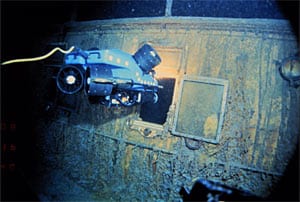
The underwater research vehicle Jason Jr., which gained international attention for its exploration inside the wreck of the R.M.S. Titanic in July 1986, and its engineering team from Woods Hole…
Read MoreNew Maps Provide Clues to the Historic 2005 Red Tide Outbreak in New England And Hints for 2006
Scientists at the Woods Hole Oceanographic Institution (WHOI) have completed two extensive survey and mapping efforts to better understand why the 2005 New England red tide was so severe and…
Read MoreNew Instrumentation May Help Scientists Understand Earthquake Mechanics
Hundreds of earthquakes occur every day around the world, most of them underneath the oceans, while the vast majority of instruments used to record earthquakes are on land. As a…
Read More