
Geology & Geophysics
Catching the Rain: Sediment Trap Technology
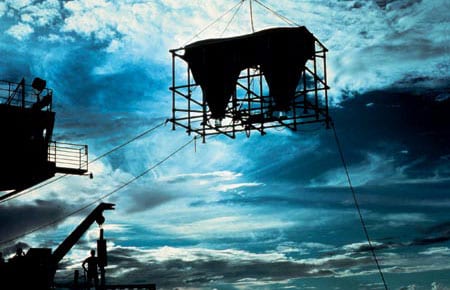
WHOI Senior Engineer Ken Doherty developed the first sediment trap in the late 1970s for what has come to be known as the WHOI PARFLUX (for “particle flux”) group. Working closely with the scientific community, Doherty has continued to improve sediment traps for two decades, and these WHOI-developed instruments are widely used both nationally and internationally in the particle flux research community.
Read MoreThe Magnetic Thickness of a Recent Submarine Lava Flow
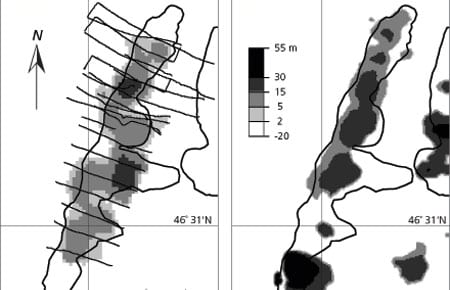
Submarine lava flows and their associated narrow feeder conduits known as dikes constitute the basic building blocks of the upper part of the ocean crust. We are only beginning to understand how lava erupts and forms on the seafloor by flooding topographic lows, flowing through channels or tubes, centralizing into volcanoes, or some combination of all of these.
Read MoreSedimentary Record Yields Several Centuries of Data
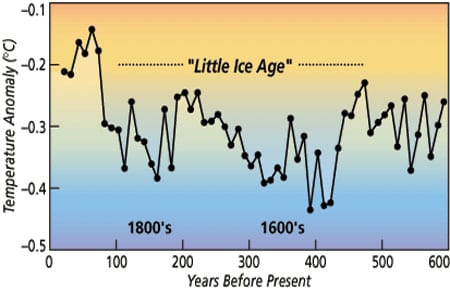
Natural climate changes like the Little Ice Age and the Medieval Warm Period are of interest for a few reasons. First, they occur on decade to century time scales, a gray zone in the spectrum of climate change. Accurate instrumental data do not extend back far enough to document the beginning of these events, and historical data are often of questionable accuracy and are not widespread geographically.
Read More