
News Releases
Researchers from WHOI and MBL Receive $1.2 Million Grant for Collaborative Salt-Marsh Study
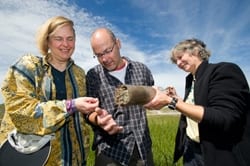
Scientists from the Marine Biological Laboratory (MBL) and the Woods Hole Oceanographic Institution (WHOI) were recently awarded a $1.2 million collaborative grant from the National Science Foundation (NSF) for studies on the role of sulfur-oxidizing bacteria in salt marsh nitrogen and carbon cycling. The fieldwork will be conducted at the Plum Island Ecosystem Long-Term Ecological Research (LTER) site on the North Shore of Boston.
Read MoreStudy Assesses Nations’ Vulnerabilities to Reduced Mollusk Harvests from Ocean Acidification
Changes in ocean chemistry due to increased carbon dioxide (CO2) emissions are expected to damage shellfish populations around the world, but some nations will feel the impacts much sooner and more intensely than others, according to a study by scientists at Woods Hole Oceanographic Institution (WHOI).
Read MoreExpedition to Mid-Cayman Rise Identifies Unusual Variety of Deep Sea Vents
deep-sea hydrothermal vents Mid-Cayman Rise Woods Hole Oceanographic Institution (WHOI) Proceedings of the National Academy of Sciences NASA-funded search extreme environments origins and evolution life
Read MoreLong-Distance Larvae Speed to New Undersea Vent Homes
Working in a rare, ?natural seafloor laboratory? of hydrothermal vents that had just been rocked by a volcanic eruption, scientists from the Woods Hole Oceanographic Institution (WHOI) and other institutions have discovered what they believe is an undersea superhighway carrying tiny life forms unprecedented distances to inhabit the post-eruption site.
Read MoreWarming Climate Impacts Base of Food Web in Western Antarctic Peninsula
A paper published this week in Science shows for the first time that the warming climate is changing the numbers and composition of phytoplankton—the base of the food web—along the…
Read MoreEmperor Penguins March toward Extinction?
Popularized by the 2005 movie “March of the Penguins,” emperor penguins could be headed toward extinction in at least part of their range before the end of the century, according…
Read MorePolar Bear Population Likely to Become Extinct
Within the month, the U.S. government must decide whether to list the polar bear as an endangered species. The question is: will such a declaration be too late because of…
Read MoreBuried, Residual Oil is Still Affecting Wildlife Decades After a Spill
Nearly four decades after a fuel oil spill polluted the beaches of Cape Cod, researchers have found the first compelling evidence for lingering, chronic biological effects on a marsh that…
Read MoreSeafloor bacteria are multi-tasking with the carbon cycle
Scientists have long known that microorganisms can use one of two different methods to convert carbon dioxide into a form that living things can use for energy. What they didn’t…
Read MoreRapid Sea Level Rise in the Arctic Ocean May Alter Views of Human Migration
Scientists have found new evidence that the Bering Strait near Alaska flooded into the Arctic Ocean about 11,000 years ago, about 1,000 years earlier than widely believed, closing off the…
Read MoreWalrus Calves Stranded by Melting Sea Ice
Scientists have reported an unprecedented number of unaccompanied and possibly abandoned walrus calves in the Arctic Ocean, where melting sea ice may be forcing mothers to abandon their pups as…
Read MoreNew Technology for New Exploration of Hydrothermal Vents
Advances in undersea imaging systems, the development of new vehicles and instruments, and improved seafloor mapping capabilities have enabled scientists to explore areas of the deep sea in unprecedented detail. …
Read MoreDiving to the Rosebud Vents – Galápagos Rift
In 2002, researchers diving in the submersible Alvin returned to the Galápagos Rift, a mid-ocean ridge about 250 miles from the Galápagos Islands in the eastern Pacific Ocean where hydrothermal…
Read MoreMajor Cruise to Galapagos Rift Marks 25th Anniversary of Deep Sea Hydrothermal Vent Discovery
In 1977, scientists made a stunning discovery on the bottom of the Pacific Ocean that forever changed our understanding of our planet and life on it. They discovered the first deep-sea hydrothermal vents, andA?to their complete surpriseA?a lush community of exotic life thriving around them.
Read MoreColonizing The Deep Sea: WHOI Scientist Helps Find Answers to Hydrothermal Vent Puzzle
For nearly 25 years, scientists have wondered how giant red-tipped tubeworms and other exotic marine life found at hydrothermal vents on the deep sea floor get from place to place and how long their larva survive in a cold, eternally dark place. Now Woods Hole Oceanographic Institution Biologist Lauren Mullineaux and colleagues have helped answer those questions.
Read MoreScientists Release First Images of Hydrothermal Vents Found in the Indian Ocean
Scientists exploring a remote area of the central Indian Ocean seafloor two and one-half miles deep have found animals that look like fuzzy snowballs and chimney-like structures two stories tall spewing super-heated water full of toxic metals. The findings, released on the Woods Hole Oceanographic Institution’s Dive and Discover Web site (http://www.divediscover.whoi.edu/) were made at the start of a month-long expedition funded by the National Science Foundation. Images and data from the seafloor may provide critical answers to long standing questions about the diversity of life in the deep sea, how animals move from place to place and how the ocean crust is changing. A Japanese team is reported to have discovered hydrothermal vents in the Indian Ocean last fall, but little information has been publicly available.
Read More