
Endangered basking sharks rely on the ocean twilight zone during long-distance migrations
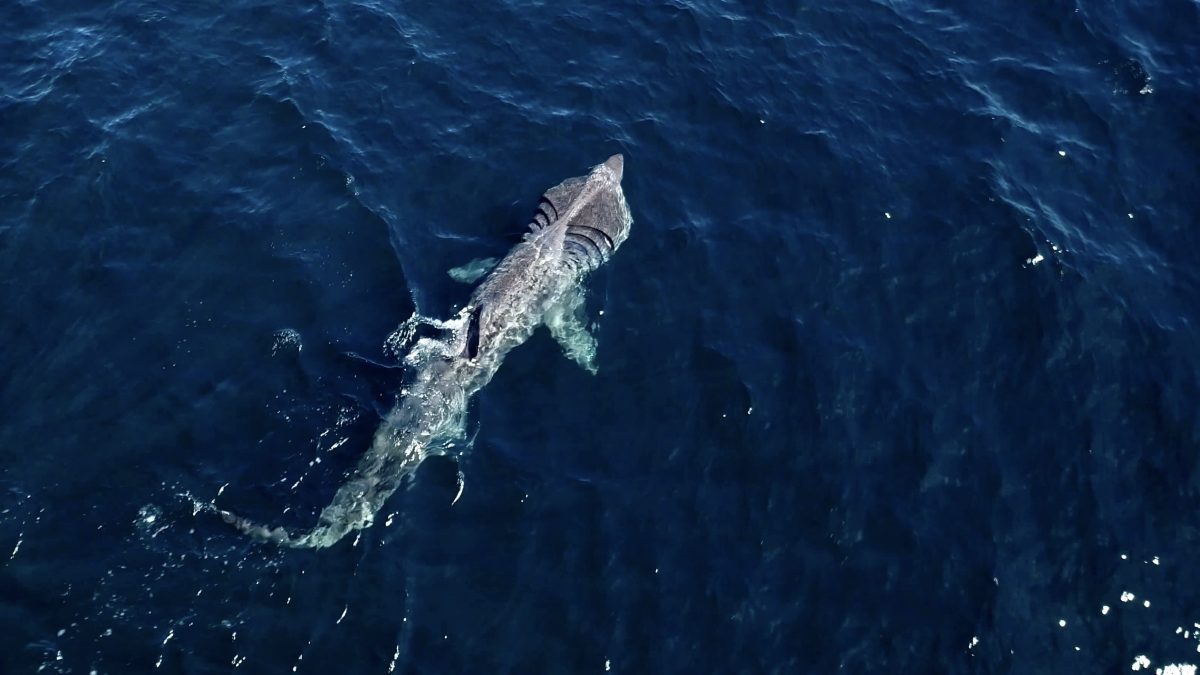 New research suggests basking sharks actively feed during
long
–
distance migrations
rather than relying solely on stored energy reserves, as previously assumed for many migratory
sharks. (Photo by Amy Kukulya, ©Woods Hole Oceanographic Institution)
New research suggests basking sharks actively feed during
long
–
distance migrations
rather than relying solely on stored energy reserves, as previously assumed for many migratory
sharks. (Photo by Amy Kukulya, ©Woods Hole Oceanographic Institution) June 3, 2026
A new WHOI study shows basking sharks dive nearly 1,000 meters deep, likely in search of prey
Photos and video available for use with credit can be found here.
Woods Hole, Mass. (June 3, 2026) – Endangered basking sharks aren’t fasting during long-distance migrations. A new study led by the Woods Hole Oceanographic Institution (WHOI) shows that they may be foraging along the way, and in much deeper areas of the ocean than previously thought. As filter feeders, this species is most often observed close to the surface, especially in waters off of New England, but data shows markedly different behavior during their winter migrations to the Sargasso Sea and the Caribbean.
By analyzing more than 8,000 days of tracking data collected from 37 basking sharks tagged between 2004 and 2011 near Cape Cod, researchers found that they’re diving as far down as the lower boundary of the ocean twilight zone, which extends from 200 to 1,000 meters below the surface.
“Reaching depths of 800 to 1,000 meters is physiologically demanding. It’s cold, dark, and low‑oxygen. Yet these sharks repeatedly dive into the secondary deep scattering layer, a resource that most large pelagic predators cannot exploit,” said Jaida Elcock, doctoral candidate in the MIT‑WHOI Joint Program and lead author of the paper.
These findings, published in PLOS, highlight the potential ecological importance of prey living in the ocean twilight zone, and contribute to growing recognition of the ecosystem services supported by deep-pelagic food webs. While the ocean twilight zone hosts more biomass than any other area of the water column, very little is understood about the lasting impacts of increased fishing or its role in the carbon cycle.
“We don’t yet know what basking sharks are feeding on at these depths. One interesting idea is filter feeding on swarms of tiny twilight zone fish that are too small for most other predators to target,” said co-author Camrin Braun, an oceanographer and ecologist at WHOI. “A key question is what would the impacts be if we started harvesting the tiny fish and squid that live in the twilight zone on an industrial scale? Would this negatively impact basking sharks and other top predators? We need to figure that out.”
Basking sharks were targeted for their oil-rich livers for centuries, and the species has not fully recovered, granting it a spot on the IUCN Red List as endangered. Their dwindling numbers create an increasing urgency to understand their migration and what future threats they may face.
“One of the biggest mysteries is their reproduction. We still don’t know where basking sharks mate or give birth, and these long-distance migrations may be tied to mating behavior happening far offshore and deep underwater, where we can’t observe it directly,” Elcock continued. “There have also been records of basking sharks moving from the Cape Cod region to the Northeast Atlantic, towards Scotland and Ireland, which raises questions about how much genetic exchange may be happening between seemingly distinct populations.”
Funding for this study was provided by NOAA’s Dr. Nancy Foster Scholarship Program and the MIT-WHOI Joint Program for Biological Oceanography. Tagging efforts were supported by National Aeronautics and Space Administration grant NNS06AA96G, National Science Foundation grant OCE-0825148, the Massachusetts Environmental Trust, and the Federal Aid in Sport Fish Restoration Program. The funders had no role in study design, data collection and analysis, decision to publish, or preparation of the manuscript.
###
About Woods Hole Oceanographic Institution
Woods Hole Oceanographic Institution (WHOI) is a private, non-profit organization dedicated to marine research, engineering, and higher education. Founded in 1930 and based on Cape Cod, Massachusetts, WHOI’s mission is to understand the ocean and its interaction with the Earth system, and to communicate the ocean’s vital role in the global environment.
Key Takeaways
- A new WHOI-led study shows endangered basking sharks actively feed during long-distance migrations.
- Tracking data revealed that basking sharks dive into the ocean twilight zone in search of prey, sometimes deeper, to over 1,000m.
- The findings suggest deep-sea food webs may play a critical role in supporting migratory marine species as industrial interest in mesopelagic fishing grows