Fertilizing the Ocean with Iron
Should we add iron to the sea to help reduce greenhouse gases in the air?
Estimated reading time: 16 minutes
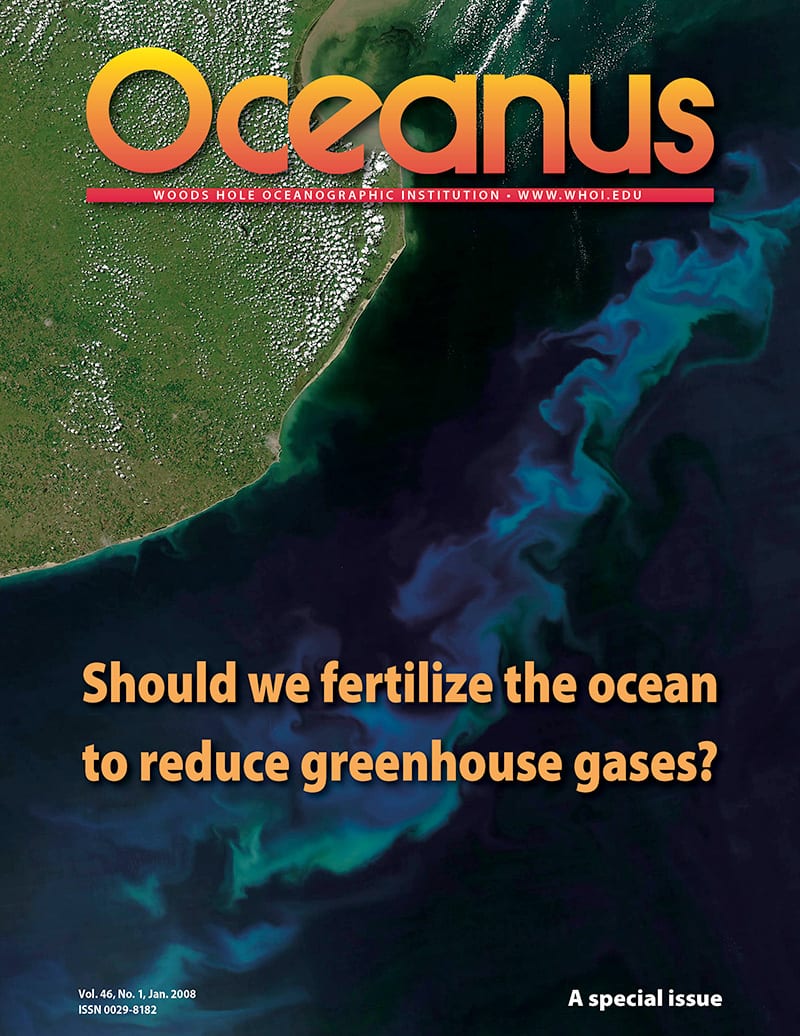 This article printed in Oceanus January 2008
“Give me half a tanker of iron, and I’ll give you an ice age” may rank as the catchiest line ever uttered by a biogeochemist. The man responsible was the late John Martin, former director of the Moss Landing Marine Laboratory, who discovered that sprinkling iron dust in the right ocean waters could trigger plankton blooms the size of a small city. In turn, the billions of cells produced might absorb enough heat-trapping carbon dioxide to cool the Earth’s warming atmosphere.
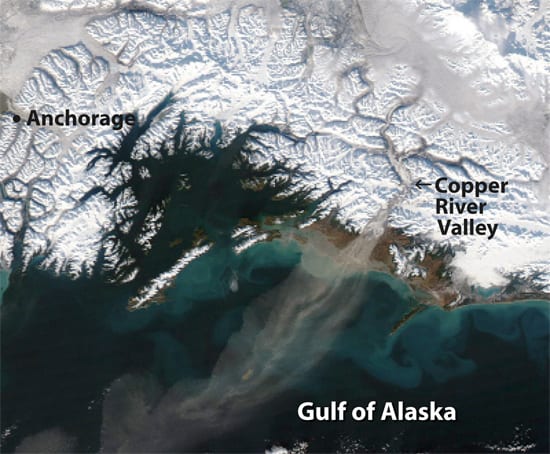
A plume of dust from Alaskan glacial sediments blows far into the Pacific Ocean. Storms like this, or from vast deserts such as the Sahara, are the natural way that iron gets into oceans to fertilize phytoplankton blooms. (NASA image courtesy Jeff Schmaltz, MODIS Rapid Response Team, Goddard Space Flight Center)
Never mind that Martin was only half serious when he made the remark (in his “best Dr. Strangelove accent,” he later recalled) at an informal seminar at Woods Hole Oceanographic Institution (WHOI) in 1988. With global warming already a looming problem, others were inclined to take him seriously.
At the time, ice-core records suggested that during past glacial periods, natural iron fertilization had repeatedly drawn as much as 60 billion tons of carbon out of the atmosphere. Laboratory experiments suggested that every ton of iron added to the ocean could remove 30,000 to 110,000 tons of carbon from the air. Early climate models hinted that intentional iron fertilization across the entire Southern Ocean could erase 1 to 2 billion tons of carbon emissions each year—10 to 25 percent of the world’s annual total.
Since 1993, 12 small-scale ocean experiments have shown that iron additions do indeed draw carbon into the ocean—though perhaps less efficiently or permanently than first thought. Scientists at the time agreed that disturbing the bottom rung of the marine food chain carried risks.
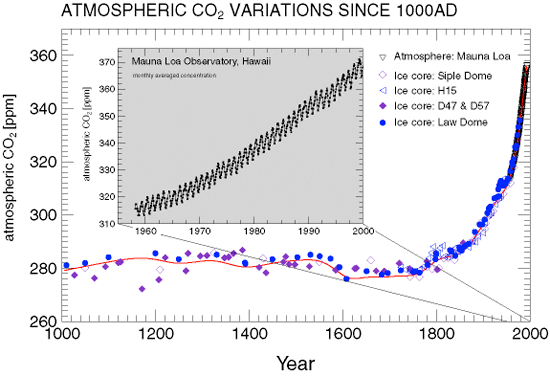
Underlying proposals to add iron to the ocean as a means to mitigate climate change is the brutal fact that atmospheric carbon dioxide levels have increased precipitously since the 1850s and continue to rise. CO2 levels for the past 1,000 years were derived from ice cores. The inset shows direct atmospheric CO2 observations from Mauna Loa, Hawaii, beginning in 1958. (Adapted from Sarmiento & Gruber. Inset: from C.D. Keeling and the National Oceanic and Atmospheric Administration Climate Monitoring and Diagnostics Laboratory)
Twenty years on, Martin’s line is still viewed alternately as a boast or a quip; an opportunity too good to pass up or a misguided remedy doomed to backfire. Yet over the same period, unrelenting increases in carbon emissions and mounting evidence of climate change have taken the debate beyond academic circles and into the free market.
Today, policymakers, investors, economists, environmentalists, and lawyers are taking notice of the idea. A handful of companies are planning a new round of larger experiments. The absence of clear regulations for either conducting experiments at sea or trading the results in “carbon offset” markets complicates the picture. But economists conclude that the planet’s growing urgency to solve its emissions problem will reward anyone who can make iron fertilization work.
In past experiments “we were trying to answer the question, ‘how does the world work?’—not ‘how do we make the world work for us?’ ” Kenneth Coale, the present-day director of Moss Landing Marine Lab, said recently. “They’re totally separate. We have not done the experiment to address the issues that we’re talking about today.”
“We’re in a learning process that involves a balance of science, commercial, and a whole variety of social activities and interests,” Anthony Michaels, director of the Wrigley Institute for Environmental Studies at the University of Southern California, said. “We’ve got to set up a measured process for moving forward.”
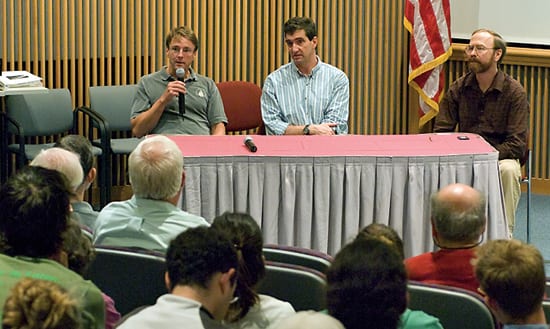
WHOI scientists (l to r) Hauke Kite-Powell, Scott Doney, and Ken Buesseler convened a two-day conference in Woods Hole to share knowledge and perspectives on ocean iron fertilization. (Photo by Tom Kleindinst, Woods Hole Oceanographic Institution)
The two scientists were speaking at a fall 2007 conference that brought together some 80 participants representing the scientific, commercial, regulatory, and economic sides of the debate. The conference was convened by WHOI marine geochemists Ken Buesseler and Scott Doney, and Hauke Kite-Powell of the WHOI Marine Policy Center. In talks and wide-ranging discussions, participants raised serious doubts about the practicality, efficacy, and safety of large-scale iron fertilization. Yet many also seemed to accept that more science—in the form of carefully designed and conducted experiments—was the best way to put those doubts to rest.
Not as simple as it sounds
Martin made his pronouncement jokingly because he knew that he was glossing over several hindrances to using iron fertilization to sequester carbon in the ocean. Opponents to the idea are quick to point out the three major ones: It may be less efficient than it at first seems; it raises a host of new, worrying consequences; and its effectiveness is difficult for anyone to measure.
In certain regions, including the equatorial and north Pacific and the entire Southern Ocean, a simple iron addition does cause phytoplankton to grow rapidly. But tiny zooplankton, known as “grazers,” eat much of the bloom almost as soon as it starts. This begins a chain of recycling that ensues from the sea surface to the seafloor as grazers, krill, fish, whales, and decomposers feed upon each other. Much of the immense carbon prize won by the iron addition quickly leaks back into the atmosphere as carbon dioxide gas.
What is critical for the effectiveness of iron fertilization schemes is the amount of organic carbon that actually sinks from the surface and is sequestered in the depths. Only a small percentage of carbon—in the form of dead cells and fecal pellets—falls to the seafloor and stays there, unused, for millennia. A higher percentage (between 20 and 50 percent) will at least reach middle-depth waters, where the carbon will remain in underwater currents for decades. Proponents consider this result good enough to buy society time to come up with other, more permanent solutions to greenhouse gas increases.

Phytoplankton blooms draw down carbon dioxide from the atmosphere. They are eaten by zookplankton, which produce pellets and aggregates of carbon-containing fecal matter (above), which sink into the depths, where carbon can be sequestered from the atmosphere. How much carbon would actually be sequestered via ocean iron fertilization is an open question.
Beyond the inefficiency of carbon sequestration, iron fertilization would likely cause other changes “downstream” of the ocean patches where iron was added. The huge green phytoplankton blooms would take up not just iron but other nutrients, too—nitrate, phosphate, and silica—essentially depleting nearby waters of the building blocks needed for plankton growth.
“You might make some of the ocean greener by iron enrichment, but you’re going to make a lot of the ocean bluer,” said Robert Anderson, senior scholar at Lamont-Doherty Earth Observatory.
Other participants at the WHOI conference—John Cullen, a biological oceanographer at Dalhousie University in Canada, Andrew Watson, a biogeochemist at the University of East Anglia, U.K., and Jorge Sarmiento, a modeler at Princeton’s Geophysical Fluid Dynamics Laboratory—pointed out several other ecological concerns. Large-scale iron fertilization, in altering the base of the food chain, might lead to undesirable changes in fish stocks and whale populations. Increased decomposition of sinking organic matter could deprive deep waters of oxygen or produce other greenhouse gases more potent than carbon dioxide, such as nitrous oxide and methane. The plankton-choked surface waters could block sunlight needed by deeper corals, or warm the surface layer and change circulation patterns.
On the other hand, more plankton might produce more of a chemical called dimethylsulfide, which can drift into the atmosphere and encourage cloud formation, thus cooling the atmosphere and helping to counteract greenhouse warming. And others argue that increased plankton supplies might enhance fish stocks.
Then there is the practical problem of verification. Iron fertilization companies would earn profits by measuring how much carbon they sequester and then selling the equivalent to companies (or people) that either wish to or are required to offset their emissions. Any plan to sell sequestered carbon requires a reliable accounting, and this promises to be difficult in the ocean.
So far, only three of 12 iron addition experiments have been able to show conclusively that any sequestration happened at all, according to Philip Boyd of the New Zealand National Institute of Water and Atmospheric Research. Perhaps more worrying to an investor, those sequestration numbers were low—about 1,000 tons of carbon per ton of iron added, as opposed to the 30,000 to 110,000 suggested by laboratory experiments.
Carefully designed research
Despite the suspected drawbacks to full-scale iron fertilization, private companies—and many scientists—support the idea of another round of experiments. Learning more about the ocean is in everyone’s interest, they argue, and the larger experiments now being proposed are still far too small to wreak environmental havoc.
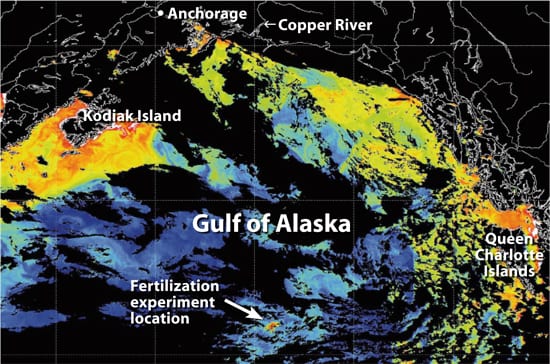
Iron fertilization experiments can set off blooms that are visible from space. In the bottom center of the satellite image above, note the red patch (indicating high levels of chlorophyll) from the Subarctic Ecosystem Response to Iron Enrichment Study in 2002. (Image provided by Jim Gower, Bill Crawford, and Frank Whitney, Institute of Ocean Sciences, Sidney BC.)
While the past experiments showed widely variable results, proponents read this as an opportunity for refinement through engineering. For millennia, humans have been repeating processes that at first were marginally useful and tuning them to our purposes. Continued research could address a number of key questions (see box below), and those answers could point the way to higher yields and efficiency.
Proponents of iron addition do acknowledge the possibility of environmental ill-effects. Still, no such effects have been detected during the past 12 experiments, probably because the experiments were small—around a ton of iron added over a few hundred square kilometers of ocean. By incrementally scaling up, they believe they can detect and avoid environmental problems.
As for the verification problem, both carbon markets and international ocean law are moving to accommodate so-called “carbon sink” projects, such as iron fertilization, which capture and sequester carbon from the air, according to Till Neeff of EcoSecurities, a leading trader of carbon credits, based in London. By the time the science is worked out, he said, the economics may be worked out as well.
Anchoring all of the arguments for continued research is the brutal fact of global carbon emissions. The most practical hope for dealing with emissions at the moment lies in a piecemeal strategy of “stabilization wedges.” Under this proposal, the world develops a portfolio of emissions reductions and carbon-capture projects, each of which offsets one piece of the global emissions pie. Combined, these wedges must begin to slow the growth of, and eventually lead to a net reduction in, our current global emissions of 7 to 8 billion tons of carbon per year. But with minimal progress so far on any wedges, and with China and India committing to major emissions increases as they develop, iron fertilization beckons as one tool in a toolbox of partial solutions.
“No option is without its impacts,” said WHOI biogeochemist Ken Buesseler, “whether we use wind turbines, grow biofuels or use energy-saving fluorescent bulbs, which contain mercury.”
But is it legal?
At present, iron fertilization falls into a gray area in both international law and formal carbon-trading markets, but this is changing.
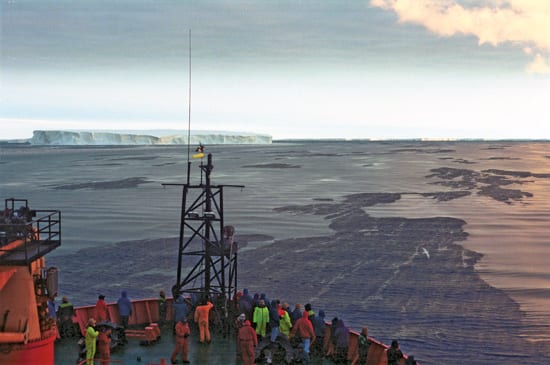
Scientists aboard the Australian research vessel Aurora Australis studied the natural cycling of iron in the Southern Ocean in 2001. Ken Buesseler, a marine chemist at Woods Hole Oceanographic Institution, was aboard that expedition, and in 2002 he served as chief scientist of the Southern Ocean Iron Experiment (SOFeX). The three-ship operation added iron to stimulate a phytoplankton bloom in the Southern Ocean and investigated the results. (Photo by Ken Buesseler, Woods Hole Oceanographic Institution)
Iron fertilization would happen on the open ocean, which is not owned by any country, according to David Freestone, senior adviser in the Legal Office of the World Bank, who briefed the symposium participants. While international treaties such as the London Convention, which governs ocean dumping and pollution, might address iron addition, treaty nations have not yet decided whether it might constitute pollution because its possible side effects remain unknown. Further, no overarching international agency exists to enforce the treaty, so responsibility falls to individual nations, he said. Ship crews intending to flout an international treaty could do so by electing to fly the flag of a country that has not signed it—a route that has already been publicly considered by one company.
Carbon trading markets are young but growing, Neeff said. Strictly regulated markets, set in motion by the Kyoto Protocol treaty, last year traded 430 million tons of carbon offsets (worth billions of dollars) among companies required to reduce total emissions. (One ton of carbon equals 3.67 tons of carbon dioxide.) Regulatory markets don’t allow for iron fertilization at present, but this may change as more carbon sink projects gain approval.
Then there are voluntary markets, Neeff said, where concerned individuals or companies buy carbon offsets to assuage their conscience or green their image. Traders would be free to sell offsets from iron fertilization in these markets. Voluntary markets are growing rapidly, Neeff said, but so far they are much smaller than regulatory markets, equivalent to 7 million tons of carbon, worth about $400 million, per year.
Voluntary markets represent one more worry for opponents of iron fertilization. Iron fertilization companies might make superficial estimates of the amount of carbon they sequester and enter a hefty balance in their trading ledgers. Any large profits made from under-regulated credits would encourage other outfits to go into business. The collective impacts to the world’s international waters could be both disastrous and impossible to trace to any single liable party, Cullen said.
But those are future scenarios. By the time iron fertilization moves from experiment to industry, laws may well be in place to regulate it, said Kite-Powell. Over the same period, increasing demand for carbon offsets is likely to ensure that iron fertilization is profitable, he said, referring to a recent economic analysis indicating a potential value of $100 billion over the next century.
Next steps: scientists and industry
Iron fertilization is being pulled in two directions, as comments during a panel discussion at the conference made clear.
Iron fertilization is not a silver bullet, said Margaret Leinen, the chief science officer at the firm Climos and former assistant director of geosciences at the National Science Foundation. But given the enormity of the greenhouse gas problem and the lack of progress so far, “let’s look at it in our portfolio for mitigation,” she said. “Uncertainty about the impacts shouldn’t preclude careful research.”
Lisa Speer of the Natural Resources Defense Council took a different view: “There is a limited amount of money, of time, that we have to deal with this problem,” she said. “The worst possible thing we could do for climate change technologies would be to invest in something that doesn’t work and that has big impacts that we don’t anticipate.”

Debating the pros and cons of ocean iron fertilization at a panel at the WHOI conference are (left to right): Elizabeth Kim of the U.S. Environmental Protection Agency; Lisa Speer of the National Resources Defense Council; and Margaret Leinen of Climos Inc. (Photo by Tom Kleindinst, Woods Hole Oceanographic Institution)
Between these viewpoints a middle ground emerged: “There are plenty of ways to do it wrong, but done right, [iron fertilization] does actually sequester carbon for hundreds of years in the place that it would ultimately end up anyway,” Watson said. That may be a tremendous advantage compared with more familiar but less secure approaches like planting trees, he said. Skeptics should not dismiss the idea out of hand before scientists have had the chance to work out the details.
One way to quell doubts lies with carefully conducting larger experiments. But iron fertilization is unlikely to receive much more federal funding. It falls to entrepreneurs concerned about the climate problem to fund the work, and they need scientists’ participation to make sure the right questions are asked and answered.
In a parallel with the way universities routinely conduct trials of the safety and efficacy of potential pharmaceuticals, Michaels pointed out that oceanographers may need to learn how to be involved with tests of iron fertilization. “We have to evolve a set of skills within our community to have those kinds of roles,” he said. “Who else should be figuring that out but us?”
Though many scientists are keen on the idea of future research, fewer are willing to team up with a private company to do it, for fear of a real or perceived effect on the impartiality of their research. Still, researchers may need to convince themselves that just because the idea is potentially profitable doesn’t mean it’s wrong—or simply accept that further research is going to happen.
“Commercial efforts are moving forward with or without scientific input,” Buesseler said. “We need to be able to evaluate their impacts and changes to the ocean carbon cycle, based upon the best possible oceanographic methods.”
For their part, private companies hope to collaborate with researchers. Of the handful already in business, one—Climos—recently proposed a code of ethics supporting involvement by scientists and full environmental audits of experiment plans. Russ George, president of rival company Planktos, who also attended the conference, agreed in principle to the code. On Nov. 5, Planktos announced that it had dispatched a ship equipped for an iron fertilization experiment but made no statements about how it might comply with the code.
What’s emerging for the next few years is the prospect of a round of experiments involving around 100 tons of iron, which is 100 times larger than previously tried. Financed by private companies, they could either be conducted by private interests with limited sampling gear or by teams of scientists through grants. New, autonomous technology promises to extend the duration of monitoring and improve measurements of how carbon sinks through the ocean.
Yields from previous experiments cannot be used to project whether larger-scale fertilizations would send millions, thousands, or even fewer tons of carbon into the ocean’s middle depths, Buesseler said. Still, commercial groups sponsoring new experiments hope to sell those carbon dioxide equivalents as voluntary offsets. While scientific research would focus on learning more about how the ocean works, the companies involved would be looking for ways to increase efficiency, make larger blooms in the future, and monitor any negative effects. As government-sponsored research on iron fertilization moves ahead in different countries, funding for larger experiments could develop into private and public partnerships.
Experiments on such a scale drive home one final point: that the near future of iron fertilization is modest on all counts—size of experiments, likely profits, environmental side-effects, and amount of carbon sequestration. However profitable iron fertilization becomes, the dent it puts in atmospheric carbon levels in coming years will remain a small one. As these ocean scientists work to assemble their stabilization wedge to mitigate carbon dioxide emissions, they remind the rest of the world that many more wedges must be found.
The Ocean Iron Fertilization Symposium: Some 80 natural and social scientists from several countries—along with environmental advocates, business representatives, policymakers, legal experts, economists, and journalists—gathered at Woods Hole Oceanographic Institution (WHOI) on Sept. 26-27, 2007, to discuss the pros and cons of ocean iron fertilization as a means to mediate global warming. This series of Oceanus articles summarize the wide range of issues raised at the conference, convened by WHOI scientists Ken Buesseler, Scott Doney, and Hauke Kite-Powell. They reviewed and edited these articles, with input from many conference participants. All the articles in this series are published in a print edition of Oceanus (Vol. 46, No. 1). Videos and PDF versions of presentations at the conference are available at http://www.whoi.edu/conference/OceanIronFertilization. The symposium was sponsored by the Elisabeth and Henry Morss Jr. Colloquia Fund, the Cooperative Institute for Climate Research at WHOI, the WHOI Marine Policy Center, the WHOI Ocean and Climate Change Institute, the WHOI Ocean Life Institute, and Woods Hole Sea Grant.