Interrogating the ‘Great Ocean Conveyor’
Is the Atlantic's circulation slowing down? Moorings in rough waters monitor the ocean's pulse.
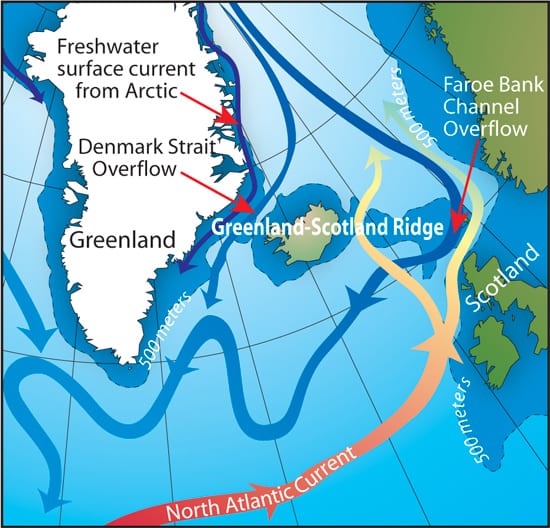
The Greenland-Scotland Ridge looms like a great undersea barrier, stretching from East Greenland to Iceland and the Faroe Islands, and across to Scotland. There are a few gaps in the ridge, and they act as critical checkpoints that regulate water flowing between the Norwegian and Greenland Seas north of the ridge and the main body of the North Atlantic Ocean to the south.
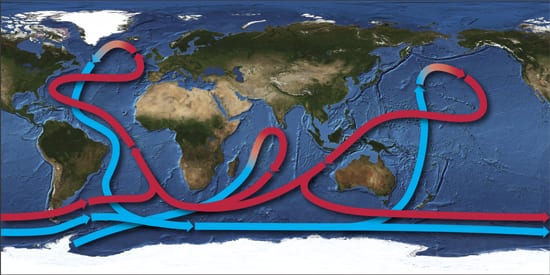
The properties of waters in these Nordic seas and the two-way flow across the ridge are critical components that help drive what is often called the Great Ocean Conveyor—the global system of ocean circulation that transports heat and salt around the planet. But only in recent years have oceanographers deployed instruments in these remote, violent, ice-infested subpolar waters to obtain long-term measurements.
These measurements aim to help answer several questions: Does ocean circulation, especially in the North Atlantic, play a central role in climate? Is greenhouse warming causing changes in the Arctic Ocean and the subpolar Nordic Seas that are moving downstream into the North Atlantic? Is the North Atlantic component of the Conveyor actually slowing down?
The ocean-climate connection
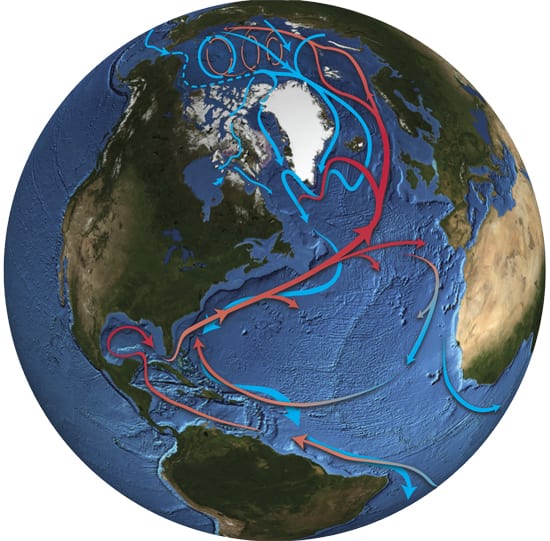
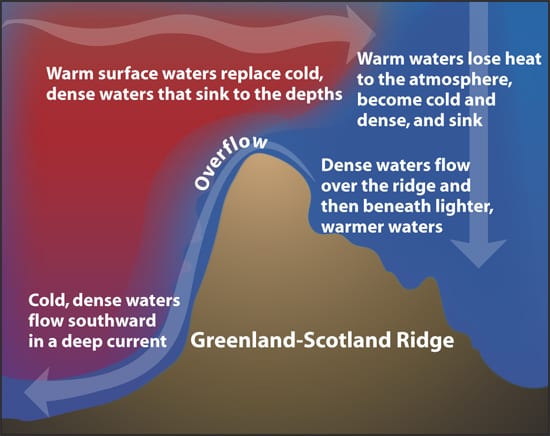
The debate on the first question is not contentious. Most scientists agree that waters in the North Atlantic become cold (and therefore dense) enough to sink to the abyss and flow out of the ocean basin via a deep southward current. The dense waters are replaced by salty, tropical, surface waters that flow north, where they release heat to the atmosphere and temper the climate of the North Atlantic region. This conveyor-like movement of water is called the Atlantic Meridional Overturning Circulation.
The amounts of water, heat, and salt that pass north across the Greenland-Scotland Ridge from the Atlantic have now been directly measured by a consortium of European and North American oceanographers working under the Arctic/Subarctic Ocean Fluxes Programme. So have corresponding fluxes into the Arctic Ocean by researchers from the Institute of Marine Science and the University of Bergen in Norway and the Alfred Wegener Institute for Polar and Marine Research in Germany.
We now know that 8.5 million cubic meters (225 million U.S. gallons) of warm, salty Atlantic water passes north across the Greenland-Scotland Ridge per second, carrying with it an average of about 313 million megawatts of power and 303 million kilograms (668 million pounds) of salt. As dense water returns south and flows over the ridge, its salinity has decreased from about 35.25 to 34.88 salinity units, and its temperature has dropped from 8.5°C (47°F) to 2°C (35.6°F) or less. Not surprisingly, the ocean’s surrendering of that amount of heat to the atmosphere has more than local climatic importance.
In a “what-if” experiment, scientists at the Hadley Centre for Climate Prediction and Research at the U.K. Meteorological Office instructed a computer model that simulates the general circulation of the atmosphere and ocean to shut down the Atlantic Meriodional Overturning Circulation. The results showed that within a decade, mean air temperatures over most of the Northern Hemisphere cooled by several degrees; over the northern Norwegian and Barents Seas, it cooled by more than 15°C (27°F).
The Hadley research group “shut down” the overturning circulation by artificially releasing a large pulse of fresh water into the North Atlantic in their model. No model predicts this will actually happen, but the addition of more buoyant fresh water to sensitive locales in the North Atlantic Ocean could decrease the density of surface water enough to curtail sinking. That could slow down the overturning circulation and convey less tropical water and heat northward.
A wide range of opinion
The obvious follow-up question is much harder to answer: Is the Atlantic Meridional Overturning Circulation actually slowing? Most computer simulations of the ocean system in a climate with increasing greenhouse-gas concentrations predict that the Atlantic overturning circulation will weaken as the subpolar seas become fresher and warmer. But opinions are divided on whether a slowdown is already under way and on whether any changes we are seeing are natural or caused by human activities such as fossil-fuel burning.
Modelers at the Geophysical Fluid Dynamics Laboratory at Princeton, for example, suggested that aerosols from human activity have blocked solar radiation and actually may have delayed a greenhouse-gas-induced weakening of the overturning circulation. Modelers at Kiel University in Germany suggested that the circulation will not weaken substantially over the next several decades. Hadley Centre modelers reported in 2004 that although waters in the deep North Atlantic became less salty in recent decades, the overturning circulation has increased (because an increasing north-to-south difference in density of waters in the upper North Atlantic).
In 2005, Harry Bryden and colleagues at the National Oceanography Centre, Southampton, in the United Kingdom, reported that the Atlantic Meridional Overturning Circulation had already slowed by 30 percent since 1957 (particularly strongly since the early 1990s), after they analysed data from five periodic survey cruises along latitude 25°N, roughly from the Bahamas to the Canary Islands. Part of this long-term decline, they said, resulted from a reduced southward flow of deep waters originating from the overflow of the Greenland-Scotland Ridge.
Modeling the same transect across the Atlantic, however, Carl Wunsch and Patrick Heimbach of the Massachusetts Institute of Technology inferred in 2006 that the circulation of deep water had become stronger. They concluded that the 25°N line, no matter how closely observed, is not immune to uncertainties.
Following up on their earlier research, the Southampton researchers used current meters to measure continuously for one year along approximately the same line. In August 2007, they reported that the Meridional Overturning Circulation varied widely within one year—so much so that the previously reported 30-percent decrease over almost 50 years is unlikely to have been significant by comparison.
Complex changes over time and space
None of these opinions—and there are others!—is controversial in the sense that they are all based on established and accepted techniques. The controversy exists is in the interpretation of what has been found.
The problem is that our oceanographic measurements are simply too short or patchy to grasp unambiguously the complex changes that the Atlantic is exhibiting over space, time, and depth. We are still developing ideas about the causes and mechanisms of ocean circulation changes, so these are too crudely represented in the models. Our observations cannot yet supply many of the numbers the modelers need to reduce the high levels of uncertainty in the present generation of climate models.
The fact remains, however, that understand it or not, our climate is changing. In their careful reassessment of the climatic record, Timothy Osborne and Keith Briffa of the University of East Anglia in England concluded in 2006 that “the most significant and longest duration feature during the last 1,200 years is the geographical extent of warmth in the middle to late 20th century.”
Data from many researchers, collated and published in 2006 by the International Council for the Exploration of the Seas, show clearly enough that the Atlantic waters crossing over the Greenland-Scotland Ridge to the Nordic Seas and Arctic Ocean are generally at their warmest and saltiest since records began. Reflecting this trend, Jonathan Overpeck of the University of Arizona and a broad team of colleagues reported in 2005 that the Arctic system remains on trajectory to a new seasonally ice-free state—“a state not witnessed for at least a million years,” they wrote.
A valiant but disastrous effort
To improve understanding of the air-sea-ice system of subarctic seas, we have focussed on measuring perhaps two of the most climatically important oceanic flows on Earth—off southeast Greenland. Recognising the significance of the region, Val Worthington, a well-known physical oceanographer at Woods Hole Oceanographic Institution (WHOI), deployed 30 current meters in February and March of 1967 across the violent flow through the Denmark Strait between Greenland and Iceland. There, the density contrast of waters north and south of the Greenland-Scotland Ridge drive cold dense water formed in the western Nordic Seas southward over the ridge. This so-called Denmark Strait Overflow cascades downward to fill the depths of the Irminger and Labrador Seas and drive the lower limb of the Atlantic overturning circulation.
Worthington later wrote of his pioneering effort: “It was a disaster. …When you put out 30 current meters and get one usable record, you can’t crow too much.” But four decades after his heroic but unsuccessful attempt, the Centre for Environment, Fisheries & Aquaculture Science, with partners at University of Hamburg and the Finnish Institute of Marine Research, have proven and fully developed an array of instrumented moorings offshore of the town of Angmagssalik, on the continental slope of East Greenland, to measure the characteristics and variability of the cold, dense Denmark Strait Overflow.
Initial findings
A decade of continuous observations from the Angmagssalik array now reveals that cold, denser water flows over the ridge in the Denmark Strait at a rate of about 4 Sverdrups (a Sverdrup is 1 million cubic meters or 264,000 U.S. gallons per second). That is close to the 3.8 Sverdrups predicted in 1998 by WHOI physical oceanographer Jack Whitehead on the basis of calculations of the hydraulic forces of fluids forced through oceanic passages.
However, our longer observational record has moved us on a little from thinking of the Denmark Strait Overflow as an unchanging flow solely governed by hydraulics to one that alternately strengthens and weakens over time. A combination of forces probably drives the overflow; among these are the amount of dense water in the reservoir north of the ridge; changes in local and regional winds; and effects of the large gyre-scale ocean circulation that feeds water into and around the region.
The array has not shown any long-term trend so far. Nor has it turned up evidence of interrelationships, as has been supposed, between the transport of water in the Denmark Strait and in Faroe Bank Channel, a gap in the ridge east of Iceland. But it may simply be that we haven’t been measuring in these places long enough to distinguish changes that occur over decades.
In 2002, we and colleagues reported in the journal Nature that Denmark Strait Overflow waters had become fresher remarkably rapidly and steadily over the previous four decades. In 2005, Ruth Curry of WHOI and Cecilie Mauritzen of the Norwegian Meteorological Institute made the next logical step. Using Whitehead’s hydraulic equation, they calculated how much more fresh water would have to be added to the western parts of the Nordic seas to produce a significant slowdown of the overturning circulation.
Not anytime soon, they found: “At the observed rate, it would take about a century to accumulate enough fresh water … to substantially affect the ocean exchanges across the Greenland-Scotland Ridge, and nearly two centuries of continuous dilution to stop them,” they wrote. “In this context, abrupt changes in ocean circulation do not appear imminent.” Reinforcing this conclusion is the fact that the freshening trend for both Greenland-Scotland Ridge overflows, which we had been observing over four decades, has slowed to a stop during the last 10 years.
In iceberg-infested waters
Over the last several years, we and our partners at the University of Hamburg have also deployed an array of moorings across the continental shelf, nearer the coast of southeast Greenland. These are aimed at measuring a flow of fresh surface waters that passes south from the Arctic Ocean to the North Atlantic under the East Greenland ice shelf. We believe that via this route, the North Atlantic receives its largest dose of fresh water from the Arctic, and ocean-climate models have implicated this fresh water in slowing down the overturning circulation.
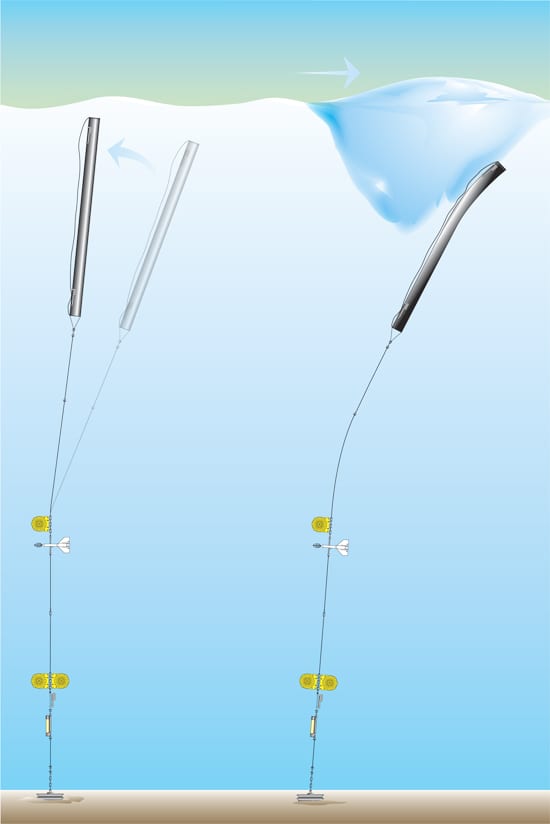
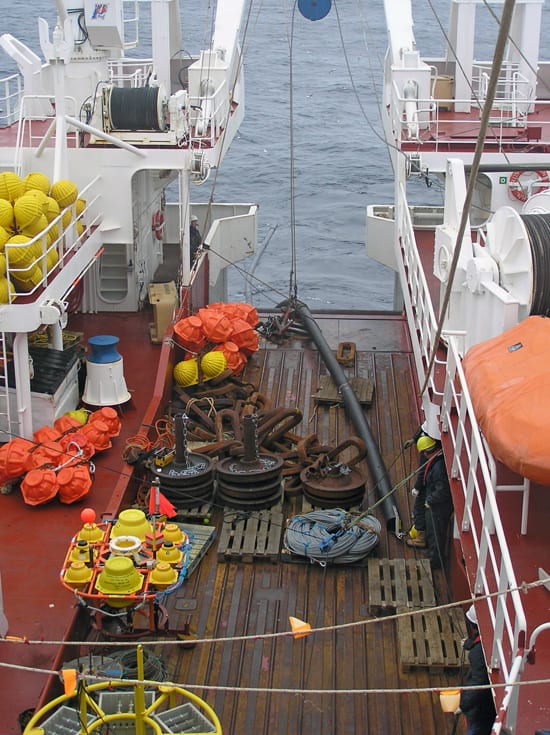
This freshwater flux array is at a much less advanced state of development than the Angmagssalik array, but we are improving it with the help funding from the WHOI Ocean and Climate Change Institute. Moorings that consist of protective, buoyant “tubes,” 40 meters (130 feet) long, bring salinity-measuring sensors up to the base of the sea ice, in the region where the less dense fresh water flows. The tubes protect against strikes by drifting ice on the principle of those inflatable dolls with weighted bottoms. In the U.K., we have been known to christen them “Margaret Thatcher dolls,” after our former prime minister, because when knocked down, they bounce back up.
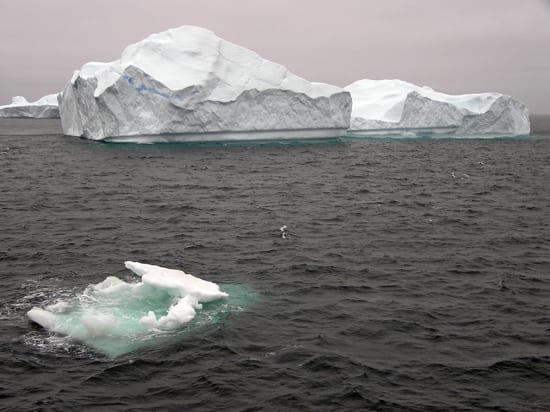
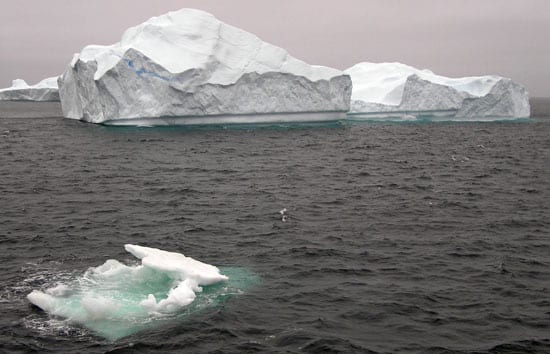
The tube moorings have brought real advances, notably the recovery of up to four years of continuous salinity measurements in the upper waters of near the coast of East Greenland. However, since 2000, the nearby Kangerdlugssuak Glacier has been calving icebergs at an accelerated rate, creating a major new and perhaps unsurvivable hazard for our moorings. When we attempted in August 2005 to recover the rudimentary mooring we deployed the year before, it was gone. But we did see many grounded icebergs in the vicinity, which may well have swept our mooring away.
In the summer and autumn of 2006, further losses and some instrumental failures combined with unsuitable conditions forced us to curtail our operations for the year. We deployed one tube mooring and an acoustic profiling current meter.
The climatic importance of measuring the water flow in this region argues against withdrawing the array at our first reverse. But this will never be a safe site, and only time will tell if our plans to re-extend the array across this dangerous shelf are justified or foolhardy.
Val Worthington would have known the feeling!
The mooring array work is supported by the Ocean and Climate Change Institute at WHOI and other organisations in Europe and the U.S. They include the national programmes of Germany, Finland, and the U.K. (Department for Environment, Food and Rural Affairs); European Union Framework Programmes, inclduing VEINS (Variability of Exchanges in the Northern Seas), ASOF (Arctic/Subarctic Ocean Fluxes-ASOF), and DAMOCLES (Developing Arctic Modeling and Observing Capabilities for Long-term Environmental Studies); and the U.S. National Oceanic and Atmospheric Administration’s Abrupt Climate Change Program (CORC-ARCHES).
References
Bryden
H.L., H.R. Longworth, and S.A. Cunningham. Slowing of the Atlantic
Meridional Overturning Circulation at 25°N. Nature, 438, 655-657
(2005).
Cunningham S.A., Kanzow T., Rayner D., Baringer M.O., Johns W.E.,
Marotzke J., Longworth H.R. Grant E.M., Hirschi J.J.-M., Beal L.M.,
Meinen C.S., Bryden H.L. Temporal variability of the Atlantic
Meridional Overturning Circulation at 26°N, Science, 317, 935-938, http://dx.doi.org/10.1126/science.1141304, (2007).
Curry R. and C. Mauritzen. Dilution of the Northern North Atlantic
Ocean in Recent Decades. Science, 308 (5729): 1772-1774 (2005).
Delworth T.L. and K.W. Dixon. Implications of the Recent Trend in the
Arctic/North Atlantic Oscillation for the North Atlantic Thermohaline
Circulation. Journal of Climatology, 13, 3721-3727 (2000).
Delworth T.L. and K.W. Dixon. Have Anthropogenic Aerosols Delayed a
Greenhouse Gas-induced Weakening of the North Atlantic Thermohaline Circulation? Geophysical Research Letters 33, LO2606,
http://dx.doi.org/10.1029/2005GL024980, (2006).
Dickson, R. R., I. Yashayaev, J. Meincke, W. Turrell, S. Dye, and J.
Holfort. Rapid Freshening of the Deep North Atlantic over the Past Four
Decades. Nature lond, 416, 832-837 (2002).
Dickson R., B. Rudels, S. Dye, M. Karcher, J. Meincke, and I.Yashayaev.
Current Estimates of Freshwater Flux through Arctic and Subarctic Seas.
Progress in Oceanography, 73, 210-230, http://dx.doi.org/10.1016/j.pocean.2006.12.003, (2007).
Girton J.B., T.B. Sanford, and R.H. Käse. Synoptic Sections of the
Denmark Strait Overflow. Geophysical Research Letters, 28, 1619-1622
(2001).
ICES Report on Ocean Climate 2005 (editors. S. L. Hughes & N. P.
Holliday). ICES Cooperative Research Report, No. 280. 47 pp. (2006).
Ingvaldsen, R.B., L. Asplin, and H. Loeng. Velocity Field of the
Western Entrance to the Barents Sea. Journal of Geophysical Research,
109, C03021, https://agupubs.onlinelibrary.wiley.com/doi/pdf/10.1029/2003JC001811, (2004a).
Ingvaldsen, R.B., Asplin, L., and Loeng, H. The Seasonal Cycle in the
Atlantic Transport to the Barents Sea during the Years 1997-2001.
Continental Shelf Research, 24, 1015-1032 (2004b).
Käse R. and A. Oschlies. Flow through Denmark Strait. Journal of Geophysical Research. 10, 28527-28546 (2000).
Köhl A., R. Käse, D. Stammer, and N. Serra.Causes of Changes in the
Denmark Strait Overflow. Journal of Physical Oceanography, 37,
1678-1696 (2007).
Latif M., C. Boening, J. Willebrand, A. Bistoch, J. Dengg, N.
Keenlyside, U. Schweckendiek, and G. Madec. Is the Thermohaline
Circulation Changing? Journal of Climate, 19, 4631-4637, http://dx.doi.org/10.1175/JCLI3876.1, (2007).
Large W.G. and A.J.G. Nurser. Ocean Surface Water Mass Transformations,
pp 317-335 In: G. Siedler, J. Church and J. Gould (Eds). Ocean Circulation
and Climate, Academic Press International Geophysics Series, 77, 715
pp. (2001).
Macrander A., U. Send, H. Valdimarsson, S. Jonsson, and R.H. Käse.
Interannual Changes in the Overflow from the Nordic Seas into the North
Atlantic through Denmark Strait. Geophysical Research Letters, 32,
L06606, https://agupubs.onlinelibrary.wiley.com/doi/full/10.1029/2004GL021463, (2005).
Manabe S. and R.J. Stouffer. Simulation of Abrupt Climate Change
Induced by Freshwater Input to the North Atlantic Ocean. Nature, 378,
165-167 (1995).
Osborn T.J. and K.R. Briffa.The Spatial Extent of 20th-Century Warmth
in the Context of the Past 1200 Years (2006). Science, 311, 841-844 http://dx.doi.org/10.1126/science.1120514, (2006).
?sterhus S., W.R. Turrell, S. Jonsson, and B. Hansen. Measured Volume,
Heat and Salt Fluxes from the Atlantic to the Arctic Mediterranean.
Geophysical Research Letters, 32, L07603, http://dx.doi.org/10.1029/2004GL022188,
(2005).
Overpeck J. and co-authors. Arctic System on Trajectory to New Seasonally Ice-free State. EOS, 86, 34, pp. 309, 312, 313 (2005).
Polyakov I. and co-authors. One More Step toward a Warmer Arctic.
Geophysical Research Letters, 32, L17605, http://dx.doi.org/10.1029/2005GL023740,
(2005).
Rahmstorf S. and A. Ganopolski. Long-term Global Warming Scenarios,
Computed with an Efficient Climate Model. Climate Change, 43, 353-367
(1999).
Rahmstorf S. Thermohaline Circulation: the Current Climate. Nature 421, 699 (2003).
Rignot E. and P. Kanagaratnam. Changes in the Velocity Structure of the Greenland Ice Sheet. Science, 311, 986-990 (2006).
Rhines P. and S. Hakkinen. Is the Oceanic Heat Transport in North
Atlantic Irrelevant to the Climate in Europe. ASOF Newsletter #2 13-17
(2003).
Schauer U., E. Fahrbach , S. ?sterhus, and G .Rohardt. Arctic Warming
through the Fram Strait: Oceanic Heat Transports from Three Years of
Measurements. Journal of Geophysical Research, 109, C06026,
http://dx.doi.org/10.1029/2003JC001823, (2004).
Vellinga M. and R.A. Wood. Global Climate Impacts of a Collapse of the
Atlantic Thermohaline Circulation. Climatic Change, 54, 251-267 (2002).
Vellinga M. Robustness of Climate Response in HadCM3 to Various
Perturbations of the Atlantic Meridional Overturning Circulation.
Hadley Centre Tech Note 48, unpaginated (2004).
Whitehead J.A. Topographic Control of Oceanic Flows in Deep Passages and Straits. Review of Geophysics, 36, 423-440 (1998).
Wood R.A., M. Vellinga, and R. Thorpe. Global Warming and Thermohaline
Circulation Stability. Philosophical Transactions of the Royal Society
of London. (A), 361, pp. 1961-1975 (2003).
Wood, R.A., M. Collins, J. Gregory, G. Harris, and M. Vellinga. Towards
a Risk Assessment for Shutdown of the Atlantic Thermohaline
Circulation. In Avoiding Dangerous Climate Change, ed. H.J.
Schellnhuber et al., Cambridge University Press, 392 pp. (2006).
Wu P., R.A. Wood, and P. Stott. Does the Recent Freshening Trend in the
North Atlantic Indicate a Weakening Thermohaline Circulation?
Geophysical Research Letters, 31, Lo2301, http://dx.doi.org/10.1029/2003GL018584,
(2004).
Wunsch C. and P. Heimbach. Estimated Decadal Changes in the North
Atlantic Meridional Overturning Circulation and Heat Flux 1993-2004.
Journal of Physical Oceanography, 36, 2112-2024, http://dx.doi.org/10.1175/JPO2957.1,
(2006).
Slideshow