
New study finds rate of U.S. coastal sea level rise doubled in the past century
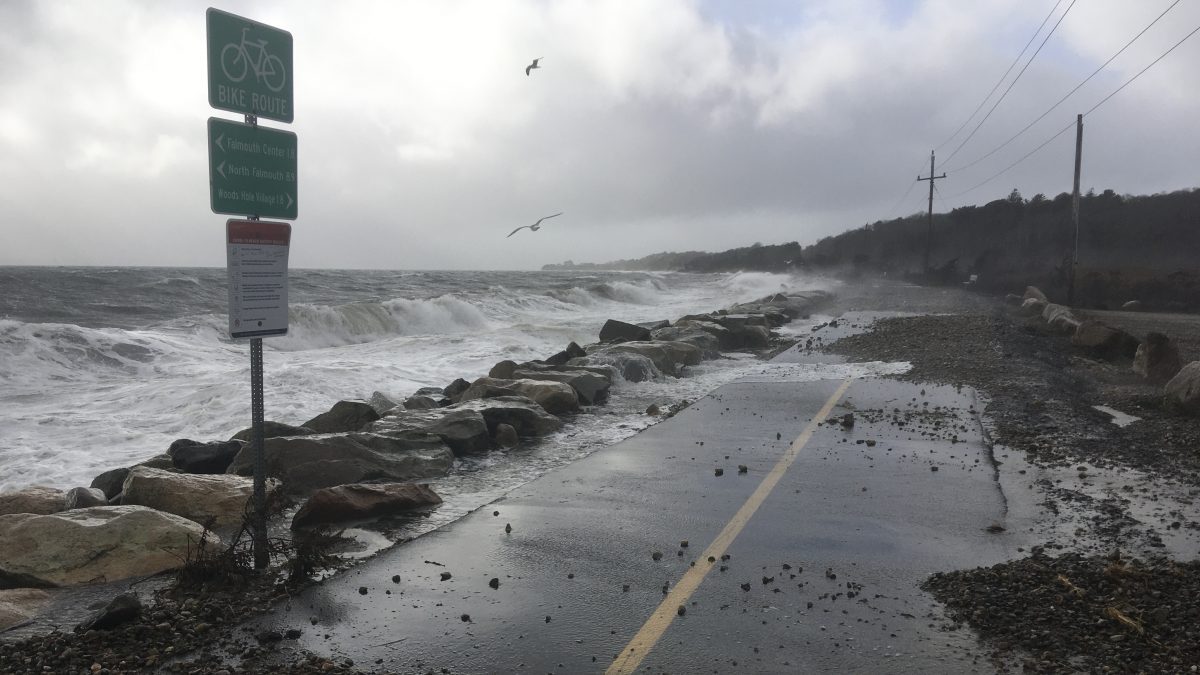 Impacts from flooding that occurred in Falmouth, Massachusetts on December 23, 2022. (Photo by Chris Piecuch)
 December 17, 2025
Woods Hole, Mass. (December 17, 2025) -- A July 2025 report from the U.S. Department of Energy (DOE) claims that U.S. tide gauge measurements “in aggregate show no obvious acceleration in sea level rise beyond the historical average rate.”
However, a new study by Chris Piecuch, a physical oceanographer with the Woods Hole Oceanographic Institution (WHOI), reaches a dramatically different conclusion.
The study finds that the rate of U.S. coastal sea-level rise has more than doubled in the past 125 years, from a rate of less than 2 millimeters per year in 1900 to more than 4 millimeters per year in 2024, and that present rates are well above the historical average. This translates to a rise in U.S. coastal sea level of about 40 centimeters, or nearly 16 inches, over that time.
“This represents conclusive evidence that coastal sea level in the U.S. is accelerating, likely due to climate change,” according to the study, “The Rate of U.S. Coastal Sea-Level Rise Doubled in the Past Century,” published in the journal AGU Advances. Piecuch said the acceleration of U.S. coastal sea level is consistent with what is happening on a global scale related to ongoing ocean warming and expansion and to continuing loss of ice from glaciers and ice sheets.
The authors of the DOE report base their conclusion on analysis of data from five tide gauge records “that may be heavily impacted by local effects and not representative of true large scale aggregate RSL [relative sea level] behavior,” according to Piecuch’s study, which adds that the DOE report’s conclusions “should be treated with caution,” due to the small number of locations considered.
In contrast to the DOE report, the Piecuch study uses data from 70 tide gauges distributed along the contiguous U.S. coast. The data set comprises all active U.S. tide-gauge stations with more than 30 years of data.
Piecuch’s results “directly contradict” the claims made in the DOE report that are based on a cursory discussion of tide gauge time series from just a handful of locations, the study states. “U.S. tide-gauge records taken collectively do show an obvious RSL acceleration above the long-term historical average trend.”
“The DOE report paints an incomplete picture of the rates of sea level change by picking just a handful of locations that are subject to local effects and that are not representative of the large-scale aggregate relative sea level behavior,” said Piecuch.
The locations in the DOE report – including Grand Isle, Louisiana, and Galveston, Texas – are known to feature vertical land motion from human activity and geological processes unrelated to anthropogenic climate change, the Piecuch study indicates. For example, Grand Isle exemplifies several local and regional processes that can cause sea level change along the Gulf coast, such as long-term compaction and sediment transport related to the dynamics of the Mississippi River as well as oil and gas extraction, Piecuch said. “These local and regional processes are thought to have caused significant land loss and subsidence, or sinking of coastal land, particularly during the 1960s and 1970s.”
Piecuch’s study acknowledges that spatially variable vertical land motion is an important control on relative sea level changes. However, the study adds that it is unlikely that land motion explains the acceleration in sea level rise.
The DOE study’s conclusion “rests largely on cursory analysis of a small number of tide-gauge records that are known to be unrepresentative of large-scale RSL behavior,” the Piecuch study states.
“You can’t argue that U.S. sea level rates are not increasing by looking at just five cherry-picked sites,” Piecuch said. “When you consider all the available observations, the data point in the opposite direction—that U.S. coastal sea level is clearly on an accelerating course.”
No federal funding supported the author’s work associated with writing this paper.
Author: Christopher G. Piecuch1
Affiliation:
1Department of Physical Oceanography, Woods Hole Oceanographic Institution, Woods Hole, MA, USA
###
About Woods Hole Oceanographic Institution
Woods Hole Oceanographic Institution (WHOI) is a private, non-profit organization on Cape Cod, Massachusetts, dedicated to marine research, engineering, and higher education. Founded in 1930, its mission is to understand the ocean, its interactions with the Earth, and its role in a changing global environment. WHOI’s pioneering discoveries arise from a unique blend of science and engineering that has made it one of the world’s most trusted leaders in ocean research and exploration. Known for its multidisciplinary approach, advanced ship operations, and unmatched deep-sea robotics, WHOI also operates the most extensive suite of ocean data-gathering platforms worldwide. More than 800 concurrent projects—driven by top scientists, engineers, and students—push the boundaries of knowledge to inform people and policy for a healthier planet. Behind the scenes, ship captains, mates, craftsmen, marine operations, and other skilled professionals provide essential support that makes this work possible. Learn more at whoi.edu.
Key Takeaways
- A new study by Chris Piecuch, a physical oceanographer with the Woods Hole Oceanographic Institution, finds that the rate of U.S. coastal sea-level rise has more than doubled in the past 125 years, from about 1.7 millimeters per year in 1900 to about 4.3 millimeters per year in 2024, and that present rates are well above the historical average.
- The findings represent conclusive evidence that coastal sea level in the U.S. is accelerating, likely due to climate change.
- The study reaches a dramatically different conclusion from a July 2025 report from the U.S. Department of Energy, which claims that U.S. tide gauge measurements “in aggregate show no obvious acceleration in sea level rise beyond the historical average rate.”
- The authors of the DOE report base their conclusion on just five tide gauge records that may be heavily impacted by local effects and not representative of true large-scale aggregate relative sea level behavior. In contrast, the Piecuch study uses data from 70 tide gauges distributed along the contiguous U.S. coast.
- “The DOE report paints an incomplete picture of the rates of sea level change by picking just a handful of locations that are subject to local effects and that are not representative of the large-scale aggregate relative sea level behavior. You can’t argue that U.S. sea level rates are not increasing by looking at just five cherry-picked locations,” Piecuch said.