
New study highlights private-public partnership advancing coastal resilience in Woods Hole
 (Photos by ©Woods Hole Oceanographic Institution)
 April 22, 2026
ResilientWoodsHole outlines a guide for small coastal communities to advance climate resilience
Woods Hole, Mass. (April 22, 2026) – A new paper published in Frontiers in Marine Science presents lessons learned and practical strategies for how small coastal communities can respond to increasing risks from sea-level rise and coastal flooding through coordinated actions, as outlined by the ResilientWoodsHole (RWH) initiative.
Coastal communities worldwide are facing accelerating impacts from rising seas and intensifying storms, yet many lack the resources, technical capacity, and frameworks needed to respond effectively. The new study provides a roadmap on how RWH, a partnership of 13 organizations including the scientific institutions Woods Hole Oceanographic Institution (WHOI), the Marine Biological Laboratory (MBL), and the NOAA Northeast Fisheries Science Center (NEFSC), local government, businesses, and residents, developed a phased approach to move from identifying risk to implementing actionable solutions.
“The hamlet of Woods Hole is an extraordinarily unique, world-class center of excellence for marine science,” said Rob Munier, Vice President of Marine Operations at WHOI, a participating member of the RWH leadership team, and an author on the publication. “It is also vulnerable to sea level rise. It is only fitting that WHOI, MBL, and NEFSC have pooled their considerable expertise to understand the risks and to develop actionable solutions that will benefit the whole community.”
RWH brings together scientific modeling, regulatory analysis, adaptive planning, pilot projects, and sustained community engagement. Using tools such as the Massachusetts Coast Flood Risk Model (MC-FRM), the team identified key flood pathways and vulnerabilities across Woods Hole, where projections show that as soon as 2070, a one-percent annual chance storm could impact approximately 30% of buildings and critical infrastructure.
Beyond technical assessments, the study emphasizes the importance of aligning policy and community priorities with resilience goals. Researchers found that existing regulatory frameworks designed to protect environmental and historic resources can create barriers to timely adaptation if not updated to reflect climate resilience.
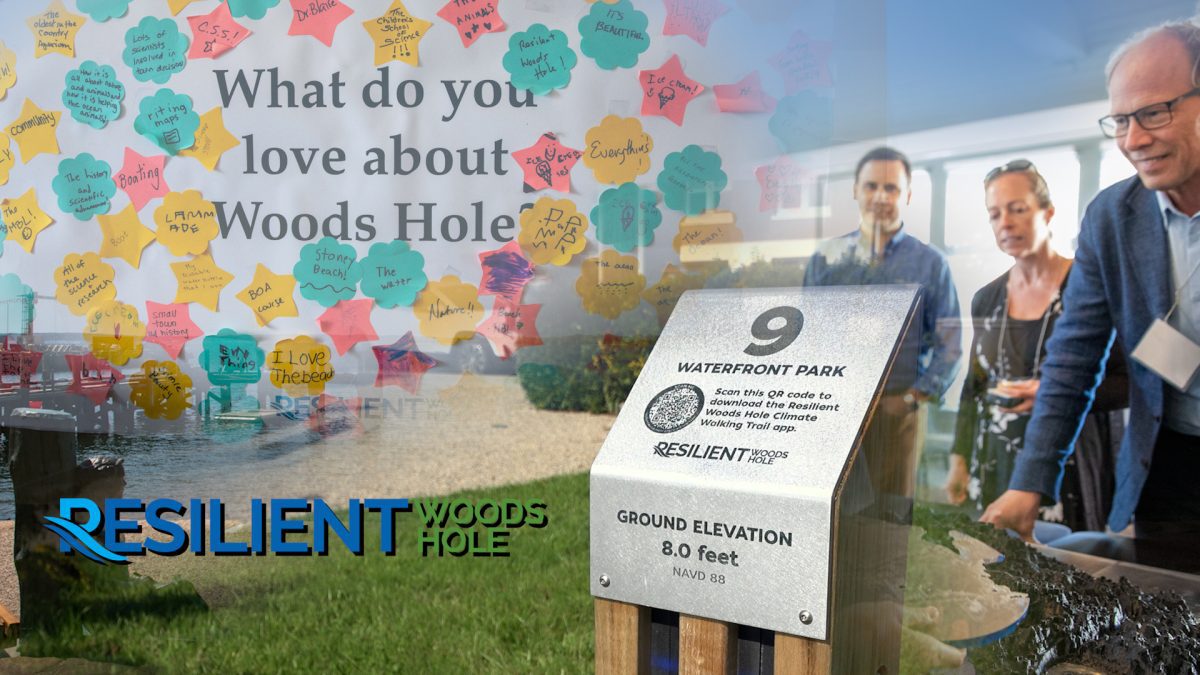
The paper also highlights the role of community engagement in shaping effective resilience strategies. Through neighborhood working groups, public workshops, and tools such as the RWH Climate Walking Trail and an interactive 3D model, RWH has helped translate complex scientific data into an accessible, shared understanding, enabling residents and stakeholders to prioritize actions collaboratively.
“Early on, we recognized the importance of engaging the community through events, workshops, and participation on RWH’s Steering Committee,” said Paul Speer, retired Chief Operating Officer, MBL, a participating member of the RWH leadership team, and an author on the publication, “For example, we conducted a study to evaluate whether MBL’s Stoney Beach, an important community resource, could be made more resilient to flooding through dune restoration. As the project progressed, we kept the community informed through meetings and shared results widely through presentations and the RWH website.”
While Woods Hole benefits from the local presence of major scientific institutions, the study shares transferable strategies that can be applied in other communities, including the use of publicly available flood models, incremental pilot projects, and participatory planning approaches.
About the authors
The paper was authored by collaborators from the Woods Hole Oceanographic Institution, the Marine Biological Laboratory, the NOAA Northeast Fisheries Science Center, and technical consultants Woods Hole Group.
Funding for this project was provided through institutional support (WHOI, MBL, and NOAA NEFSC) and grants from the Massachusetts Office of Coastal Zone Management Coastal Resilience Program.
###
About Woods Hole Oceanographic Institution
Woods Hole Oceanographic Institution (WHOI) is a private, non-profit organization on Cape Cod, Massachusetts, dedicated to marine research, engineering, and higher education. Established in 1930, its mission is to understand the ocean and its interactions with the Earth as a whole, and to communicate an understanding of the ocean’s role in the changing global environment. WHOI’s pioneering discoveries stem from an ideal combination of science and engineering—one that has made it one of the most trusted and technically advanced leaders in fundamental and applied ocean research and exploration anywhere. WHOI is known for its multidisciplinary approach, superior ship operations, and unparalleled deep-sea robotics capabilities. We play a leading role in ocean observation and operate the most extensive suite of ocean data-gathering platforms in the world. Top scientists, engineers, and students collaborate on more than 800 concurrent projects worldwide—both above and below the waves—pushing the boundaries of knowledge to inform people and policies for a healthier planet. Learn more at whoi.edu.
The findings underscore several key recommendations for coastal communities:
- Phased Planning: Structured frameworks can help communities move from awareness of risk to implementation of solutions over time.
- Early Regulatory Review: Identifying policy barriers early can prevent delays in adaptation efforts.
- Community-Driven Prioritization: Engagement processes are essential for aligning projects with local needs and gaining public support.
- Sustained Funding Mechanisms: Long-term investment is critical to maintain momentum and implement projects at scale.