
Oil residues can travel over 5,000 miles on ocean debris, study finds
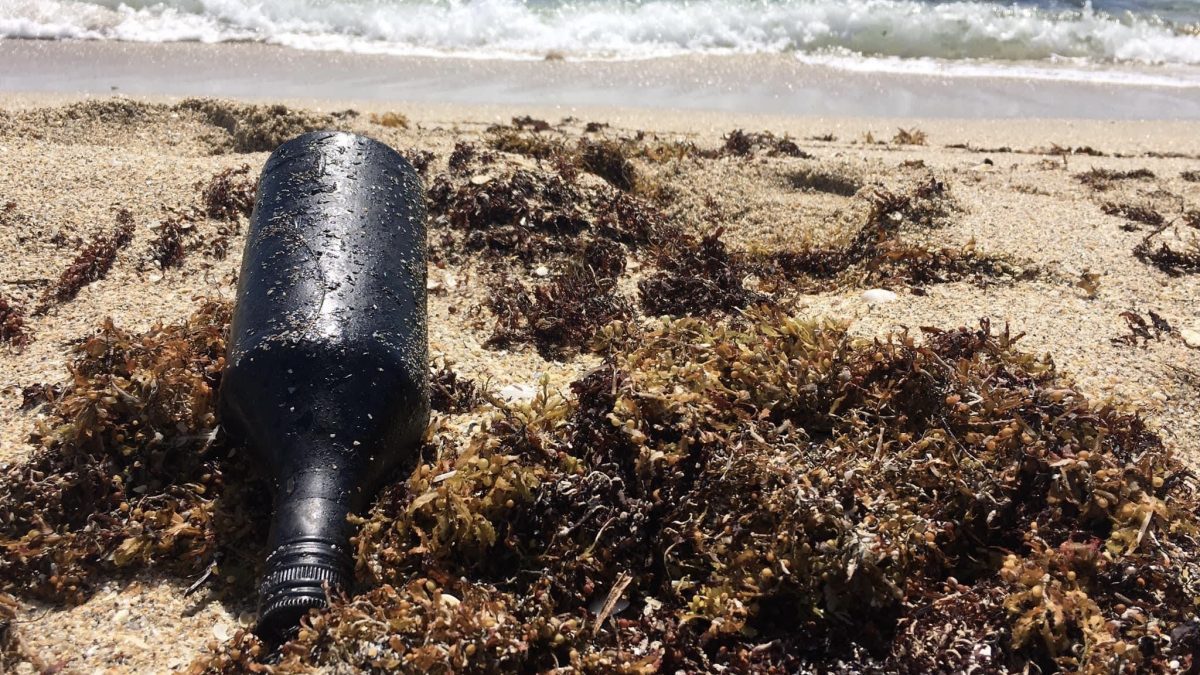 Petroleum residues can survive long-distance transport by adhering to floating debris, dramatically extending how far oil pollution can travel in the marine environment. (Diane Buhler, Friends of Palm Beach)
 January 7, 2026
Oil spill forensics reveal how plastic debris can carry petroleum pollution across entire ocean basins
Images available for use with credit can be found here.
Woods Hole, Mass. (January 7, 2026) -- When oily plastic, glass, and rubber washed ashore on Florida beaches in 2020, it appeared at first to be a local mystery. But through a collaboration that paired community observations with world-leading oceanographic and chemical expertise, scientists traced the contamination across more than 5,200 miles of ocean.
In a new study published in ACS Environmental Science & Technology, researchers from Woods Hole Oceanographic Institution (WHOI) and Northeastern University, in collaboration with community scientists from Friends of Palm Beach, show that petroleum residues can survive long-distance transport by adhering to floating debris, dramatically extending how far oil pollution can travel in the marine environment.
Using advanced ocean current modeling and chemical fingerprinting developed at WHOI, the team linked the Florida debris to a massive oil spill that occurred along Brazil’s coastline in 2019.
“This study demonstrates how plastic pollution fundamentally changes the fate of oil in the ocean,” said Chris Reddy, chemical oceanographer at WHOI and a global authority on oil spill forensics. “By hitchhiking on debris, petroleum residues can persist and move far beyond what we previously believed possible.”
From beach cleanup to basin-scale discovery
The investigation began when Friends of Palm Beach, a long-running beach cleanup organization, noticed an unusual influx of black, oil-coated debris—plastic bottles, glass containers, and large rubber fragments—on Florida shores. With no nearby spills reported, the group shared their findings online, catching the attention of scientists.
Community members partnered with an international research team led by WHOI and Northeastern University to uncover the debris’s origin. The multilingual labels on the bottles, including Portuguese, Spanish, and English, hinted at a distant source.
“Without the sharp eyes and persistence of the Friends of Palm Beach, this research would never have happened,” said Northeastern’s Bryan James, lead author of the study, and former WHOI postdoc. “Their local knowledge turned an odd observation into a globally significant scientific finding.”
Tracing oil across the Atlantic
Oil typically degrades within a few hundred miles due to sunlight and microbial activity. But the research team hypothesized that oil adhering to plastic and rubber could survive much longer.
To test this, the researchers combined ocean current simulations, which traced the debris backward in time to potential origins in the Gulf of Mexico, Central America, and Brazil; Drift-time modeling, showing the debris could plausibly travel for about 240 days, consistent with transport from Brazil to Florida; and WHOI-based chemical fingerprinting, revealing that the oily residues on Florida debris matched petroleum from the 2019 Brazil spill and showed signs of refining.
Expanding the concept of “petroplastic”
Reddy said the findings highlight a previously underappreciated interaction between oil pollution and plastic waste.
“This work shows an additive contaminant effect,” he explained. “Plastic doesn’t just pollute on its own—it can act as a vehicle for oil, transporting petroleum contamination across oceans. This expands our understanding of what we call ‘petroplastic,’ a complex and emerging form of pollution driven by human activity.”
The study underscores the global consequences of marine debris and the critical role of interdisciplinary science—combining community observations, oceanography, and chemical forensics—to understand and mitigate pollution in the world’s oceans.
“WHOI has long been at the forefront of understanding the fate of pollutants in the ocean,” said Reddy. “This study demonstrates how our expertise in oil spill forensics and ocean circulation can illuminate hidden pathways of contamination that operate on a global scale.”
###
About Woods Hole Oceanographic Institution
Woods Hole Oceanographic Institution (WHOI) is a private, non-profit organization on Cape Cod, Massachusetts, dedicated to marine research, engineering, and higher education. Founded in 1930, its mission is to understand the ocean, its interactions with the Earth, and its role in a changing global environment. WHOI’s pioneering discoveries arise from a unique blend of science and engineering that has made it one of the world’s most trusted leaders in ocean research and exploration. Known for its multidisciplinary approach, advanced ship operations, and unmatched deep-sea robotics, WHOI also operates the most extensive suite of ocean data-gathering platforms worldwide. More than 800 concurrent projects—driven by top scientists, engineers, and students—push the boundaries of knowledge to inform people and policy for a healthier planet. Behind the scenes, ship captains, mates, craftsmen, marine operations, and other skilled professionals provide essential support that makes this work possible. Learn more at whoi.edu.