
A new study reveals how oxygen first reached Earth’s oceans
 South Africa’s exceptionally preserved ancient rocks hold key evidence for the rise of atmospheric oxygen. Within them, researchers see the disappearance of sulfur mass-independent fractionation, evidence for a GOE. (Photo by Daniel Hentz, ©Woods Hole Oceanographic Institution)
 December 9, 2025
Researchers use vanadium isotopes to track the rise of oxygen in ancient seas
Photos available for use with credit can be found here.
Woods Hole, Mass (December 9, 2025) – For roughly two billion years of Earth’s early history, the atmosphere contained no oxygen, the essential ingredient required for complex life. Oxygen began building up during the period known as the Great Oxidation Event (GOE), but when and how it first entered the oceans has remained uncertain.
A new study published in Nature Communications shows that oxygen was absorbed from the atmosphere into the shallow oceans within just a few million years—a geological blink of an eye. Led by researchers at Woods Hole Oceanographic Institution (WHOI), the work provides new insight into one of the most important environmental shifts in Earth’s history.
“At that point in Earth’s history, nearly all life was in the oceans. For complex life to develop, organisms first had to learn not only to use oxygen, but simply to tolerate it,” said Andy Heard, lead author of the study and assistant scientist at WHOI. “Understanding when oxygen first accumulated in Earth’s atmosphere and oceans is essential to tracing the evolution of life. And because ocean oxygenation appears to have followed atmospheric oxygen surprisingly quickly, it suggests that if we detect oxygen in the atmosphere of a distant exoplanet, there’s a strong chance its oceans also contain oxygen.”
Researchers used new chemical analyses of black shales, organic-rich marine sedimentary rocks from South Africa, that formed in the ocean during the ongoing Great Oxidation Event. They found that the trace metal vanadium saw a shift in the relative abundance of its stable isotopes in shales formed before and after the stratigraphic level marking the occurrence of oxygenation in the atmosphere.
“South Africa is one of the few places on Earth with exceptionally well-preserved rock records from this pivotal time in our planet’s history. These sedimentary rocks play host to some of our strongest indicators for the rise of atmospheric oxygen,” said Chad Ostrander, one of the study’s co-authors and an isotope geochemist at the University of Utah. “These rocks have relatively tight age constraints, and within them we see the disappearance of sulfur mass-independent fractionation—the traditional ‘smoking gun’ evidence for a GOE.”
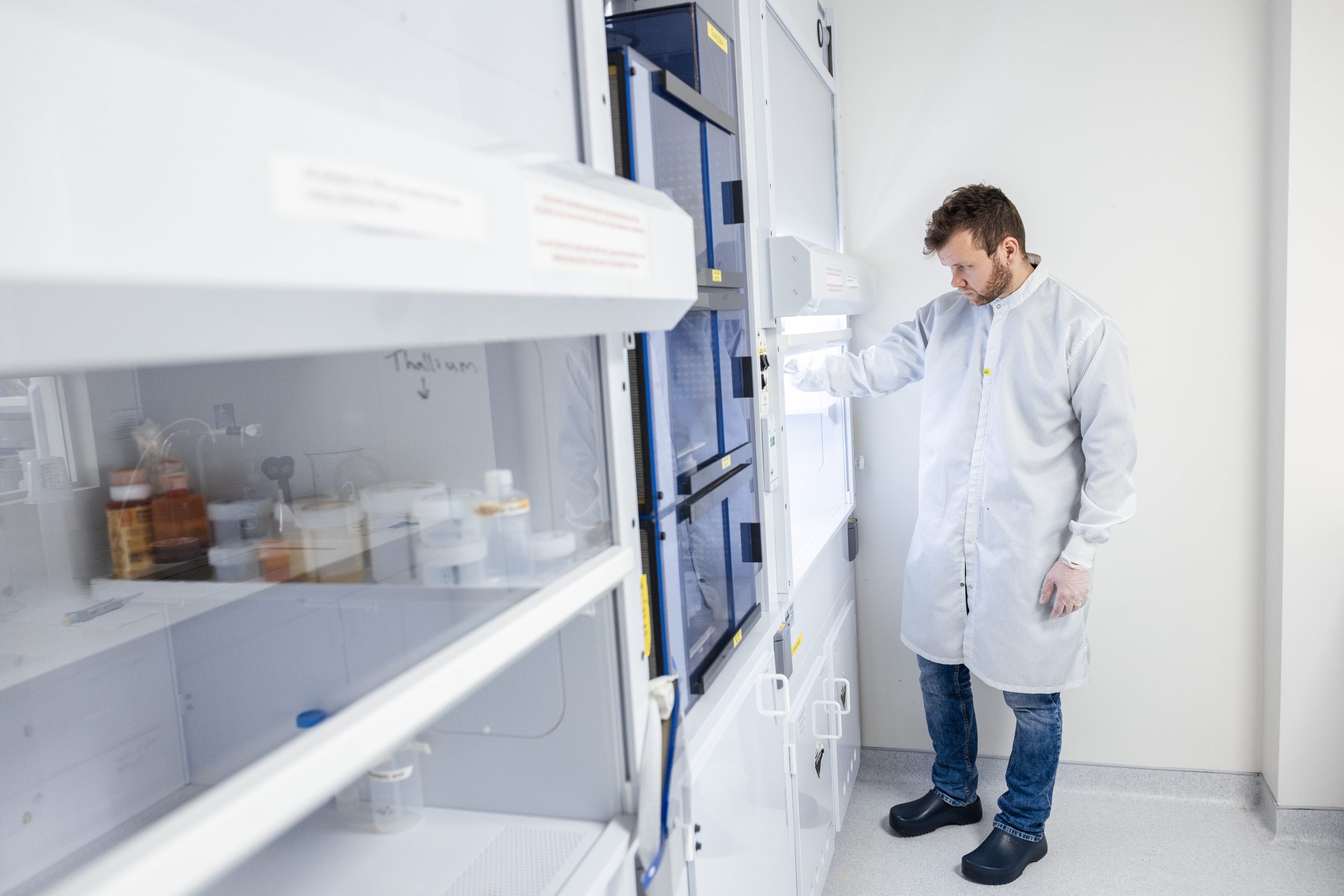
Researchers analyzed South African black shales and found a shift in vanadium isotopes across the GOE interval, providing evidence for when Earth’s oceans first became oxygen-rich. (Photo by Daniel Hentz, ©Woods Hole Oceanographic Institution)
“Vanadium is especially powerful because it responds to relatively high levels of dissolved oxygen compared to other geochemical proxies used for this period of Earth’s history. That means we can detect when oxygen in the oceans first rose above roughly 10 micromoles per liter—a few percent of modern levels,” said Sune Nielsen, one of the study's co-authors and adjunct scientist at WHOI. Nielsen is also noted as one of the first scientists to use the vanadium isotope redox method to study past ocean oxygen levels. “For context, today’s oceans average about 170 micromoles of dissolved oxygen per liter. It’s not much by modern standards, but in oceans that were previously almost entirely oxygen-free, it represents a major step in Earth’s oxygenation.”
These findings show that Earth’s oceans began accumulating oxygen far earlier, and more rapidly, than previously thought, reshaping our understanding of how the planet became habitable for complex life.
“This study helps clarify one of the biggest turning points in Earth’s history,” Heard continued. “By tracing when oxygen first reached the oceans, we’re getting closer to understanding how the conditions for complex life emerged on our planet—and how they might arise elsewhere.”
This work was funded by NASA Exobiology, the WHOI postdoctoral scholar program, the Agouron Institute Fellowship in Geobiology, Discovery and Accelerator Grants from the Natural Sciences and Engineering Research Council of Canada, ACS Petroleum Fund, and the Natural Environmental Research Council.
###
About Woods Hole Oceanographic Institution
Woods Hole Oceanographic Institution (WHOI) is a private, non-profit organization on Cape Cod, Massachusetts, dedicated to marine research, engineering, and higher education. Founded in 1930, its mission is to understand the ocean, its interactions with the Earth, and its role in a changing global environment. WHOI’s pioneering discoveries arise from a unique blend of science and engineering that has made it one of the world’s most trusted leaders in ocean research and exploration. Known for its multidisciplinary approach, advanced ship operations, and unmatched deep-sea robotics, WHOI also operates the most extensive suite of ocean data-gathering platforms worldwide. More than 800 concurrent projects—driven by top scientists, engineers, and students—push the boundaries of knowledge to inform people and policy for a healthier planet. Behind the scenes, ship captains, mates, craftsmen, marine operations, and other skilled professionals provide essential support that makes this work possible. Learn more at whoi.edu.