
Preliminary results from the first EPA-permitted ocean alkalinity enhancement (OAE) field trial
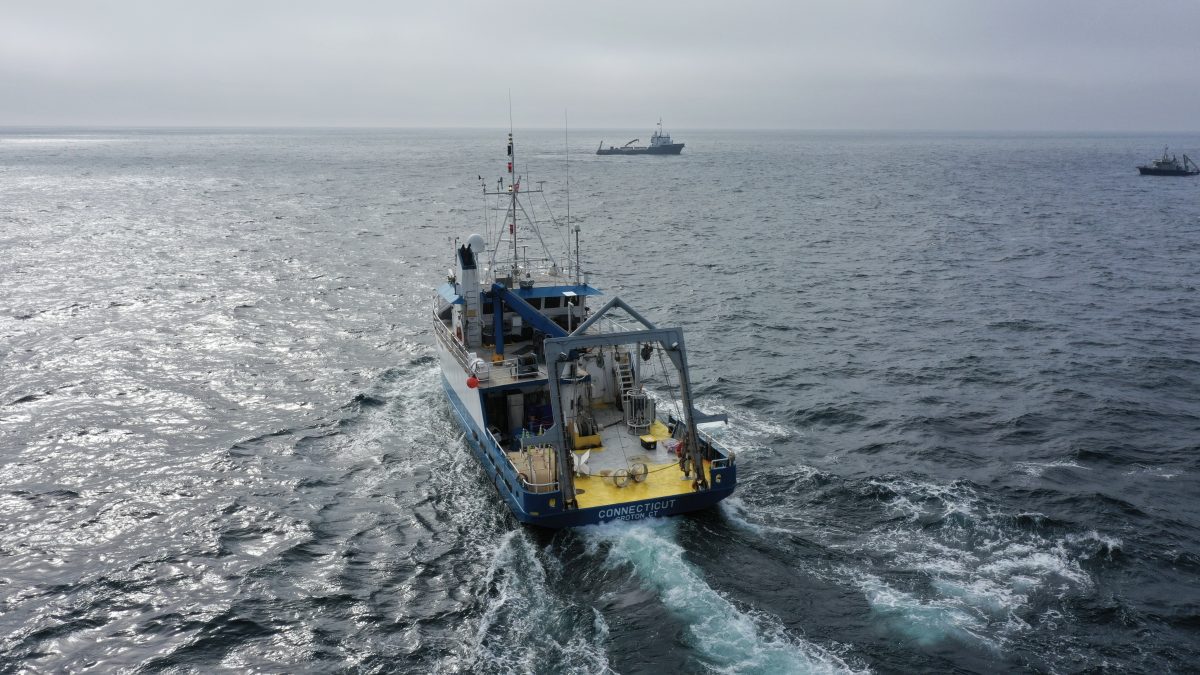 Three ships were part of the successful completion of an EPA-approved, small-scale environmental research trial of ocean alkalinity enhancement (OAE) in the Gulf of Maine as part of the LOC-NESS Project. (Photo: Daniel Cojanu, Undercurrent Productions, ©Woods Hole Oceanographic Institution)
 February 25, 2026
LOC-NESS project team shares findings at annual Ocean Sciences Meeting
Link to photos, captions, and credits is here
Woods Hole, Mass. and Glasgow, UK (February 25, 2026, 3 p.m. GMT/10 a.m. ET) — The Woods Hole Oceanographic Institution (WHOI) today announced preliminary findings from the first U.S. Environmental Protection Agency (EPA)-permitted ocean alkalinity enhancement (OAE) field trial, which was conducted in federal waters in the Gulf of Maine in August 2025. The trial, part of the. The findings from the LOC-NESS (Locking Ocean Carbon in the Northeast Shelf and Slope) project were shared at a press briefing at the biennial Ocean Sciences Meeting (OSM), the premier international conference of marine scientists, students, and professionals, currently underway in Glasgow, Scotland.
Ocean alkalinity enhancement is a marine carbon dioxide removal (mCDR) approach identified by leading scientific bodies, including the U.S. National Academies of Science, Engineering, and Medicine (NASEM) and the Intergovernmental Panel on Climate Change (IPCC), as a high-potential strategy for durable atmospheric carbon dioxide removal. OAE works by enhancing the ocean’s natural capacity to absorb carbon dioxide while simultaneously avoiding extra ocean acidification. This research, which has earned significant, independent support from the scientific community, is funded by several philanthropic and federal sources and advances critical goals laid out in the National Marine Carbon Dioxide Removal Strategy released by the U.S. government in 2024.
In August 2025, the LOC-NESS team conducted an engineered, six-hour dispersal in the Wilkinson Basin area of the Gulf of Maine. Highly purified sodium hydroxide, commonly used to adjust the pH of drinking water, was introduced into the surface waters of the Wilkinson Basin area of the Gulf of Maine along with a red tracer dye known as Rhodamine Water Tracer (RWT). WHOI scientists in a fully equipped research vessel followed behind the release vessel to carefully monitor environmental conditions and then remained on-site to follow the patch of alkalinity for four days, tracking the physical, chemical, and biological conditions of the ocean to assess OAE’s potential for safely removing carbon dioxide from the atmosphere. In addition, scientists deployed four self-propelled autonomous underwater vehicles and free-swimming gliders to measure key water properties before, during, and after release and monitored the evolution of the alkalinity patch by satellite. Complementary observations included CTD profiles, water sampling, plankton net tows, and satellite imagery. Release of the alkalinity was also observed by WHOI engineers, chemical industry experts, federal regulators, and a commercial fisher.
Speaker summaries from the press briefing
Adam Subhas, LOC-NESS Principal Investigator, WHOI
Subhas is the LOC-NESS principal investigator (PI) and project lead. He emphasized that LOC-NESS was created in response to international scientific consensus that carefully designed field trials are essential to validate the effectiveness and environmental impacts of marine carbon dioxide removal approaches, and added that mCDR does not replace the need for reduced carbon emissions.
Preliminary findings from the LOC-NESS field trials confirm:
- It represented a successful and controlled dispersal of alkalinity and tracer.
- Effective tracking of the alkaline patch for approximately five days (dispersal day plus subsequent monitoring) is possible.
- There is a strong correlation between modeled and observed dispersal patterns.
- Seawater pH and tracer levels returned to baseline within the expected timeframes.
- The experiment successfully and safely produced conditions that allowed the surface ocean to take up carbon from the atmosphere. A portion of the resulting CO₂ uptake can be quantified by combining pH and pCO₂ measurements with data from the rhodamine tracer.
- Tracking an alkalinity patch in the ocean with a water tracer dye is a highly effective monitoring approach at the research stage.
These preliminary and subsequent results will translate to substantive recommendations for MRV (measurement, reporting, verification), a key goal of the field trials. Research by the LOC-NESS team will continue refining the impacts and compiling quantitative results into an upcoming peer-reviewed publication.
“LOC-NESS was designed to inform future science, regulation, and policy surrounding marine carbon dioxide removal. These early results demonstrate that small-scale OAE deployments can be engineered, tracked, and monitored with high precision,” said Subhas. “We are confident that the data collected and our analysis will advance scientific knowledge of OAE’s carbon uptake potential and environmental impacts. We need independent, transparent research to determine which solutions might work.”
David “Roo” Nicholson, LOC-NESS Co-Principal Investigator, WHOI
Nicholson led the deployment and use of autonomous gliders, and a long-range AUV to collect additional data before, during, and after the field trials. These data were integrated with shipboard, remote sensing, and drifter data to realize a more comprehensive view of the experiment. Real-time dashboards accessible to shipboard and shore-based teams enabled precise real-time tracking of the alkalinity-enhanced water. This open-source, cloud-based data integration system is publicly available and adaptable for future research. Technology included:
- Autonomous gliders
- Drifters
- Satellite imagery
- Modeled particle tracks
- A long-range AUV
- Shipboard sensors
“We successfully tracked the LOC-NESS OAE patch across five days with a mixed fleet of in-water assets,” said Nicholson, ”and our results provide a roadmap for designing and implementing observing systems for larger-scale OAE additions. Approaches that integrate in situ observations, remote sensing, and numerical modeling are essential for future monitoring and verification of marine carbon removal.”
Rachel Davitt, PhD Student, Department of Marine and Coastal Sciences, Rutgers University
Davitt helped to lead the biological and ecological impact assessment on LOC-NESS alongside other WHOI and Rutgers scientists. Davitt collected both discrete and underway data to measure impacts to the microbial community, combining with data on zooplankton and fish/lobster larvae to give a holistic overview of the effect of the deployment on the biological system. Davitt presented these data, which included impacts to the microbial community (bacteria and phytoplankton) and impacts to zooplankton, fish larvae, and lobster larvae. Key findings include:
- Biological impacts in the laboratory appear concentration- and exposure-dependent, and as hypothesized, the field trial resulted in no measurable impact to ocean life.
- When comparing bacteria concentrations, phytoplankton cell concentrations, amount of dying cells, photosynthetic health, and chlorophyll-a concentrations in and out of the alkalinity patch over the study period, no significant differences were found. Additionally, there were no significant differences in zooplankton abundance, fish larvae abundance, and lobster larvae abundance in and out of the alkalinity patch.
- Although we did not measure direct impacts to higher trophic levels, and impacts to fisheries are still uncertain and will need modeling to resolve clear results, the base of the marine food web that higher trophic levels rely on was not significantly impacted from the data we collected.
- Therefore, initial assessments of research data indicate that there were no significant biological impacts due to the alkalinity addition, largely in keeping with laboratory experiments conducted before the field trial.
“Based on the biological and ecological impact data that we have collected and analyzed so far, there was no significant impact of the LOC-NESS field trial on the biological community using the metrics we measured,” said Davitt. “Further studies should continue to explore concentration and exposure-dependent effects of alkalinity on biological systems, especially in complicated ecosystems such as the Gulf of Maine, as well as working to improve modeling abilities to assess potential impacts on fisheries.”
Kristin Kleisner, Lead Senior Scientist, Associate Vice President for Ocean Science, Environmental Defense Fund
LOC-NESS team members organized or participated in more than 50 community engagement and outreach activities throughout the research, design and public review process. Kleisner summarized the efforts conducted with fishing communities, tribal representatives, industry stakeholders, and the public. Key reflections include:
- Repeated engagement showed project transparency and willingness for collaboration with stakeholders.
- Stakeholder feedback helped to influence research questions, permitting requirements and communications.
- Engagement can help achieve multiple goals, ranging from public education to dispelling misinformation to hearing and addressing community concerns.
- Challenges remain in defining responsibility for engagement across various project phases, but the LOC-NESS team have shown that, especially in early stages of research and testing, engagement early and often is key to building trust.
“Robust two-way engagement can’t be an afterthought–it’s critical for giving communities and rights holders a platform to voice concerns, gain knowledge and make informed decisions based on that information,” said Kleisner. “The LOC-NESS team has greatly advanced understanding about what meaningful engagement entails for mCDR and how to build legitimacy and trust in responsible research.”
Background leading up to the August 2025 field trials:
- In April 2025, the EPA approved the LOC-NESS field research proposal following a rigorous, year-long review that included two public comment periods totaling 75 days and garnered more than 250 comments. The research earned significant, independent support from the scientific community.
- EPA consultations with NOAA Fisheries and the U.S. Fish and Wildlife Service found minimal potential environmental impact for the scale and nature of the proposed trial. The EPA determined that the project “demonstrates scientific rigor” and is “not expected to significantly affect human health, the marine environment or other uses of the ocean.”
- This non-profit research builds on years of laboratory experiments, computer modeling, and theoretical studies about the safety and effectiveness of OAE, and it comes as commercial ventures related to OAE are progressing.
- Prior to the field trial, a series of lab experiments were conducted with the copepod Calanus finmarchicus, a primary food for North Atlantic right whales and commercially important fish, with preliminary results showing no impact of elevated pH on this key food web species in the region.
- The LOC-NESS team performed a simulated alkalinity deployment at a 10-million-liter, open-air federal testing facility in New Jersey, which helped refine the engineering and methodological design of the Gulf of Maine experiment.
- LOC-NESS team members organized or participated in more than 50 community engagement and outreach activities throughout the research design and public review process.
- The LOC-NESS project is funded by the Carbon to Sea Initiative and ICONIQ Ocean Co-Lab, with additional monitoring support from National Oceanic and Atmospheric Administration (NOAA). LOC-NESS is an independent scientific research effort with no commercial stake in mCDR development.
On-site media contact:
Suzanne Pelisson, Director, Public Relations
Woods Hole Oceanographic Institution
SPelisson@WHOI.edu
973-801-6223
###
About Woods Hole Oceanographic Institution
The Woods Hole Oceanographic Institution (WHOI) is a private, non-profit organization on Cape Cod, Massachusetts, dedicated to marine research, engineering, and higher education. Established in 1930, its primary mission is to understand the ocean and its interaction with the Earth as a whole, and to communicate an understanding of the ocean’s role in the changing global environment. WHOI’s pioneering discoveries stem from an ideal combination of science and engineering—one that has made it one of the most trusted and technically advanced leaders in basic and applied ocean research and exploration anywhere. WHOI is known for its multidisciplinary approach, superior ship operations, and unparalleled deep-sea robotics capabilities. We play a leading role in ocean observation and operate the most extensive suite of data-gathering platforms in the world. Top scientists, engineers, and students collaborate on more than 800 concurrent projects worldwide—both above and below the waves—pushing the boundaries of knowledge and possibility. For more information, please visit www.whoi.edu.
Detailed analyses are ongoing, but preliminary results suggest:
- Controlled, small-scale OAE dispersals can be conducted and tracked effectively using a wide range of platforms and technology.
- Carbon uptake potential can be quantified using integrated observational and modeling tools.
- Biological impacts in the laboratory appear concentration- and exposure-dependent, and as hypothesized, the field trial resulted in no measurable impact to ocean life.
- Community engagement remains a critical and evolving component of responsible mCDR research.