
New climate-based tool predicts coral bleaching months in advance, offering critical lead time for reef protection
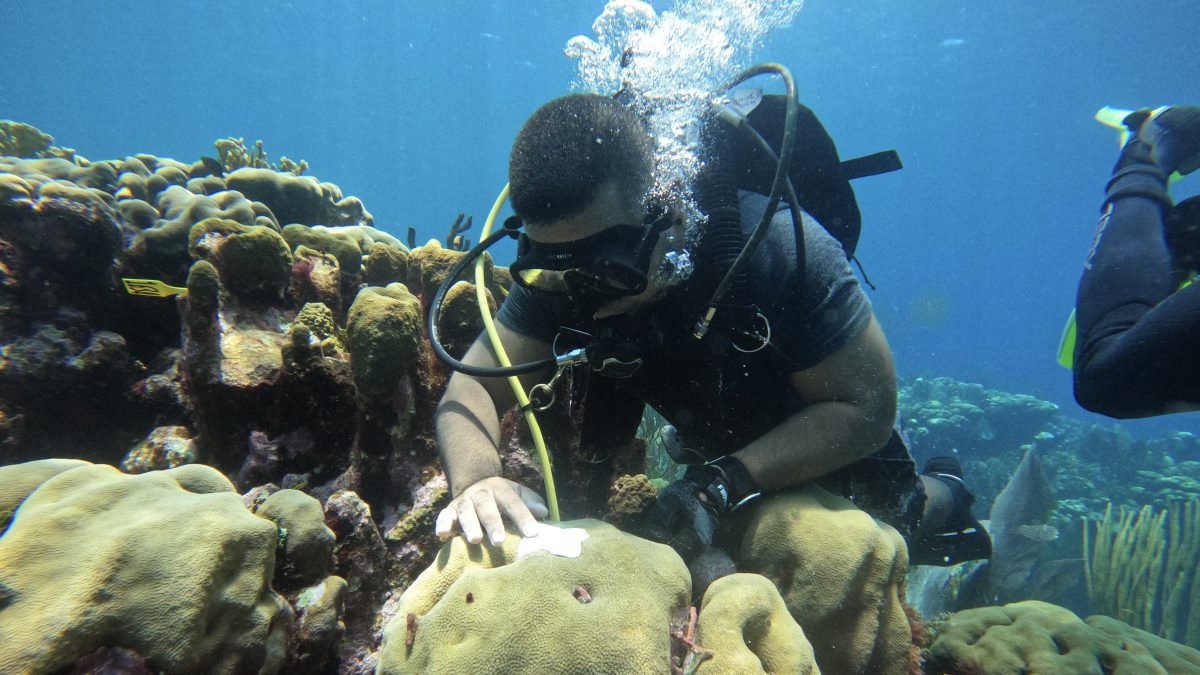 Evii Tong, a WHOI research assistant, patches a sampled
Orbicella faveolata
colony. (Photo by Mariya Galochkina, ©Woods Hole Oceanographic Institution)
Evii Tong, a WHOI research assistant, patches a sampled
Orbicella faveolata
colony. (Photo by Mariya Galochkina, ©Woods Hole Oceanographic Institution) June 2, 2026
Images available for use with credit can be found here.
Woods Hole, Mass. (June 2, 2026) — Researchers at the Woods Hole Oceanographic Institution (WHOI) have developed a new method to predict coral bleaching five to six months before it occurs, giving reef managers valuable time to protect vulnerable ecosystems.
In the new study, Climate modes can be leveraged to forecast coral bleaching months in advance, published today in Communications Earth and Environment, researchers demonstrate that coral bleaching on the Caribbean island of Curaçao occurs when three major climate patterns in the Pacific and Atlantic Oceans align in specific ways that intensify ocean warming. By monitoring these climate modes months before peak summer heat, the team created a new, early-warning tool called the Bleaching Event Early Predictor (BEEP). This research highlights how large-scale climate dynamics can be used to anticipate extreme marine heat stress at local reefs, an advance that could significantly improve coral reef management worldwide.
According to Mariya Galochkina, lead author of the study and MIT-WHOI Joint Program doctoral researcher, “Existing bleaching forecasts track heat stress in near-real time, and also rely on generalized thresholds for predicting bleaching risk, which means they often do not provide reef managers and restoration practitioners with enough lead time to prepare and respond effectively, or the predictions are inaccurate.” “We take a different approach by using large-scale climate patterns that interact to shape regional ocean and atmosphere conditions with a time lag, which lets us identify bleaching risk months in advance.”
This advance warning gives reef managers the lead time they need to act, including moving coral fragments from in-situ restoration nurseries to cooler areas on the reef or out of the water and into land-based nurseries if bleaching is forecast.
Coral bleaching occurs when corals become stressed by unusually warm ocean temperatures and expel the microscopic algae that provide them with energy and color, which can lead to widespread coral mortality. Across the Caribbean, coral reefs have declined dramatically in recent decades. Rising ocean temperatures have intensified marine heatwaves, increasing the frequency and severity of bleaching events. For island communities that rely on reefs for fisheries, tourism, and coastal protection, the stakes are high. On Curaçao alone, coral reef tourism and fisheries contribute hundreds of millions of dollars annually to the local economy.
“Our work shows how basic science can be rapidly translated into solutions for real‑world challenges, but these breakthroughs don’t come from thin air,” said Anne Cohen, senior scientist at WHOI and co-author of the study. ”They’re built on decades of investment in fundamental research and continuous Earth‑system monitoring, including satellites. And BEEP is only possible because the agencies that monitor our planet make that data freely available.
To build a long-term bleaching record, the team analyzed skeletal cores from massive reef-building corals collected from Curaçao’s reefs. When corals bleach, their growth patterns change, leaving behind distinctive high-density “stress bands” in their skeletons. Using CT scans of 44 coral cores, the researchers reconstructed a 72-year bleaching history from 1950 to 2022, revealing that significant bleaching events on Curaçao began only around 1990, after ocean temperatures had already warmed significantly.
Since then, bleaching has occurred repeatedly in years when three large-scale climate modes align: Atlantic Multidecadal Variability, El Niño–Southern Oscillation, and North Atlantic Oscillation. When these patterns combine in certain ways, they weaken regional winds and reduce cooling induced by upwelling currents, allowing reef temperatures to rise above bleaching thresholds. By tracking these climate indicators months before peak summer heat, the team developed their new forecasting tool, which identifies years when the climate system is primed for bleaching. The system currently focuses on Curaçao but could potentially be adapted for coral reefs across the Caribbean and other tropical regions.
"Existing global observing systems help provide critical data to climate prediction centers to monitor and skillfully predict these climate modes months in advance,” said co-author Caroline Ummenhofer, a climate scientist at WHOI. “Capitalizing on these efforts, BEEP offers a novel tool to reef managers for risk mitigation."
The study underscores WHOI’s long-standing leadership in coral reef science and research. WHOI scientists combine field observations, climate modeling, and innovative analytical tools to better understand how marine ecosystems respond to environmental change. By translating fundamental climate science into practical tools for reef managers, researchers are helping communities prepare for and potentially reduce the impacts of marine heatwaves on coral ecosystems.
“Coral reefs are among the most vulnerable ecosystems on the planet,” said Cohen. “Advances like this give us a better chance to protect them in a warming ocean.”
Looking ahead, the team hopes to expand the framework behind BEEP to create regional bleaching forecasts for reefs across the tropics. With improved early warning, conservation groups, governments, and restoration programs could plan interventions more strategically and protect reefs during periods of greatest risk.
“Our research and understanding of the global climate system can help lead to practical solutions for one of the ocean’s most urgent challenges,” said Cohen.
This work was supported by the National Science Foundation Biological Oceanography Program, a National Science Foundation Graduate Research Fellowship, an MIT MathWorks Fellowship, and Woods Hole Oceanographic Institution Ocean Ventures Fund; the Grossman Family Foundation Fund; Alta Futures; the James E. and Barbara V. Moltz Fellowship for Climate-Related Research at WHOI; and the Woods Hole Oceanographic Institution Investment in Science Program.
###
About Woods Hole Oceanographic Institution
Woods Hole Oceanographic Institution (WHOI) is a private, non-profit organization on Cape Cod, Massachusetts, dedicated to marine research, engineering, and higher education. Established in 1930, its mission is to understand the ocean and its interactions with the Earth as a whole, and to communicate an understanding of the ocean’s role in the changing global environment. WHOI’s pioneering discoveries stem from an ideal combination of science and engineering—one that has made it one of the most trusted and technically advanced leaders in fundamental and applied ocean research and exploration anywhere. WHOI is known for its multidisciplinary approach, superior ship operations, and unparalleled deep-sea robotics capabilities. We play a leading role in ocean observation and operate the most extensive suite of ocean data-gathering platforms in the world. Top scientists, engineers, and students collaborate on more than 800 concurrent projects worldwide—both above and below the waves—pushing the boundaries of knowledge to inform people and policies for a healthier planet. Learn more at whoi.edu.