
New Woods Hole Oceanographic Institution study cautions that deep-sea fishing could undermine valuable tuna fisheries
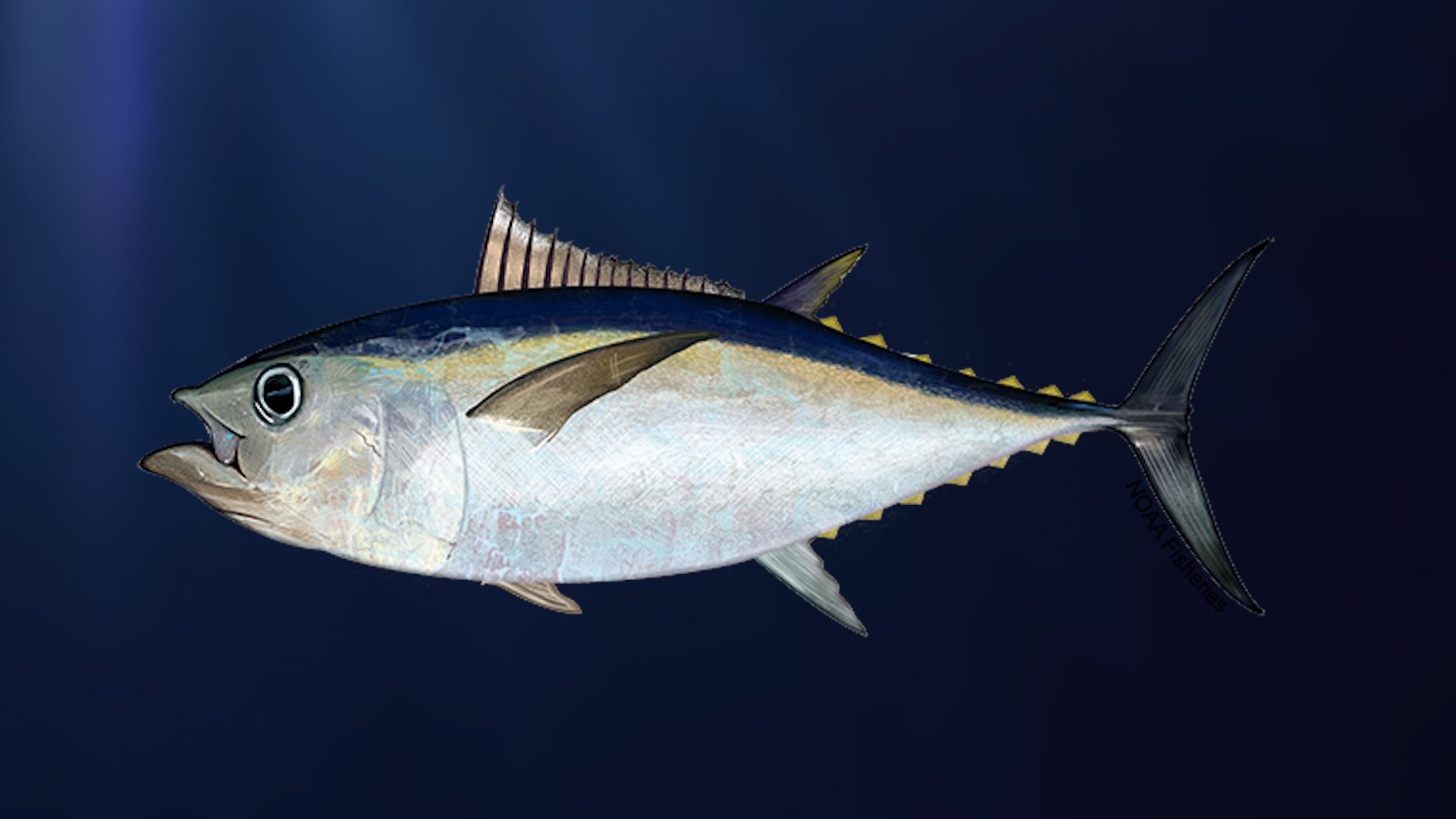
Woods Hole, Mass. (January 28, 2026) — A new study led by scientists at Woods Hole Oceanographic Institution (WHOI), along with international partners, finds that proposed commercial fishing in the deep ocean could have serious consequences for bigeye tuna, one of the world’s most valuable and widely consumed fish.
The study in Fisheries Management and Ecology shows that large-scale harvesting of mesopelagic fish –small, deep-sea species that live hundreds of meters below the surface –could reduce the food available to bigeye tuna, ultimately harming tuna populations and the fisheries that depend on them. Mesopelagic fish such as lanternfish and bristlemouths form one of the largest animal biomasses on Earth and are increasingly viewed as a potential new source of fishmeal and fish oil for aquaculture. This new research suggests that exploiting this deep-sea resource without careful management could come at a high cost.
“Bigeye tuna rely heavily on mesopelagic fish for food, at a higher level and with greater consistency than previously assumed,” said Ciara Willis, the study’s lead author. Willis conducted the research as part of her PhD thesis in Biological Oceanography at WHOI and is currently a Postdoctoral Fellow at Monterey Bay Aquarium Research Institute (MBARI.) “If we remove too much of this critical food source via large-scale mesopelagic fisheries, we risk undermining existing tuna fisheries that support livelihoods around the world, and bigeye tuna won’t be the only species impacted. Numerous large marine predators from fish to whales to seabirds source a meaningful portion of their diets from the mesopelagic.”
The mesopelagic or midwater is a layer of the ocean that stretches around the globe, 200 to 1,000 meters (about 650 to 3,300 feet) below the ocean surface, just beyond the reach of sunlight. It is also referred to as the Ocean Twilight Zone (OTZ), and in 2018, WHOI launched an ambitious mission to explore and understand this important ocean layer. Studies suggest that the biomass of fish in the twilight zone may be ten times greater than previously thought, more than in all the rest of the ocean combined. Animals in the twilight zone range in size from microscopic to among the largest on the planet. Some organisms spend their lives in its shadowy depths, while others travel to and from the surface every day in the largest animal migration on Earth. Animals in the twilight zone help support the ocean’s food web and transport huge amounts of carbon from surface waters into the deep ocean, helping to regulate global climate.
Knowing what animals in the twilight zone eat, and who eats them, is essential for understanding the zone’s role in the marine ecosystem. WHOI co-author Di Jin, an expert in marine economics, contributed to the modeling approach that linked predator and prey. “Combining food-web science with economic modeling gave us a full picture of how coupled natural and human systems could respond to mesopelagic fishing,” said Jin.
Interest in mesopelagic fishing is growing due to rising global demand for aquaculture feed and technological advances that make deep-sea fishing more feasible. At the same time, oversight for mesopelagic fisheries remains largely unregulated, especially in international waters. Species like bigeye tuna get up to 50–60 percent of their diet from mesopelagic food webs.
Co-author Melina Kourantidou, an environmental and resource economist and Guest Investigator at WHOI’s Marine Policy Center, emphasized the importance of considering trade-offs across fisheries. “From an economic perspective, this isn’t just a question of whether mesopelagic fishing is technically possible, but whether it makes sense once we account for what could be lost. If harvesting deep-sea forage fish undermines high-value fisheries like tuna, the total costs could far outweigh the benefits. Our results highlight the importance of considering these cross-fishery trade-offs before new fisheries expand.”
The study underscores the need for early and ongoing ecosystem-based management that considers how fisheries interact, impact species, and help inform policy.
“Mesopelagic fish are central to the ocean food web, and to the future of tuna fisheries,” said Willis. “Decisions about deep-sea fisheries made today will shape ocean ecosystems for decades.”
This work was funded in part by a Natural Sciences and Engineering Research Council of Canada Postgraduate Scholarship—Doctoral and a Massachusetts Institute of Technology Martin Family Society of Fellows for Sustainability Fellowship. This work was part of the Woods Hole Oceanographic Institution's Ocean Twilight Zone Project, funded as part of the Audacious Project housed at TED.
###
About Woods Hole Oceanographic Institution
The Woods Hole Oceanographic Institution is a private, non-profit organization on Cape Cod, Massachusetts, dedicated to marine research, engineering, and higher education. Established in 1930, its primary mission is to understand the ocean and its interaction with the Earth as a whole, and to communicate an understanding of the ocean’s role in the changing global environment. Top scientists, engineers, and students collaborate on more than 800 concurrent projects worldwide—both above and below the waves—pushing the boundaries of knowledge and possibility.