
Woods Hole Oceanographic Institution and CMA CGM expand their partnership to advance marine mammal conservation with cutting-edge technology

Images and video available for use with credit can be found here
Woods Hole, Mass. (January 27, 2026) – Woods Hole Oceanographic Institution (WHOI) and CMA CGM Group, a global player in sea, land, air, and logistics solutions, announced today a new, expanded collaboration to protect endangered marine animals and preserve ocean health.
CMA CGM, which has long been committed to preserving biodiversity through multiple initiatives in the U.S. and worldwide, will support two key WHOI projects: the Continuous Operation of Two Acoustic Monitoring Buoys, near real-time passive acoustic monitoring systems off the coasts of Norfolk, VA, and Savannah, GA, initially funded by CMA CGM in 2022; and the launch of Monitoring Biodiversity for Ocean Health, a unique collaboration with the shipping industry to support biodiversity research and monitoring aboard a commercial cargo vessel.
Operation and Maintenance of Acoustic Buoys
The highly congested and relatively shallow waters along the continental shelf of the eastern U.S. create a perilous superhighway for the critically endangered North Atlantic right whale, making them vulnerable to harm from human activities like vessel strikes, entanglement in fishing gear, and noise pollution. With their total population estimated to be less than 370 individuals, the protection of every one of the species is imperative. Many right whales, including pregnant females, travel more than 1,000 miles along the U.S. Atlantic Coast each year to give birth in warmer southern waters, and then head back—a rare few with a calf in tow—to feed in northern waters.
For the past three years, CMA CGM has supported the deployment and operation of two acoustic buoys off the coasts of Savannah, GA, and Norfolk, VA, chosen because these ports are among the busiest in the U.S. Acoustic buoys play an important role in protecting marine animals. Each species of whale creates its own unique call, and the buoys are equipped with a digital acoustic monitoring (DMON) instrument that transmits information about detected sounds to shore every two hours. This WHOI-developed DMON technology can detect, classify, and report the sounds of marine mammals in near real-time from a variety of autonomous platforms, including moored buoys.
The data from the moored buoys is analyzed by an acoustician to determine which species are present. Results are displayed publicly on Robots4Whales, and shared in near real-time with CMA CGM fleet center, mariners, and other stakeholders. This enables dynamic protections, including NOAA’s Slow Zones for Right Whales, which are areas with voluntary vessel-speed restrictions along the eastern seaboard that are established when right whales are detected.
“We are grateful to continue our partnership with CMA CGM on the Savannah and Norfolk buoy sites,” said Mark Baumgartner, Senior Scientist in the Biology Department at WHOI and project lead. “The data from our network of 11 acoustic buoys along the East Coast is improving awareness of right whales in our marine backyard and helping to support important dynamic management measures to reduce risks to this highly endangered species. Having buoys in busy port locations is critical, and this continued partnership reflects our shared commitment to the protection of this species.”
Monitoring Biodiversity for Ocean Health
Tracking biodiversity and carbon in the ocean is a complex issue, requiring scientific teams to pioneer new measurement techniques to harness existing platforms that can offer sustained scientific observations and monitoring.
Since the 1970s, scientific equipment has been mounted on container ships operating on the Bermuda Container Line Oleander, which runs between New Jersey and Bermuda twice a week. This access to ocean sampling is uniquely possible from vessels that maintain regular shipping routes over long periods of service.
“Cargo ships that make opportunistic, regular measurements for the science community can help fill critical gaps by providing direct observations of in situ data about the ocean and atmosphere,” said Magdalena Andres, co-principal investigator of the new project, and a WHOI Senior Scientist in physical oceanography leading the NSF[1]-funded Oleander Project. Researchers collect and analyze biological and environmental data from commercial ships in transit, offering an efficient platform to study marine life across global shipping routes.
With the support of CMA CGM, WHOI scientists will optimize data collection through the use of an Imaging FlowCytobot (IFCB) aboard the CMV Oleander, to capture automated, real-time plankton images during the vessel’s weekly round trips, collecting data through one of the most dynamic and turbulent parts of the global ocean – the Gulf Stream System. This work will pioneer measurements and pave the way for a new global technique to track and understand planktonic ecosystems and their changing biodiversity. The measurements will be overlaid with NASA’s new hyperspectral PACE satellite, with the combination of data from the satellite imagery and detailed physical and chemical observations from the ship rapidly accelerating scientists’ understanding of the biodiversity of the surface ocean.
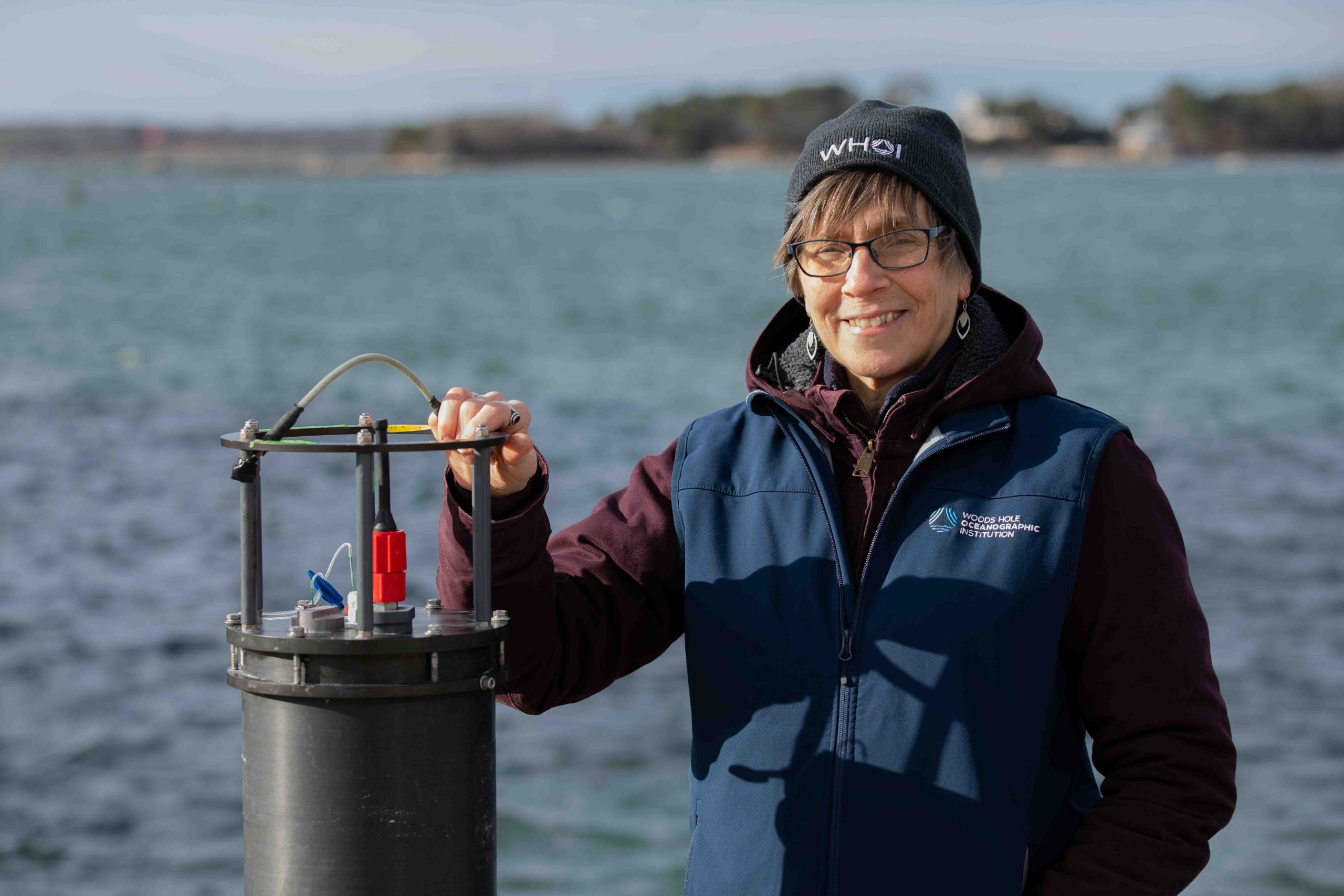
Heidi Sosik, a senior scientist in the WHOI Biology Department, is principal investigator for the CMA CGM supported research that has added a new component to the Oleander Project, which collects and analyzes biological and environmental data from commercial ships in transit, providing an efficient platform for studying marine life across global shipping routes. (Photo by Daniel Cojanu, ©WHOI)
The addition of scientific sensors to the Oleander supports the concept of the WHOI-led Science Research on Commercial Ships (ScienceROCS), a program between research institutions and industry to monitor the vast and open ocean, helping to meet a long-standing need for more scientific observations and monitoring of the ocean. ScienceROCS contributes to WHOI’s Ocean Vital Signs Network (OVSN), focused on integrating observing and modeling in the Northwest Atlantic. Once the observing system is optimized for operation in a commercial ship environment, the method could be scaled to CMA CGM ships.
“Regular measurements from ships that can observe the physics (ocean flows), chemistry (ocean carbon), and biology (biodiversity in plankton patches) simultaneously are critical to our continued understanding of a dynamic and rapidly changing ocean,” said Heidi Sosik, principal investigator for the project, and a Senior Scientist in the Biology Department at WHOI.
“The addition of this equipment helps us to better understand how and why phytoplankton patches occur, how they are linked to the turbulent structures of the ocean flow, and the ways the biodiversity within these patchy communities supports ocean food webs. This collaboration marks the beginning of a shared vision to drive innovation and research, creating a lasting impact in oceanography.”
[1] US National Science Foundation
###
About Woods Hole Oceanographic Institution
Woods Hole Oceanographic Institution (WHOI) is a private, non-profit organization on Cape Cod, Massachusetts, dedicated to marine research, engineering, and higher education. Established in 1930, its mission is to understand the ocean and its interactions with the Earth as a whole, and to communicate an understanding of the ocean’s role in the changing global environment. WHOI’s pioneering discoveries stem from an ideal combination of science and engineering—one that has made it one of the most trusted and technically advanced leaders in fundamental and applied ocean research and exploration anywhere. WHOI is known for its multidisciplinary approach, superior ship operations, and unparalleled deep-sea robotics capabilities. We play a leading role in ocean observation and operate the most extensive suite of ocean data-gathering platforms in the world. Top scientists, engineers, and students collaborate on more than 800 concurrent projects worldwide—both above and below the waves—pushing the boundaries of knowledge to inform people and policies for a healthier planet. Learn more at whoi.edu.
About CMA CGM
The CMA CGM Group is a global player in sea, land, air, and logistics solutions. True to its corporate purpose, we imagine better ways to serve a world in motion. Present in 177 countries, it employs 160,000 people, of which nearly 6,000 are in Marseilles, where its head office is located.
The world's 3rd largest shipping company, CMA CGM, serves more than 420 ports across 5 continents with a fleet of over 650 vessels. In 2024, CMA CGM carried over 23 million TEU (twenty-foot equivalent unit) containers. Its subsidiary CEVA Logistics, one of the world's top five players, operates 1,000 warehouses and handled 15 million shipments in 2024. CMA CGM AIR CARGO, the Group's air freight division, will operate a fleet of 6 cargo aircraft by 2025.
CMA Media, France’s 3rd largest private media group, includes RMC-BFM and several national and regional press titles (La Tribune Dimanche, La Tribune, La Provence, and Corse Matin), as well as the social media outlet Brut.
Committed to energy transition, the CMA CGM Group is aiming for Net Zero Carbon by 2050.
The CMA CGM Foundation provides humanitarian aid in crisis situations and is committed to education for all and equal opportunities throughout the world. To date, the CMA CGM Foundation has transported 100,000 tons of humanitarian aid to 100 countries and supported over 550 educational projects.
Follow the CMA CGM Group on: cmacgm-group.com