
WHOI discovers the oldest known whale recordings, dating to 1949
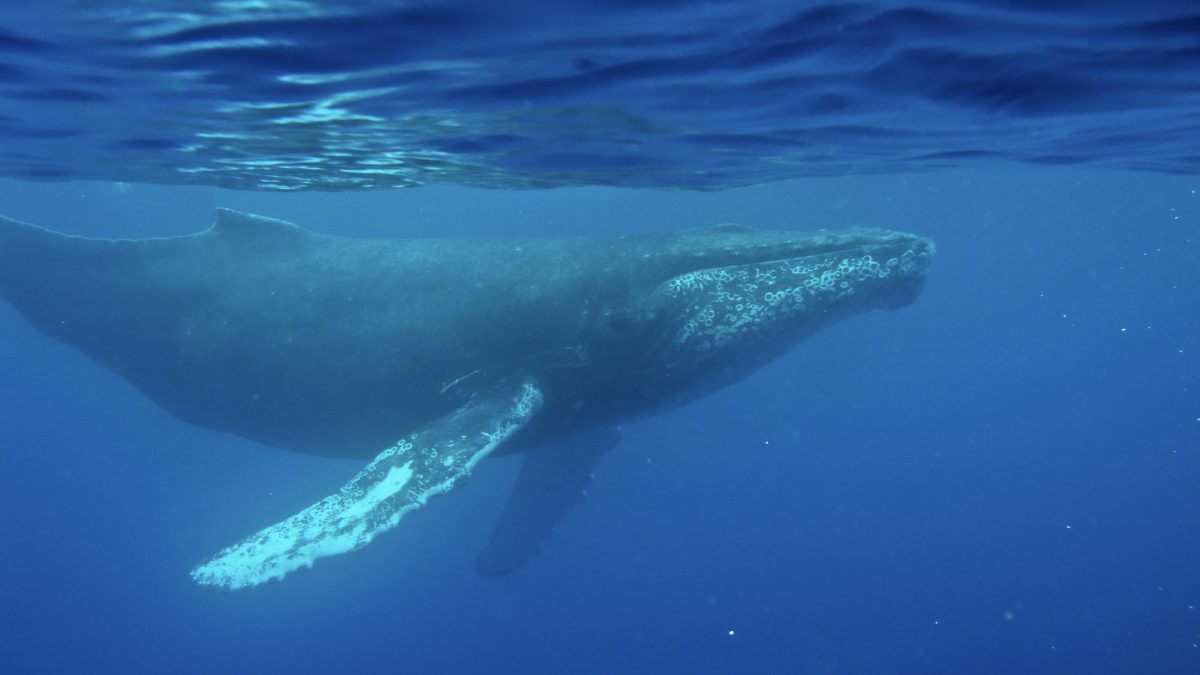 Humpback whales are legendary for their long, haunting songs, which can travel thousands of miles through the ocean. (Photo by Aran Mooney, ©Woods Hole Oceanographic Institution)
 February 10, 2026
Photos, video, and audio available for use with credit can be found here.
Woods Hole, Mass. (February 10, 2026)— Researchers and archivists at the Woods Hole Oceanographic Institution (WHOI) have identified what may be the earliest preserved recording of a whale: the song of a humpback, captured on March 7, 1949, near Bermuda.
The recording was discovered on a fragile but remarkably well-preserved audograph disc in WHOI’s archival collections that was digitized by Mass Productions. At the time of the recording, researchers aboard the R/V Atlantis were testing sonar systems, measuring explosive volumes, and conducting other acoustic experiments in partnership with the U.S. Office of Naval Research. Advances in technology were just beginning to enable recordings of underwater sound, which highlighted how little we knew about the sources of many of the ocean’s sounds.
Around the same time, WHOI scientist William Schevill and his wife Barbara Lawrence, a pioneering mammologist herself, were laying the groundwork for what would become the field of marine mammal bioacoustics. In 1949, they used a crude hydrophone and a dictating machine to record beluga whales from a small boat in the Saguenay River in Canada; the first recording that identified sounds from a marine mammal in the wild. Many recordings from the late 1940s are poorly preserved and often inaccessible, reflecting a period when science had yet to reliably identify which ocean sounds were produced by marine mammals.
“Data from this time period simply don’t exist in most cases,” said Laela Sayigh, a marine bioacoustician and senior research specialist at WHOI. “The ocean is much louder now, with increases in both number and types of sound sources. This recording can provide insight into how humpback whale sounds have changed over time, as well as serving as a baseline for measuring how human activity shapes the ocean soundscape.”
To help place the 1949 humpback recording in historical and acoustic context, WHOI has been working with colleagues at Ocean Alliance, which maintains an archive of more than 2,400 recordings of whale and ocean sounds collected from the 1950s through the 1990s.
How ocean listening has changed
Today, WHOI scientists rely on technologies such as passive acoustic buoys, Slocum gliders, and autonomous hydrophones to monitor ocean acoustics. These modern systems generate vast datasets used to study marine life, track human impacts, and understand long-term environmental change.
The WHOI-led Robots4Whales program has a targeted focus on protecting marine mammals, utilizing autonomous ocean robots equipped with the Digital Acoustic Monitoring Instrument (DMON) to detect whales in real-time. DMONs carry a low-frequency detection and classification system that identifies marine mammal calls by analyzing how sound frequency changes over time, producing “pitch tracks” derived from spectrograms. These pitch tracks allow the system to classify calls based on a known library and report results back to shore via satellite in near-real time.
“Underwater sound recordings are a powerful tool for understanding and protecting vulnerable whale populations. By listening to the ocean, we can detect whales where they cannot easily be seen,” said Peter Tyack, a marine bioacoustician and emeritus research scholar at WHOI. “At the same time, these acoustic tools let us track how human activity, from shipping noise to industrial sounds, changes the ocean soundscape and affects the way whales communicate, navigate, and survive.”
Preserved against the odds
These newly discovered recordings from 1949 mark an early moment in the evolution of ocean acoustic technology. The sounds were captured on a Gray Audograph—an office dictation device that etched audio onto thin plastic discs rather than magnetic tape—and were likely recorded using the WHOI “suitcase,” an early experimental underwater acoustic recording system.
Unlike most recordings from this era, which have been lost as tapes deteriorated, these discs survived and appear to have been uniquely used for underwater sound, making them a rare and possibly singular example of early ocean listening preserved on audograph media.
“These audograph discs survived because of their material and careful preservation,” said Ashley Jester, Director of Research Data and Library Services at WHOI. “WHOI’s audograph collection reflects a chain of close observation and curiosity—first by the scientists and engineers who recorded underwater sounds they couldn’t explain, and now by the librarians, archivists, and audio preservation experts who were determined to keep digging.”
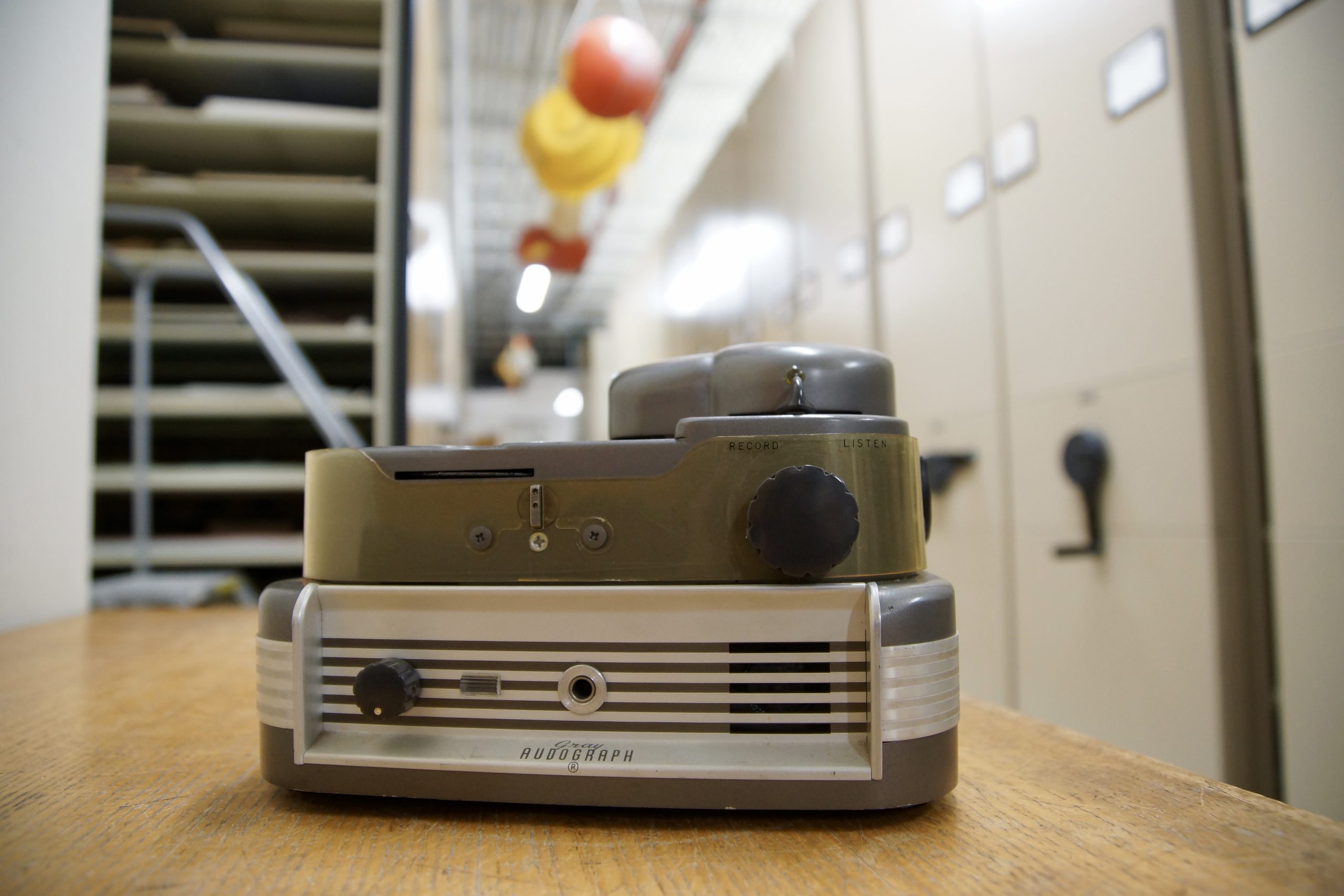
The 1949 humpback whale sounds were captured on a Gray Audograph, an office dictation device that etched audio onto thin plastic discs, and were likely recorded using the WHOI “suitcase,” an early experimental underwater acoustic recording system. (Photo by Rachel Mann, ©Woods Hole Oceanographic Institution)
The WHOI Archives recently received a $10,000 award from the National Recording Preservation Foundation to digitize its audograph collection to ensure its long-term preservation. Once digitization is complete, the collection will be more accessible to researchers and the general public, opening the door for more discoveries.
“Preserving data when it is created is an investment in the future of science,” Jester continued. “These recordings remind us why we collect data, even when we don’t immediately know what it means.”
###
About Woods Hole Oceanographic Institution
Woods Hole Oceanographic Institution (WHOI) is a private, non-profit organization on Cape Cod, Massachusetts, dedicated to marine research, engineering, and higher education. Founded in 1930, its mission is to understand the ocean, its interactions with the Earth, and its role in a changing global environment. WHOI’s pioneering discoveries arise from a unique blend of science and engineering that has made it one of the world’s most trusted leaders in ocean research and exploration. Known for its multidisciplinary approach, advanced ship operations, and unmatched deep-sea robotics, WHOI also operates the most extensive suite of ocean data-gathering platforms worldwide. More than 800 concurrent projects—driven by top scientists, engineers, and students—push the boundaries of knowledge to inform people and policy for a healthier planet. Behind the scenes, ship captains, mates, craftsmen, marine operations, and other skilled professionals provide essential support that makes this work possible. Learn more at whoi.edu.