A hadal zone mystery solved
An upside-down swimming isopod shows how tightly we are connected to the deep ocean
Estimated reading time: 4 minutes
 This article printed in Oceanus Summer 2026
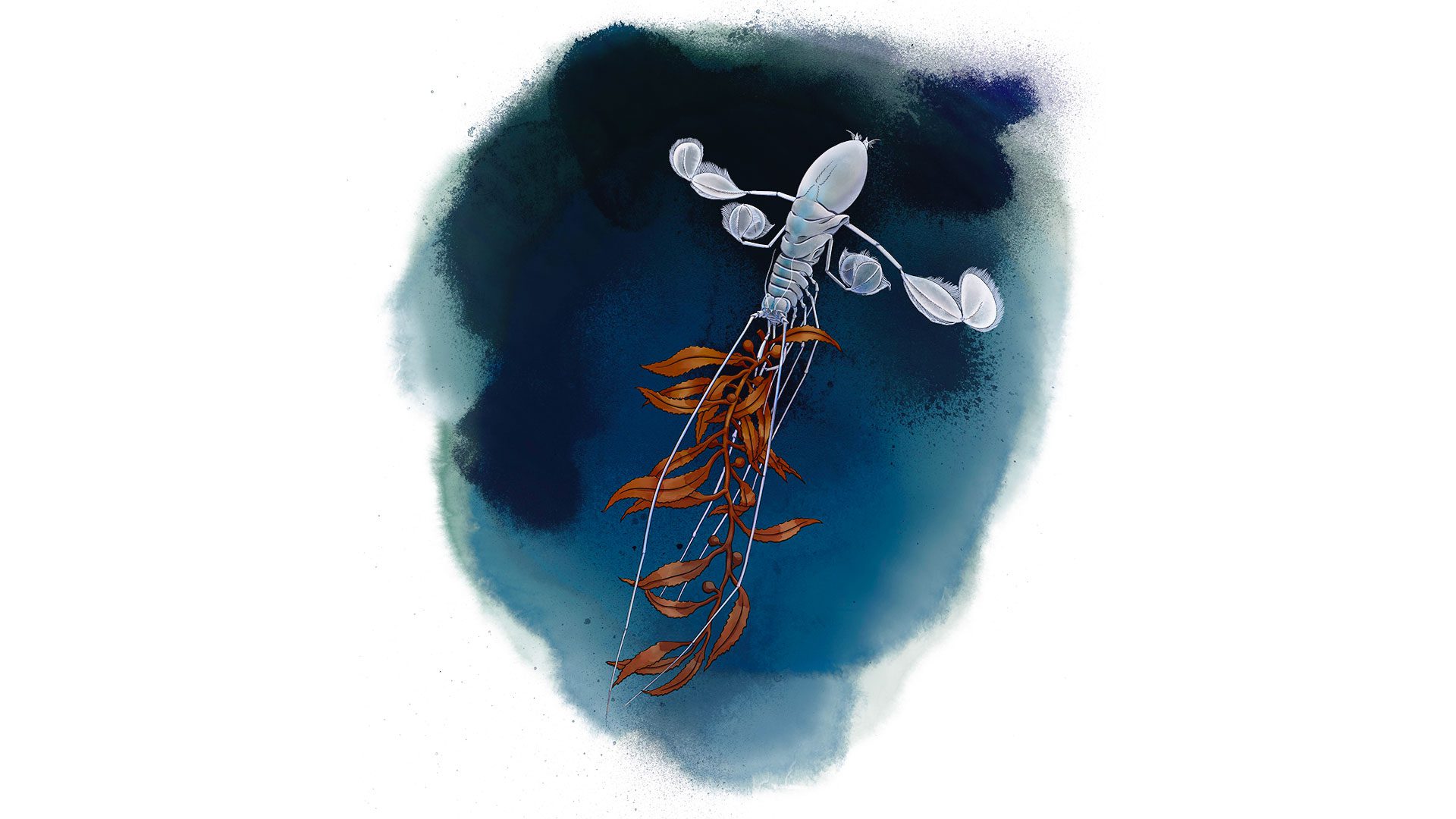
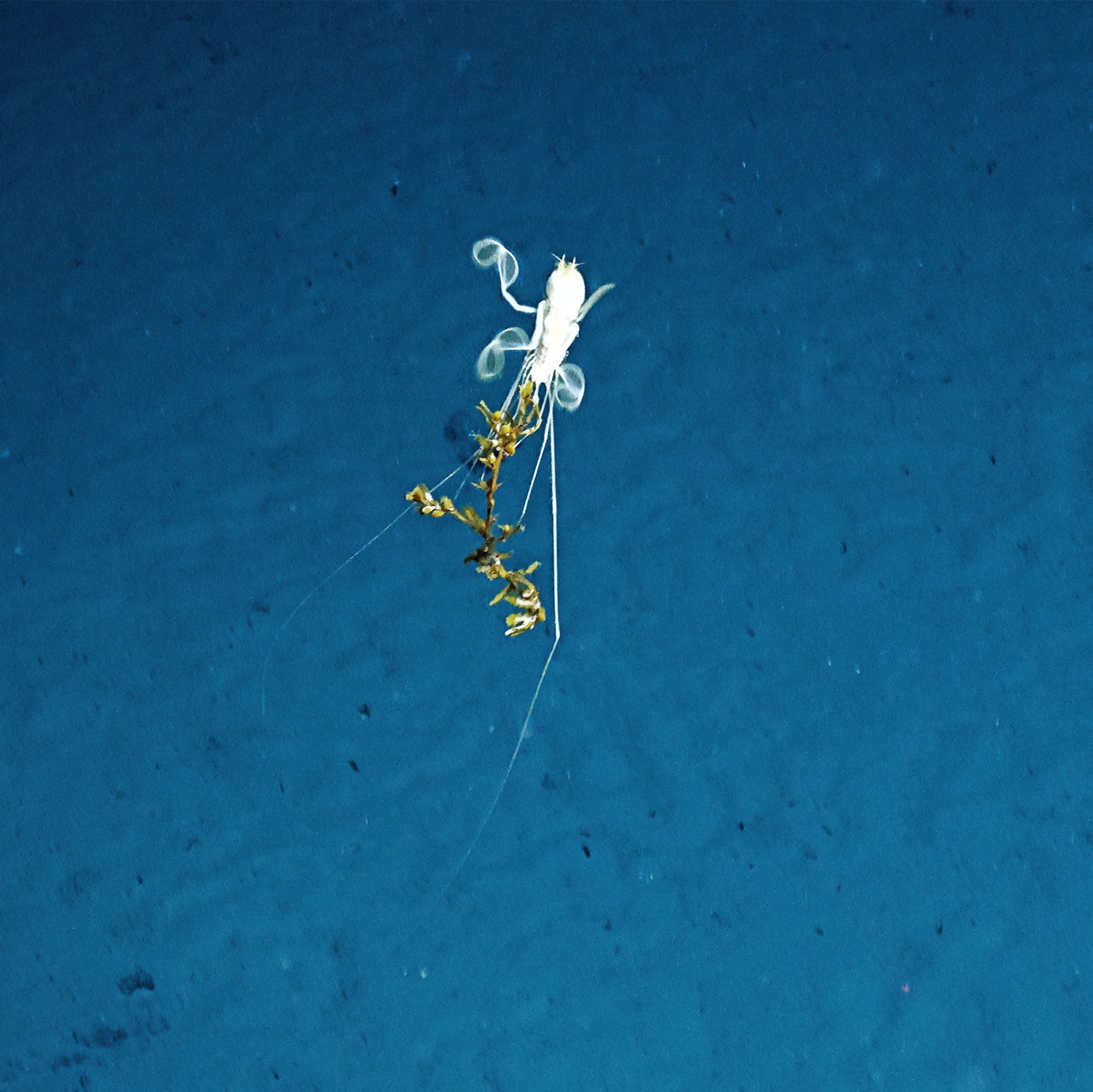
A translucent white animal, slightly larger than a cricket, slowly rises from the seafloor amid the enveloping darkness. At more than 3.8 miles (6.1 kilometers) deep, the animal swims upward by engaging two sets of paddle-like legs that work with the mechanical precision of an Olympian doing the breaststroke. This built-in propulsion system allows the animal to move vertically through the water while upside down, and carrying a patch of seaweed it had snagged in its mouth from the seafloor.
Fortunately, it’s all on film, thanks to a series of upgrades made to HOV Alvin in recent years that allowed a team of WHOI scientists to descend into the ocean’s deepest ecosystem, the hadal zone. This brings the human-occupied submersible to a depth of 21,171 feet (6,453 meters) in the Puerto Rico Trench.
But what on Earth was this rare little animal doing, hauling seaweed upside‚ down in one of the ocean’s least explored places?
“It’s an extremely rare isopod,” said WHOI Guest Investigator Johanna Weston. Through morphological analysis, the researchers identified the deep-sea swimmer as Bathyopsurus nybelini—one of the first species to teach us that life can thrive at these depths.
Weston has become smitten with the ocean’s deepest life forms during her eight years in hadal research, and this creature is no different. “It was first described in 1955 following the 1948 Swedish Deep-Sea Expedition on the Albatross to the Puerto Rico Trench,” she said. “But those specimens were collected by trawl and not in good shape—no legs, also called appendages; one lost half its body; and one was only a head.”
With this pristine Alvin-collected specimen, and a second one that wasn’t on film, Weston and a collaborative team of researchers from the University of Montana's Flathead Lake Biological Station, SUNY Geneseo, Willamette University, and the University of Rhode Island applied modern approaches to solve the hadal mystery of what the isopod in the video was doing. Was it taking the seaweed somewhere for an afternoon snack, or using it as something to hide behind to keep safe from predators? Or could it have been carrying the seaweed to simply make itself appear larger?
According to a study in the journal Proceedings of the Royal Society B: Biological Sciences, this deep-sea isopod was feasting on sargassum. By combining anatomical studies, CT scans, DNA sequencing, and microbiological analyses, the team showed that the isopod is both physically and behaviorally adapted to use this drifting seaweed as food.
“The expanded depth capacity of Alvin is so exciting. It’s changing the way we do hadal science.” —Johanna Weston, WHOI guest investigator
At the ocean’s surface, sargassum grows through photosynthesis, forming vast floating forests. Most people know it as the seaweed that sometimes washes ashore in massive, smelly piles along beaches of the Great Atlantic Sargassum Belt. But not all of it stays at the surface. Some of this seaweed eventually sinks, and footage from the submersible Alvin revealed large piles carpeting the deep seafloor—a journey that takes approximately 40 hours of sinking.
In the dark depths, this isopod lies in wait to capitalize on this rain of sun-grown nutrients. Yet what looks like a buffet is actually a challenging meal: sargassum is tough, packed with complex compounds such as alginates and polysaccharides, rich in carbon but poor in nitrogen.
The team discovered that Bathyopsurus nybelini is exquisitely equipped to make a living from one of the ocean’s toughest meals. Its mouthparts act like a tiny recycling machine, with saw-like edges to shred the tough sargassum and grinding surfaces that crush it into digestible pieces. Inside its gut, a specialized community of microbes takes over, breaking the seaweed down even further. The researchers found that these microbes carry the genetic tools needed to digest complex sugars in the algae. Even more surprising, many of the most abundant microbes can also convert nitrogen gas from seawater into a form that living cells can use—potentially supplying an extra source of nutrition for both the microbes and their isopod host.
“I think we can all appreciate the importance of the microbes in our guts to our health,” said Logan Peoples, an aquatic microbial ecologist at Flathead Lake Biological Station and lead author of the study. “It is exciting to see that gut microbes are likely just as important to organisms that live in the deepest places in the ocean.”
 “The expanded depth capacity of Alvin is so exciting,” added Weston. “Instead of having to rely on baited traps or trawling methods to collect hadal animals, we can now take a vehicle like Alvin down there and say, ‘I want that sample’ and just collect it on demand rather than having to wait and see what comes up to the surface. It’s changing the way we do hadal science.”
Moreover, this isopod shows us how closely the ocean’s surface is linked to its depths. Though they may be miles apart, the deep ocean isn’t an impenetrable barrier.
She said observations like this force her and her colleagues to go back to the very beginning of how biology works and to think about the basics of how animals behave in the deep and what they might need. Through this analysis of the isopod in action, the researchers are learning more about swimming adaptations in the hadal zone and where isopods like this tend to live in the water column. It also provides clues as to how readily these animals are using sargassum, which helps us better understand how strongly the hadal zone is connected to the surface.