Is the ocean carbon sink in risk of faltering?
WHOI scientists explain how the ocean mitigates climate change—and could be compromised by it

By Daniel Hentz | JUNE 12, 2026
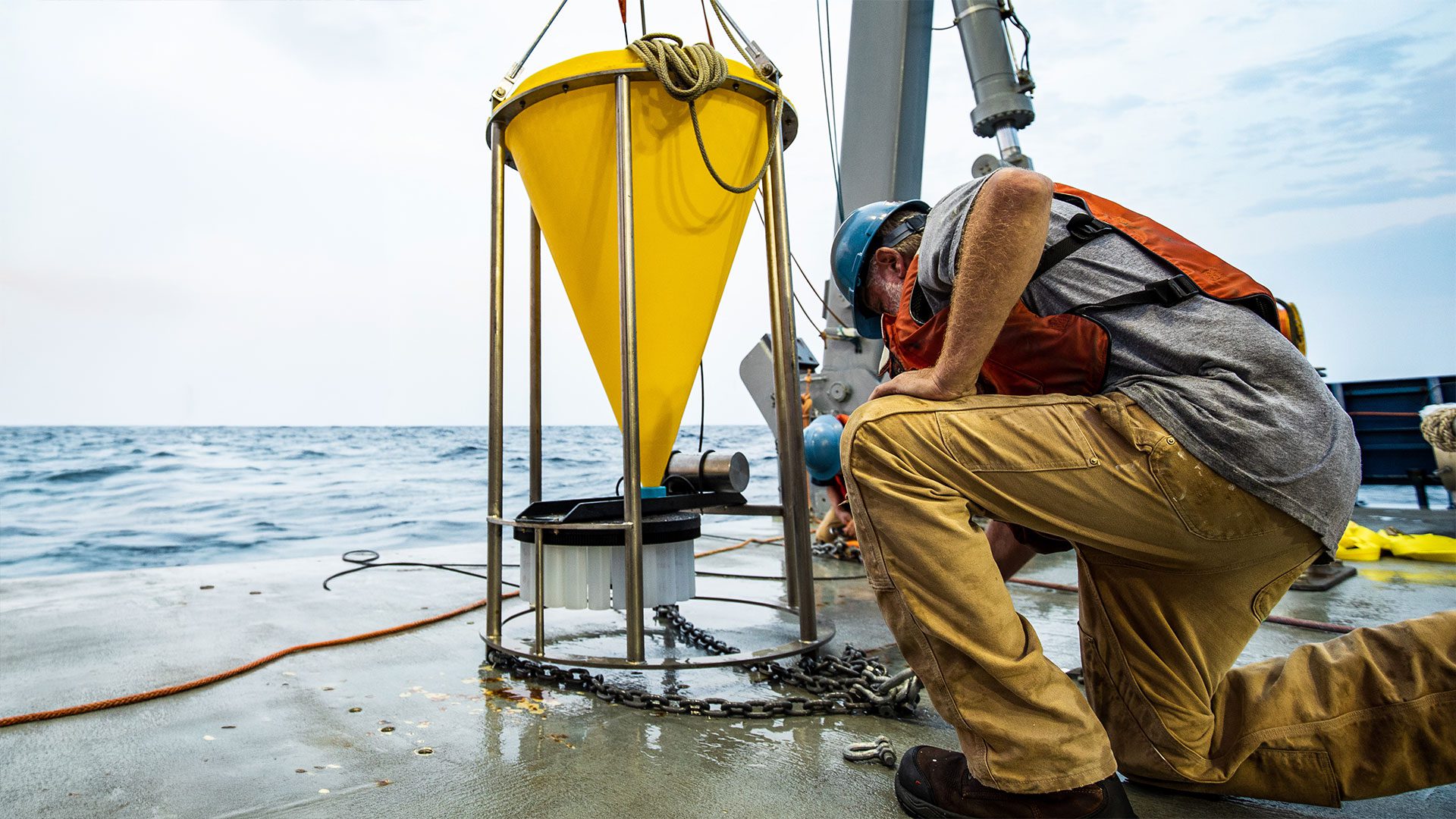
One hundred miles off the coast of New England, the most active signs of life above the waves can be found aboard an ocean-class research vessel. Here, in the remote Northwest Atlantic, scientists deploy a diverse array of instruments: ocean gliders, remotely operated vehicles (ROVs), 6-foot-tall sediment traps, and towable imaging sleds. Of all the measurements these technologies will make, the most consequential today is arguably that of marine carbon.
Carbon is the elemental backbone of carbon dioxide, the greenhouse gas driving planetary warming. The deep sea quietly regulates our climate by absorbing and storing this element. In total, the ocean holds over 39,000 gigatons of carbon—nearly 20 times that in all living things—and the equivalent of thousands of years of human-made emissions.
It’s this vast carbon sink that has helped stabilize Earth’s climate for millions of years—far exceeding the amount of carbon dioxide stored by all the world’s land plants. And it’s not just carbon dioxide. The deep ocean has also absorbed roughly 90% of the excess heat caused by human carbon emissions in the atmosphere.
Average global temperatures are already 1.4 °C (2.5 °F) warmer than pre-industrial levels, a change that has worsened droughts, spread disease, and increased air pollution from wildfires. In 2024, a report from The Lancet estimated that one-third of annual heat-related deaths—roughly 160,000—are linked to planetary warming. That’s with the ocean. Without it, scientists estimate Earth would be at least 11 °C (20 °F) warmer than today.
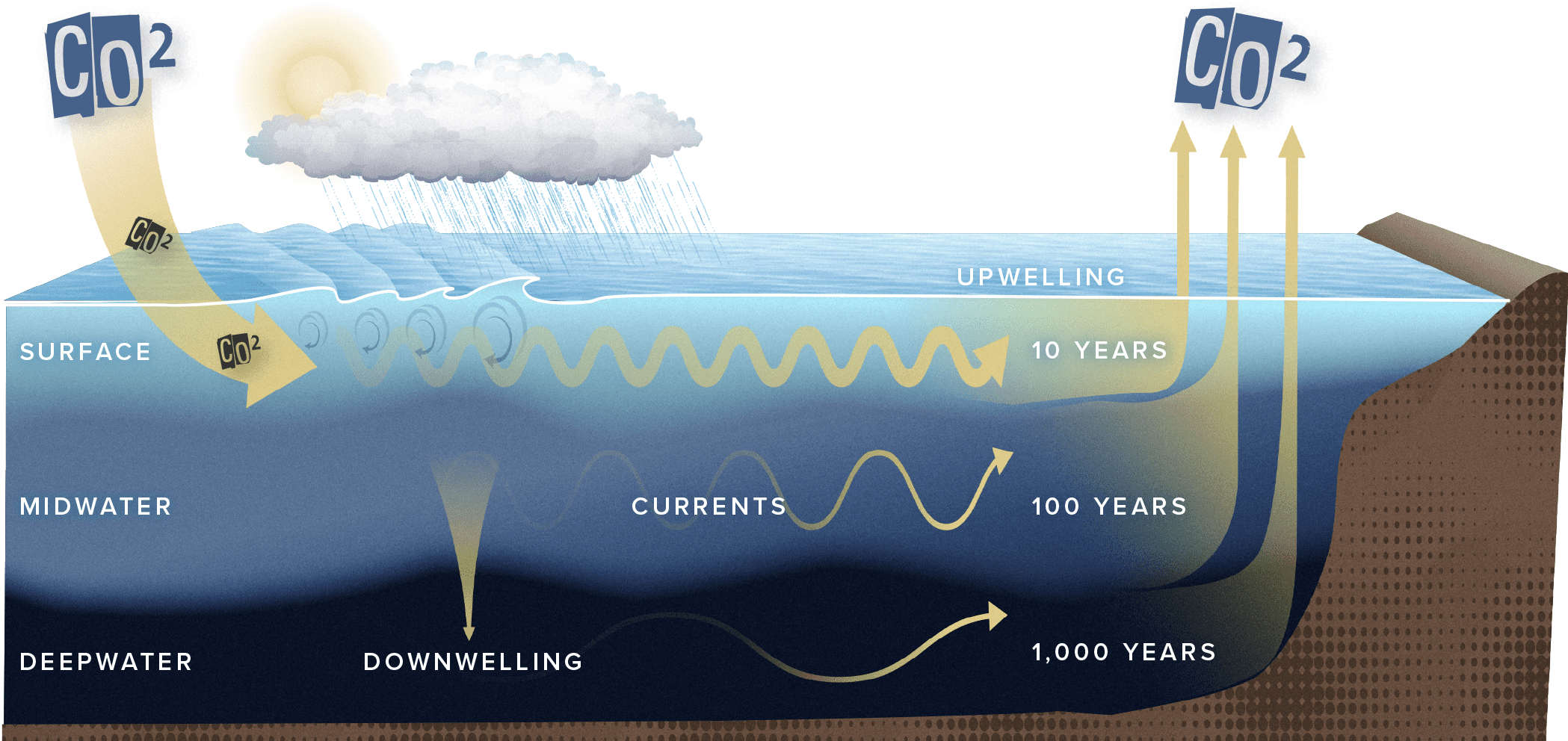
The stability of the deep ocean’s carbon storage depends on a set of physical and biological processes that move carbon from the sea surface into the abyss, where it can remain locked away for centuries. In the last hundred years, planetary warming has begun to strain these mechanisms, raising urgent questions about how long the deep ocean can hold back the worst of climate change.
“Almost all global system models that include ocean and land show a decrease in the ocean’s capacity to take up CO2 from the atmosphere in the next century,” said Ken Buesseler, a senior scientist who studies marine carbon at WHOI.
Understanding how the deep ocean sequesters carbon and why that carbon sink is under strain has become one of the central challenges of ocean-climate science at WHOI.
The Invisible Engine
Hidden in the cold, dark remoteness of the open ocean is an invisible set of pumps that suck up carbon dioxide from the atmosphere and store it in various forms—from organic matter, like fish fecal pellets and seafloor sediments, to dissolved inorganic carbon, such as free-floating CO2 molecules.
The first of these mechanisms is the physical carbon pump, also known as the “solubility pump.” Like carbonating water to make soda, CO2 from the atmosphere diffuses into seawater. Currents carry this seawater toward the poles, where it cools, absorbs more carbon along the way, becomes denser, and sinks.
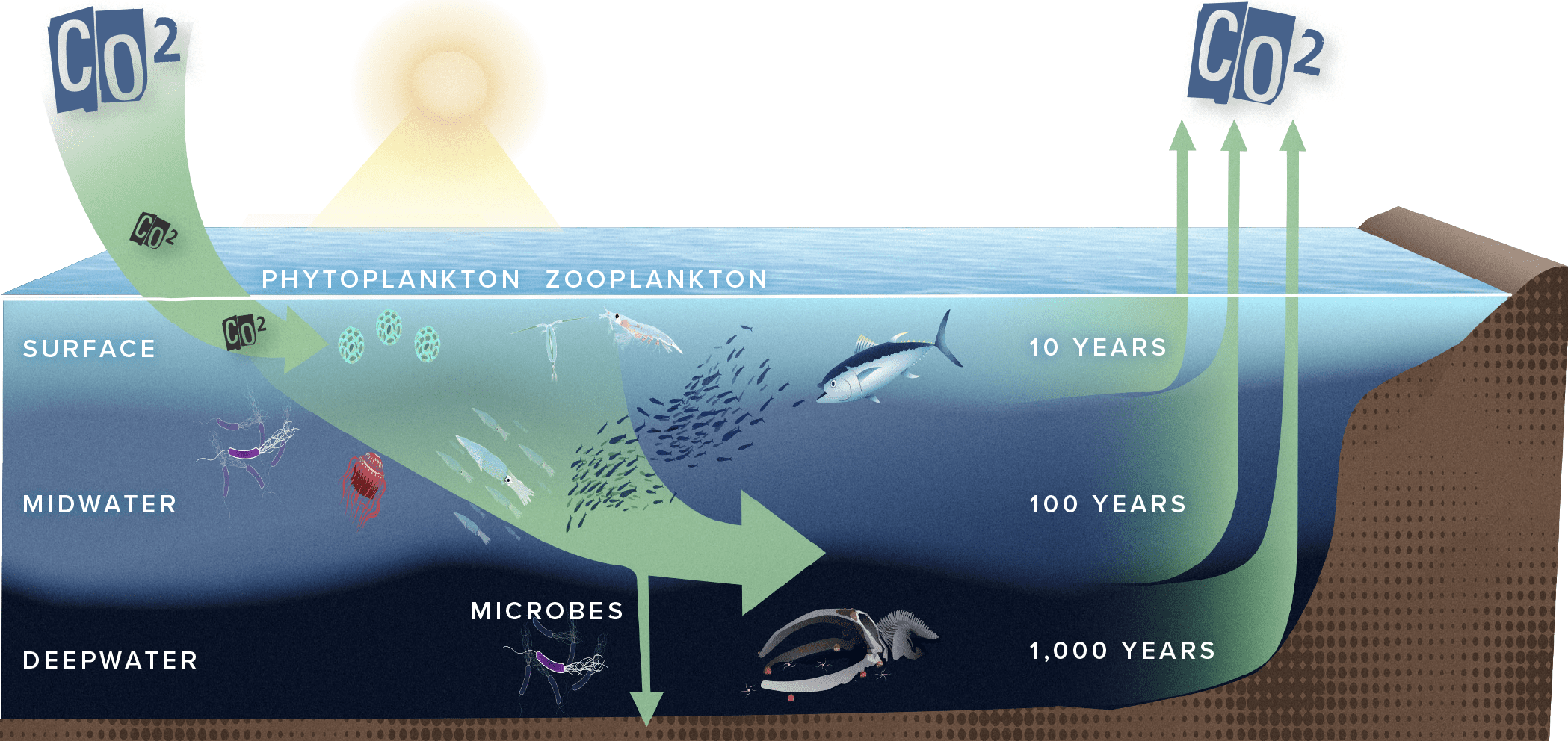
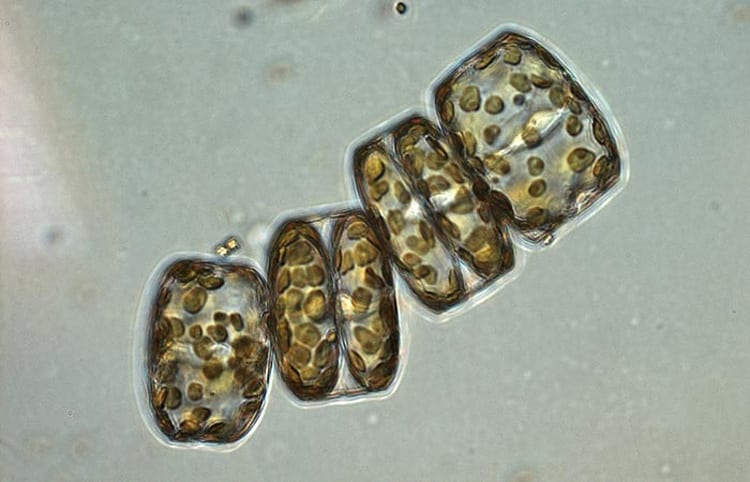
The second system, the biological pump, comprises all the organisms that help usher carbon into deeper waters. At the surface, trillions of phytoplankton consume CO2 and store it in their tissues through photosynthesis. Many plankton are eaten by fish, which excrete carbon as fecal pellets that make up drifting matter called “marine snow.” Other phytoplankton, like silica-shelled diatoms, are heavy enough to bring carbon thousands of feet to the seafloor. Microbes also process carbon, releasing nutrients that phytoplankton use to grow.
Roughly 90% of the carbon processed by the biological pump is recycled before it leaves the surface layers of the ocean. What makes it below these layers matters enormously. Just 1% of carbon absorbed by the sea will reach the seafloor. Some of it will react with alkaline rocks such as olivine and basalt, which can lock that CO2 away for hundreds, even thousands of years.
“If I can get 50% of that [carbon] down below 500 meters, it’ll stay for 100 to 1,000 years in the deep ocean,” said Buesseler. “That can have a significant effect on climate for timescales of centuries to millennia.”
Together, these carbon pumps have helped the ocean absorb roughly one-third of fossil fuel emissions. But scientists are now concerned that these systems may be at their limits.
When climate bites back
As the planet warms, the same heat and carbon the ocean has absorbed are also altering its biological, physical, and chemical properties.
Warmer global temperatures have heated the top 100 meters (328 feet) of the ocean by 0.8 °C (1.5 °F) in the last century, creating a steep contrast between the sunlit surface and deeper layers. This makes the upper layers less dense than the lower waters, which inhibits ocean mixing.
“If you have a warmer, more stratified ocean, fewer nutrients from the deep ocean reach the surface, so you get less productivity in phytoplankton,” said Buesseler. “As that happens, ocean concentrations of CO2 increase.”
Marine plants are already responding. In 2019, a WHOI-led review of satellite data over the North Atlantic showed a 10% drop in primary productivity over the previous decade.
Excess CO2 has also lowered the ocean’s pH, making it more acidic and corrosive to many shelled organisms—including certain phytoplankton that absorb CO2.
“On timescales of decades to a century, there’s only so much buffering that the ocean can do,” said WHOI marine chemist Adam Subhas. “As more CO2 enters the ocean and acidifies seawater, you reduce the ability of that carbon sink to continue at its current rate.”

Subhas, like Buesseler, wants to know how the deep ocean’s pumps are faring to help policymakers understand our climate future. He can make predictions using computer models, but will need much more data to know how much marine carbon is moving throughout the deep ocean—and how fast.
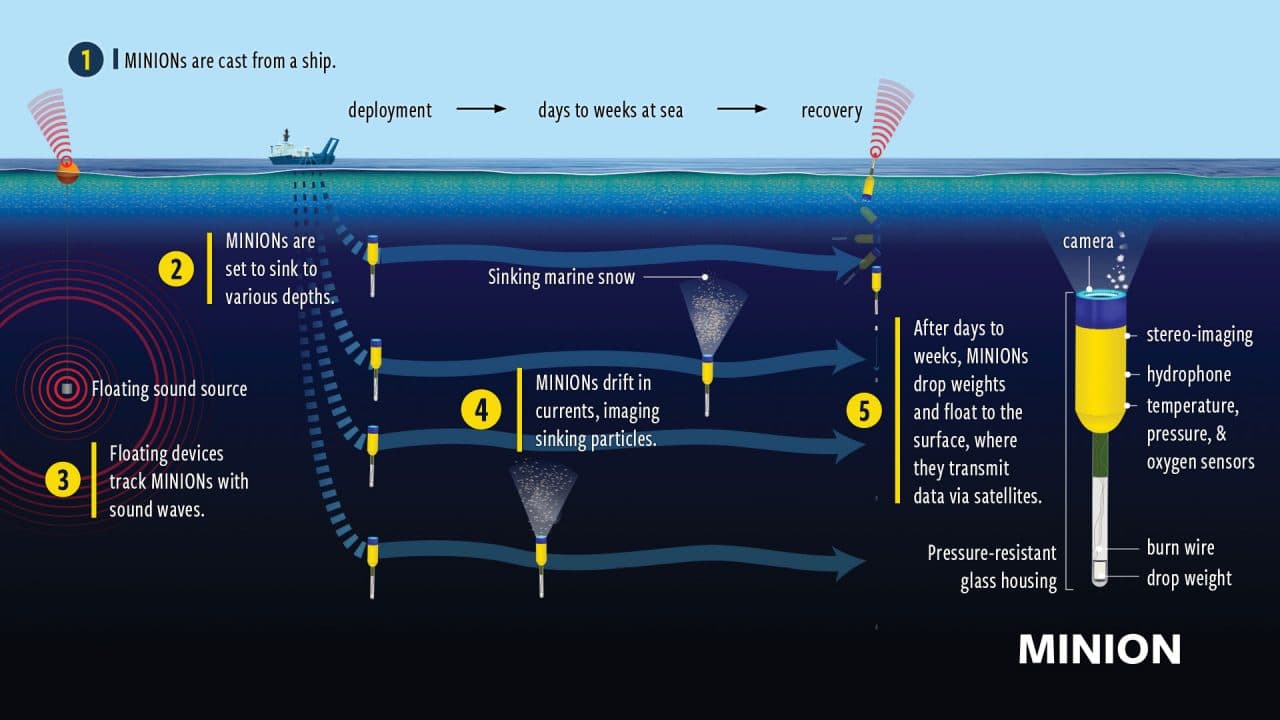
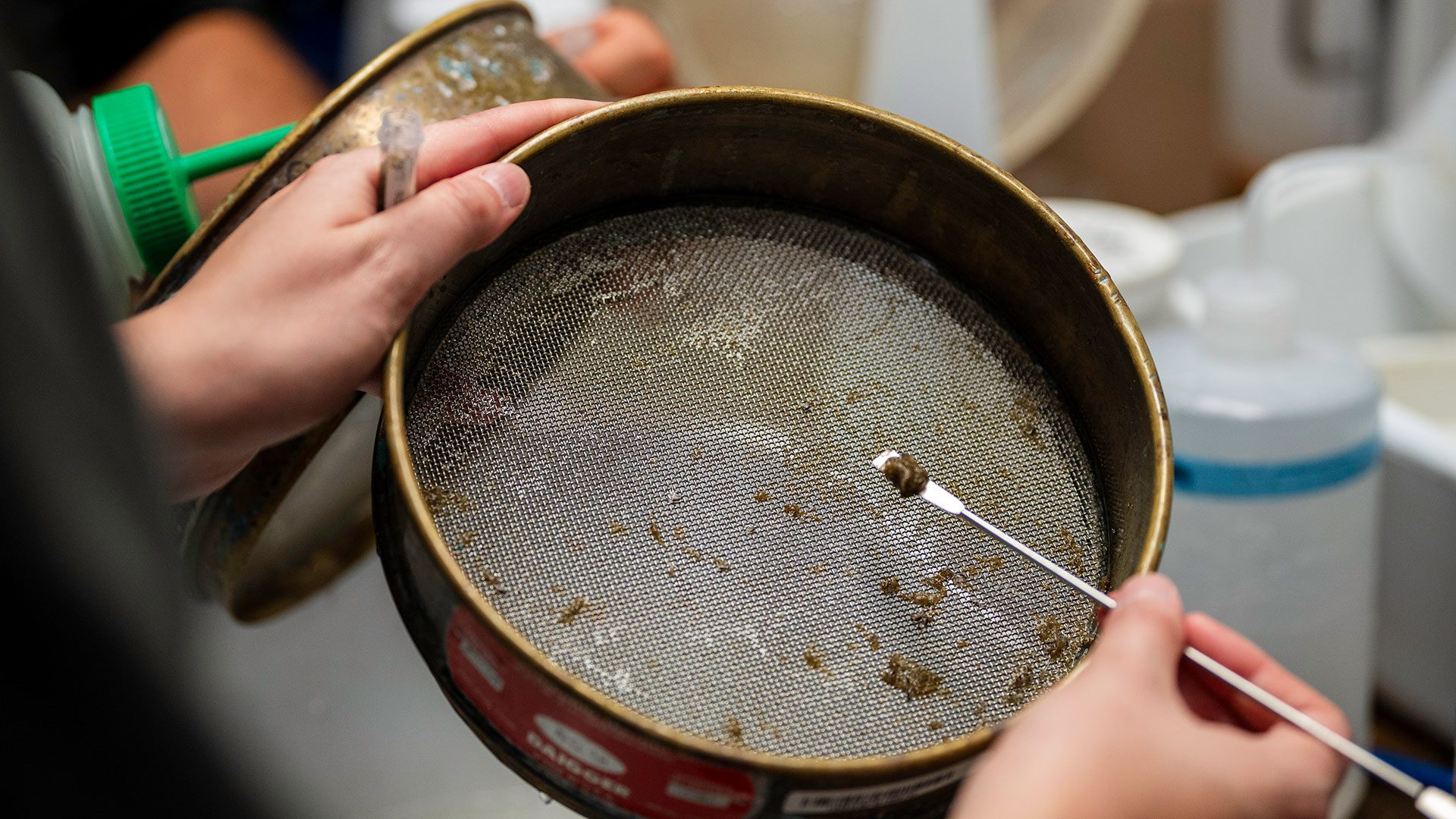
Quantifying marine carbon is difficult, thanks to the remoteness of the deep sea and the many forms carbon takes. At WHOI, scientists observe organic matter at depth, such as marine snow, either by collecting it using cylindrical sieves or by photographing by lowering towable cameras. For inorganic carbon, such as CO2, researchers rely on chemical analysis of the seawater carried out by deep-diving floats and gliders. These vehicles can transmit data on temperature, salinity, oxygen, and pH back to shore. For carbon-rich sediments, scientists must make the intrepid trip by ship and lower drilling equipment to extract samples from the seafloor.
Global efforts, such as the National Science Foundation’s Biogeochemical Argo Floats, have helped to capture much of the chemical data. Still, scientists say they need a more dedicated data-collection effort to calculate not just how much marine carbon the ocean is storing, but also how much less it may be sequestering each year.
“Research programs allow us to get a basin-wide snapshot of what the ocean is doing,” said Subhas. “They’re really critical for us to start understanding how the deep ocean is responding to climate change.”

Watching the vital signs
In 2023, the Intergovernmental Panel on Climate Change published its sixth climate assessment, which included a summary of findings from global models. The ocean carbon sink, it concludes, would likely see a “large reduction of its buffering capacity” by 2050. Exactly how much less carbon the deep sea will absorb by then remains a mystery—one scientists can only solve with more data to feed ocean-climate models.
In August 2024, WHOI launched the Ocean Vital Signs Network (OVSN) to monitor the health of the deep ocean’s carbon pumps by scaling up existing observatories in the Northwest Atlantic. The team, a cohort of 15 principal investigators including Buesseler, has already launched a dedicated fleet of gliders, begun development of a new inorganic carbon sensor, and leveraged key partnerships in the shipping industry to collect crucial chemical data—metrics such as pH, oxygen, and temperature that will change in response to carbon levels. What’s more, OVSN will seed research projects designed to gather new observational data, not only on the physics and chemistry of marine carbon, but also on the organisms interacting with it.
“There’s this whole complicated food web that you’ve got to deal with, and it’s very [seasonal] in nature—that makes it hard to measure marine carbon,” said Susan Wijffels, a physical oceanographer and one of OVSN’s lead investigators. “We’re hoping to collect observations that will help us understand processes,” from microbial carbon cycling to seasonal blooms in phytoplankton near polar waters—activity that changes how much carbon is sequestered throughout the year.
Whereas many studies of marine carbon have been siloed in the past, OVSN will funnel data into a centralized model, one in which scientists can feed realistic parameters that ground predictions of the deep ocean’s future. From field observations, they’ll be able to incorporate new knowledge of the diets of different species of microbes, the growth rates of plankton, and the physics behind whether organic matter drifts or sinks.
Though the initiative has begun in WHOI’s aquatic backyard, Wijffels says the hope is to eventually globalize OVSN’s comprehensive approach to marine carbon research and monitoring.
“We need this capability globally,” she said. “As much as people don’t want to deal with this, we’re going to have to manage the carbon in the atmosphere, and the ocean is a major player.”