
Sei whales take their spring break in waters off New York and New Jersey
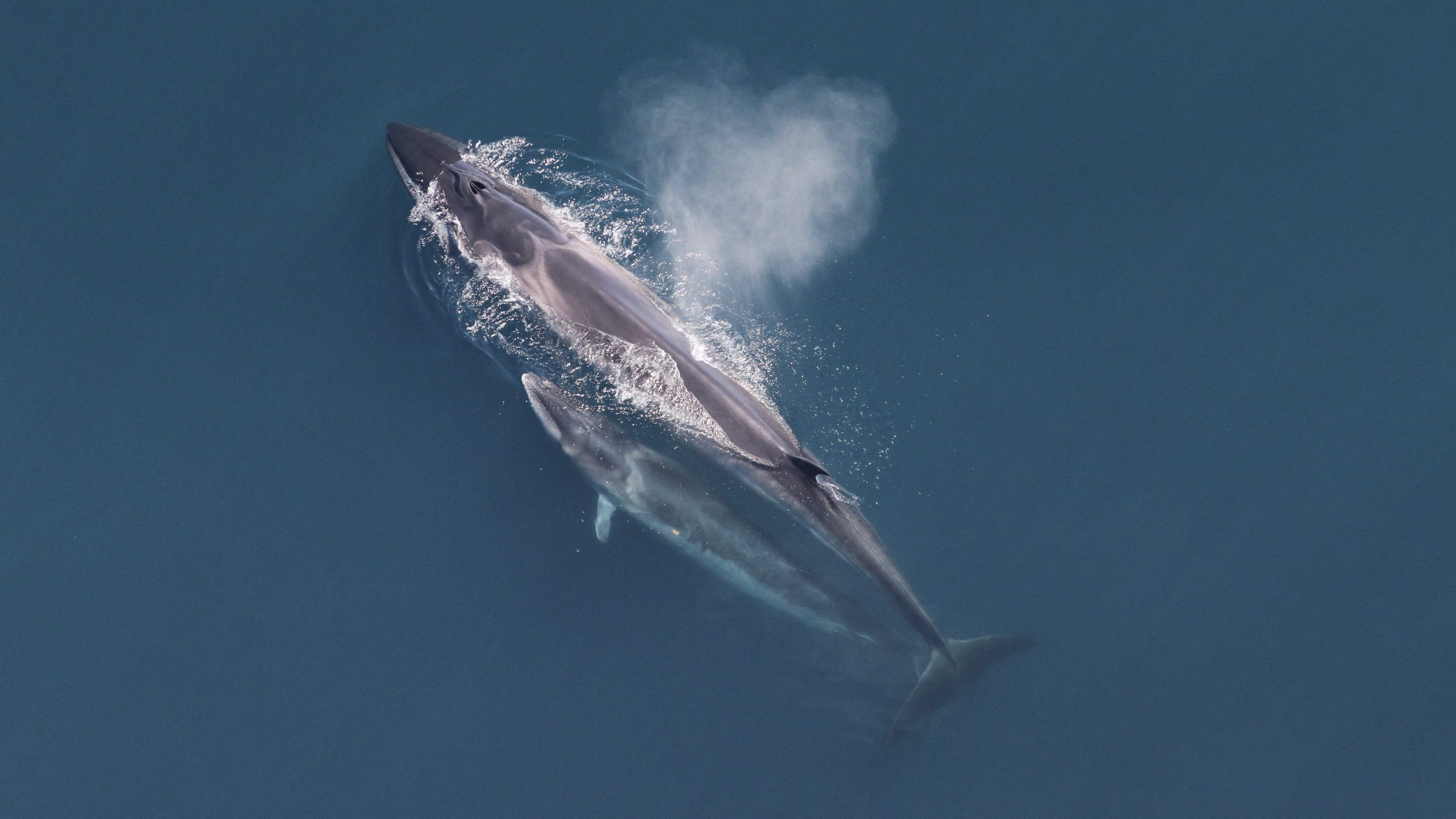
Images available for use with credit can be found here.
New York (April 2, 2026) — A new study led by scientists from the Wildlife Conservation Society (WCS) and Woods Hole Oceanographic Institution (WHOI) reveals that endangered sei whales regularly use the New York Bight as a key spring habitat, underscoring the importance of this heavily trafficked region for one of the world’s fastest and most elusive baleen whales.
Using acoustic monitoring data collected with WHOI-developed technology from 2017 to 2020, researchers documented strong seasonal and daily patterns in sei whale presence and vocal activity. The findings suggest that the waters off New York and New Jersey may serve as an important migratory corridor—and potentially a feeding area—during early spring.
The study, Seasonal and Diel Acoustic Activity of Sei Whales (Balaenoptera borealis) in the New York Bight, was conducted by researchers from WCS’s New York Bight Program and WHOI.
“This is the first detailed analysis of daily and seasonal acoustic patterns for sei whales in the New York Bight,” explained Maria Papadopoulos, lead author of the study with WCS and graduate researcher at Columbia University. “We found that 95 percent of sei whale vocalizations were detected between March and May, with activity peaking in the late spring, when temperatures are between 41 and 48 degrees Fahrenheit. This highlights a narrow environmental window when the whales are most likely to be present, potentially linked to prey availability.”
Sei whales are listed as Endangered under U.S. and international laws, yet they remain one of the least-studied large whales in the North Atlantic. Adult sei whales, with a dark gray to black body, a white colored belly, and irregular light gray to white markings, are on average 47 feet long, weighing 44,000 pounds (a similar weight to four African elephants). They are the third largest whale species after blue and fin whales. They produce loud, low-frequency sounds that go down in pitch and are generally produced in doublets (pairs) or triplets.
The study found that sei whales vocalize more frequently during daylight hours, a pattern consistent with reduced calling at night when whales are thought to be feeding. This daily rhythm allows us a better understanding of times when sei whales may be more sensitive to disruption by human activities. For example, elevated noise levels during the daytime when sei whales are more vocal may make vital communication between sei whales challenging.
“These results suggest that sei whales may not just transit through the New York Bight but may also use these waters more seasonally in certain years,” said Papadopoulos. “Continuing to document trends in sei whale presence will help inform policies and practices to improve protections for this endangered species.”
The New York Bight encompasses the busiest port complex in the United States. By establishing a clear baseline for when sei whales are present and how they may use the area, the study provides critical information for managing human activities in ways that reduce risks to whales.
The authors note that sei whales are already being detected in near-real time by the same acoustic systems (deployed and managed by the Woods Hole Oceanographic Institution) used to protect critically endangered North Atlantic right whales.
“Acoustic monitoring provides us with an amazing opportunity 24/7/365 to learn about whales and dolphins in the waters off New York and New Jersey,” said Dr. Howard Rosenbaum, co-author and Executive Director of the WCS New York Bight Program. “That capability is especially important for species like sei whales that are rarely seen but clearly present. Understanding when and where whales occur is essential for effective conservation. This study gives us that knowledge about sei whales—and an opportunity to act on it.”
WCS has conducted research in the New York Bight for more than a decade, informing policy recommendations to protect sei whales and several other species of whales, including fin, North Atlantic right, humpback, and minke.
###
About Woods Hole Oceanographic Institution
The Woods Hole Oceanographic Institution is a private, non-profit organization on Cape Cod, Massachusetts, dedicated to marine research, engineering, and higher education. Established in 1930, its primary mission is to understand the ocean and its interaction with the Earth as a whole, and to communicate an understanding of the ocean’s role in the changing global environment. Top scientists, engineers, and students collaborate on more than 800 concurrent projects worldwide—both above and below the waves—pushing the boundaries of knowledge and possibility.
Wildlife Conservation Society (WCS)
WCS saves wildlife and wild places worldwide through science, conservation action, education, and inspiring people to value nature. To achieve our mission, WCS, based at the Bronx Zoo, harnesses the power of its Global Conservation Program in more than 55 countries and in all the world’s oceans, and its five wildlife parks in New York City, visited by more than 3.5 million people annually. WCS combines its expertise in the field, zoos, and aquarium, to achieve its conservation mission.
Visit: WCS Newsroom. Follow: @TheWCS and @WCSNewsroom.
Listen: WCS Wild Audio podcast. For more information: +1 (347) 840-1242