
Bacteria hitching a ride on “marine snow” may slow the ocean’s carbon sink
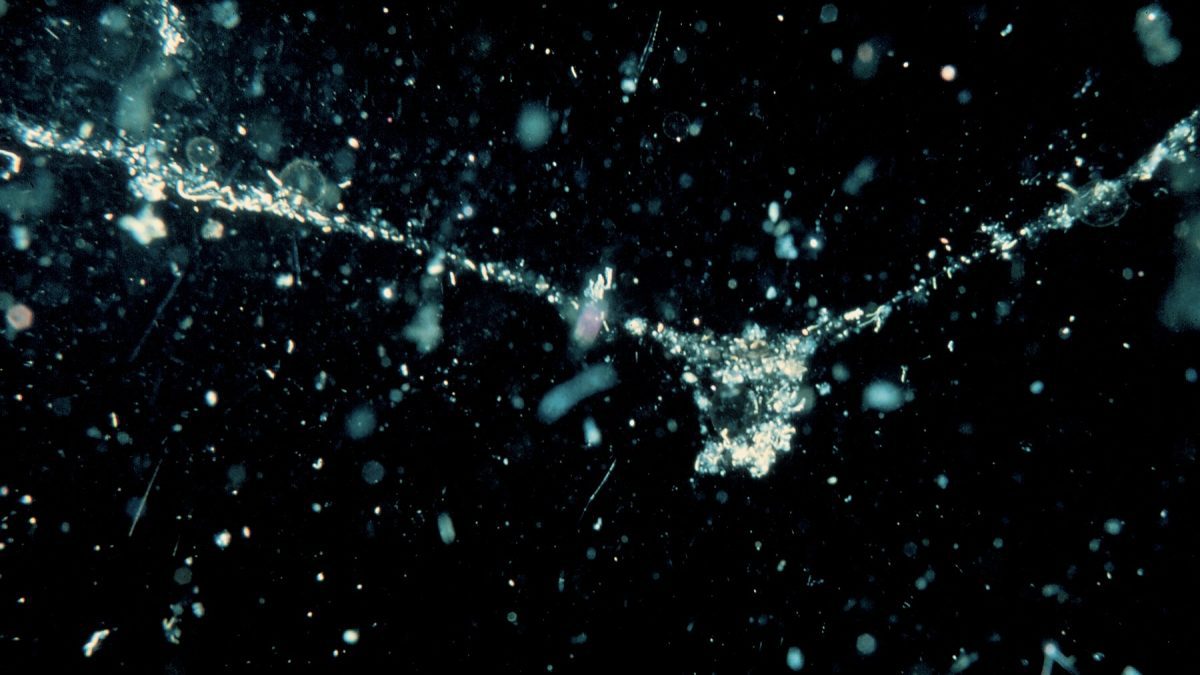 Marine snow is organic debris and fecal pellets that clump together to form millimeter-long flakes as they fall through the water column. (Photo ©Woods Hole Oceanographic Institution)
 March 11, 2026
Woods Hole, Mass. (March 11, 2026)—In some parts of the deep ocean, it can look like it’s snowing. This “marine snow” is the constant fall of organic debris, including dead plankton, fecal pellets, and other particles, that drifts down from the ocean’s surface. As these particles sink, they carry carbon with them, helping the ocean store carbon away from the atmosphere for centuries.
Now, a new study published this week in Proceedings of the National Academy of Sciences shows that tiny microbial hitchhikers can impact just how far that snow sinks.
A team of researchers from Woods Hole Oceanographic Institution (WHOI), the Massachusetts Institute of Technology (MIT), and Rutgers University found that bacteria living on marine snow particles can dissolve calcium carbonate, which is a mineral that helps particles sink deeper into the ocean. Less calcium carbonate means less ballast – or weight- to help marine snow reach the bottom. The discovery helps explain a longstanding puzzle: why calcium carbonate dissolves in relatively shallow ocean waters, despite chemical conditions that should keep it intact.
“Our findings show that microbes living on sinking particles can reshape the chemistry of their immediate environment,” said lead author Benedict Borer, assistant professor of marine and coastal sciences at Rutgers University. “What happens within these microscopic particles can ultimately influence the ocean’s ability to store carbon.”
Marine snow is central to the ocean’s biological carbon pump, the natural system that moves carbon from the surface ocean into the deep sea. At the surface, phytoplankton absorb carbon dioxide from the atmosphere and convert it into organic matter and calcium carbonate, the same mineral found in shells and corals. When these organisms die, fragments sink as marine snow. If those particles reach deep waters or the seafloor, the carbon they carry can remain stored for hundreds to thousands of years. But the new research shows that bacteria feeding on these particles can change that trajectory.
Because marine snow is responsible for transporting billions of tons of carbon to depth each year, even subtle changes in sinking behavior could affect how efficiently the ocean stores carbon. For WHOI scientists, the study underscores the importance of understanding how biological and chemical processes intersect to shape ocean systems.
Adam Subhas is a marine geochemist at WHOI and co-author of the study, “As calcium carbonate dissolves within particles, those particles become lighter and won’t sink as fast. This means that any further breakdown of organic compounds and calcium carbonate will happen at shallower depths, keeping a portion of carbon and alkalinity from reaching the deep ocean.”
“This phenomenon has been posed by scientists for decades, and our study has now opened the door to documenting its importance in the ocean’s carbon and alkalinity cycles,” Subhas continued. “Now that we know this process is occurring in marine particles, we can start to predict how it might respond to environmental change, both through earth history, and looking forward into the future.”
The study was supported in part by the Simons Foundation, the National Science Foundation, and the Climate Project at MIT.
###
About Woods Hole Oceanographic Institution
The Woods Hole Oceanographic Institution is a private, non-profit organization on Cape Cod, Massachusetts, dedicated to marine research, engineering, and higher education. Established in 1930, its primary mission is to understand the ocean and its interaction with the Earth as a whole, and to communicate an understanding of the ocean’s role in the changing global environment. Top scientists, engineers, and students collaborate on more than 800 concurrent projects worldwide—both above and below the waves—pushing the boundaries of knowledge and possibility.