Three ocean robots that plunge into active volcanoes
BY AMELIA MACAPIA | MARCH 18, 2026
Ocean robots have taken scientists into live underwater volcanoes. From Jason to Mesobot to Nereid Under Ice (NUI), these vehicles have maneuvered through narrow craters and their hydrothermal systems, helping researchers track how Earth releases heat, how volcanoes influence migrating marine life, and how far robots can go on their own.
1. Jason
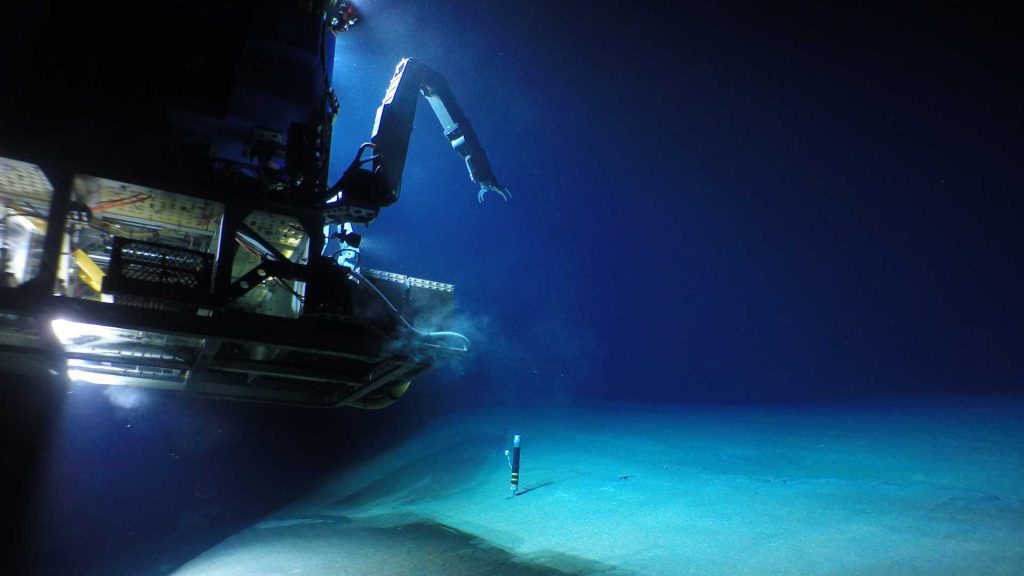
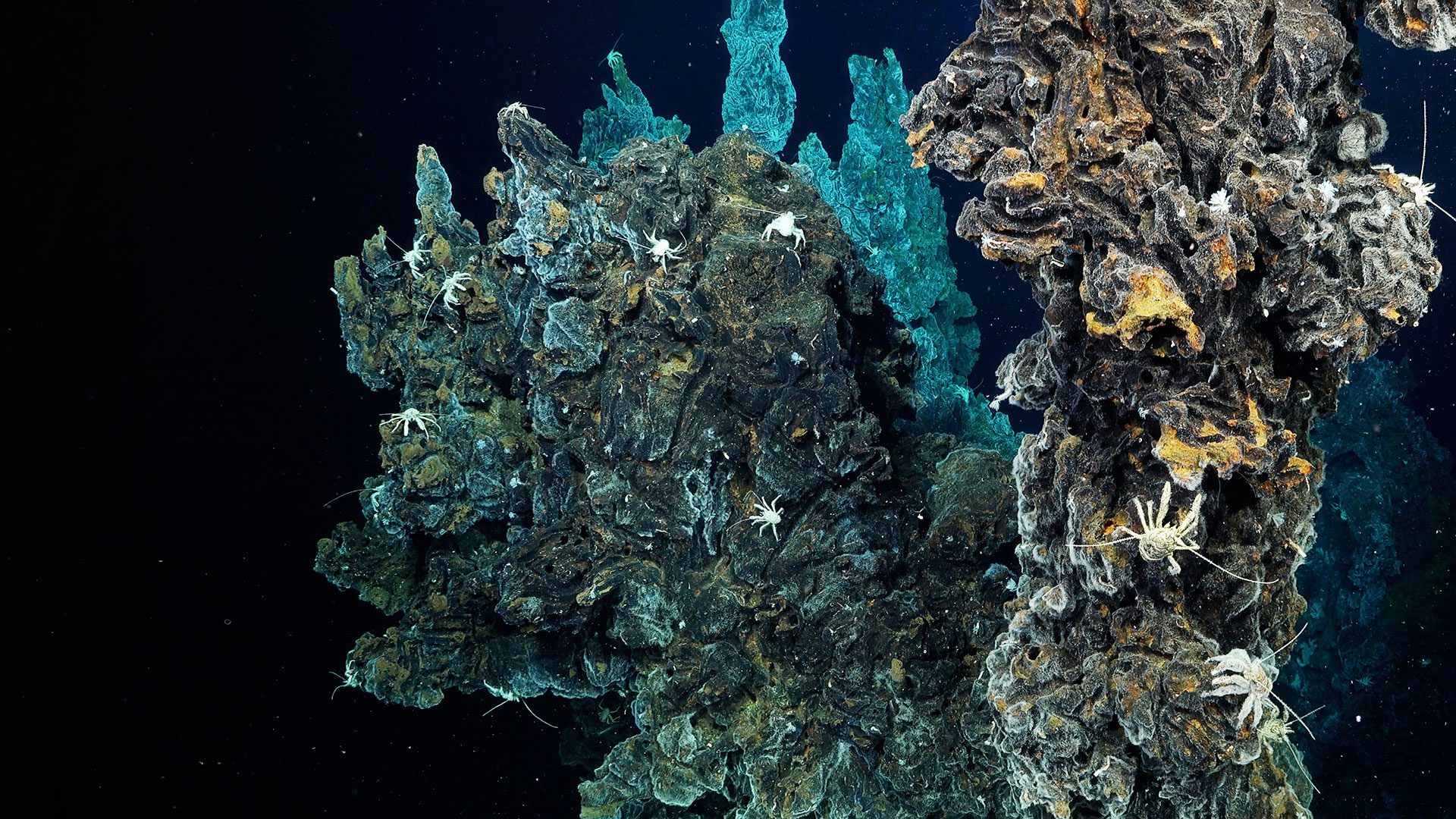
In 2015, Jason explored the inside of the Havre volcano on the seafloor near New Zealand. (Photo courtesy of Dan Fornari and S. Adam Soule, WHOI, and Rebecca Carey, Univ. of Tasmania/NSF/WHOI-MISO)
In 2023, Jason returned to Kama’ehuakanalua Seamount (previously Lōʻihi Seamount), an underwater volcano off of Hawai’i. Jason dove to the volcano’s summit crater, Pele’s Pit — a roughly mile-wide, 300-meter-deep depression formed during the seamount’s last eruption. There, Jason had to hover close to the crater’s towering, jagged cliffs to collect samples from cracks along the crater’s base. These vents released fluid at nearly 60°C (140°F).
Jason’s mission was to map terrain, sample hydrothermal fluids, and track temperature changes of vent sites. For Senior Scientist Chris German, Jason’s dives offered a rare chance to see whether the volcano remained dormant, or had begun to show signs that it was ready to erupt.
In May of 2020 and again on Christmas Eve 2021, a series of earthquakes had rippled through the region — larger than any that had been detected in the preceding 25 years. The U.S. Geological Survey identified Kama’ehuakanalua Seamount as the source of those seismic waves.
German and others had been monitoring the temperature of five hydrothermal vent sites on the seamount for decades. Since the last eruption in the 1990s, those vents had been steadily cooling by one or two degrees, as if the system were slowly becoming dormant. After an expedition in 2018 “I had thought they would just keep cooling for a long time,” explained German.
But the two waves of seismic activity made him wonder whether something was changing in the system’s magmatic plumbing.
When his team returned to Pele’s Pit, they began by visiting vent sites they had already sampled during a 2018 expedition. At first, everything looked the same — lots of candelabra-like hydrothermal chimneys with plumes of fluid billowing upward. German anticipated the vents should now be five to ten degrees cooler after five years away. Instead, it seemed like they had not cooled at all, or if they had, they had since warmed up again.
Then, Jason drove up a slope toward the base of the crater wall. The robot’s cameras revealed that the delicate “candelabra” chimneys there had been wiped flat. “There was just this pile of lava rubble with microbial mats everywhere and the whole seafloor was shimmering with warm water flowing up among the rocks,” said German.
Jason collected samples of hydrothermal fluid at the vent sites that were still there. With its manipulator arms, it could place titanium “snorkels” shaped like
bendy-straws into the crevices where fluid was flowing out. By carefully lowering the snorkel, like dipping a paintbrush into a paintpot, the team was able to capture undiluted fluid inside the vents.
The next day, Jason dove to the center of the crater floor — an area that had been uniformly flat and covered in yellow iron oxide sediment during prior visits. This time, the seafloor was covered with “fresh lavas in tortured shapes, like fresh black taffy that had been teased out so it was really rugged,” said German. Fluid was seeping through new fractures.
While there wasn’t a big eruption, magma had been replenished within the cone of the seamount, beneath the crater floor — a stage of pre-eruption readiness. Most of that fresh magma remains poised within the cone, with small amounts leaking out “like the little bit squeezed out of the end of a tube of toothpaste,” said German.
Now, he is trying to get the results from Jason written up in time to catch Kama’ehuakanalua’s next eruption. “Clearly, the system is poised to erupt again – it would be extraordinary if we could be on site to capture that,” he said.
2. Mesobot
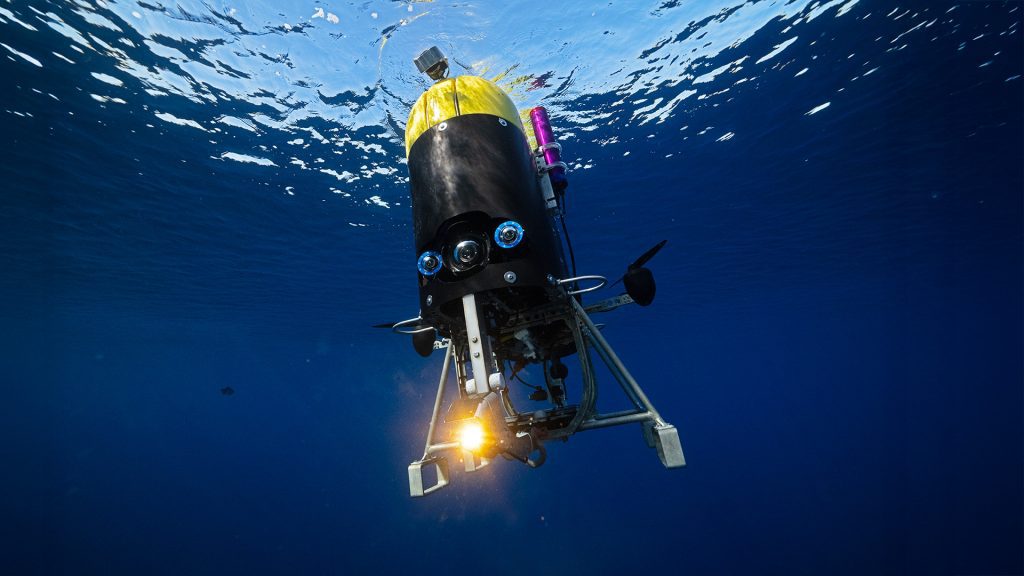
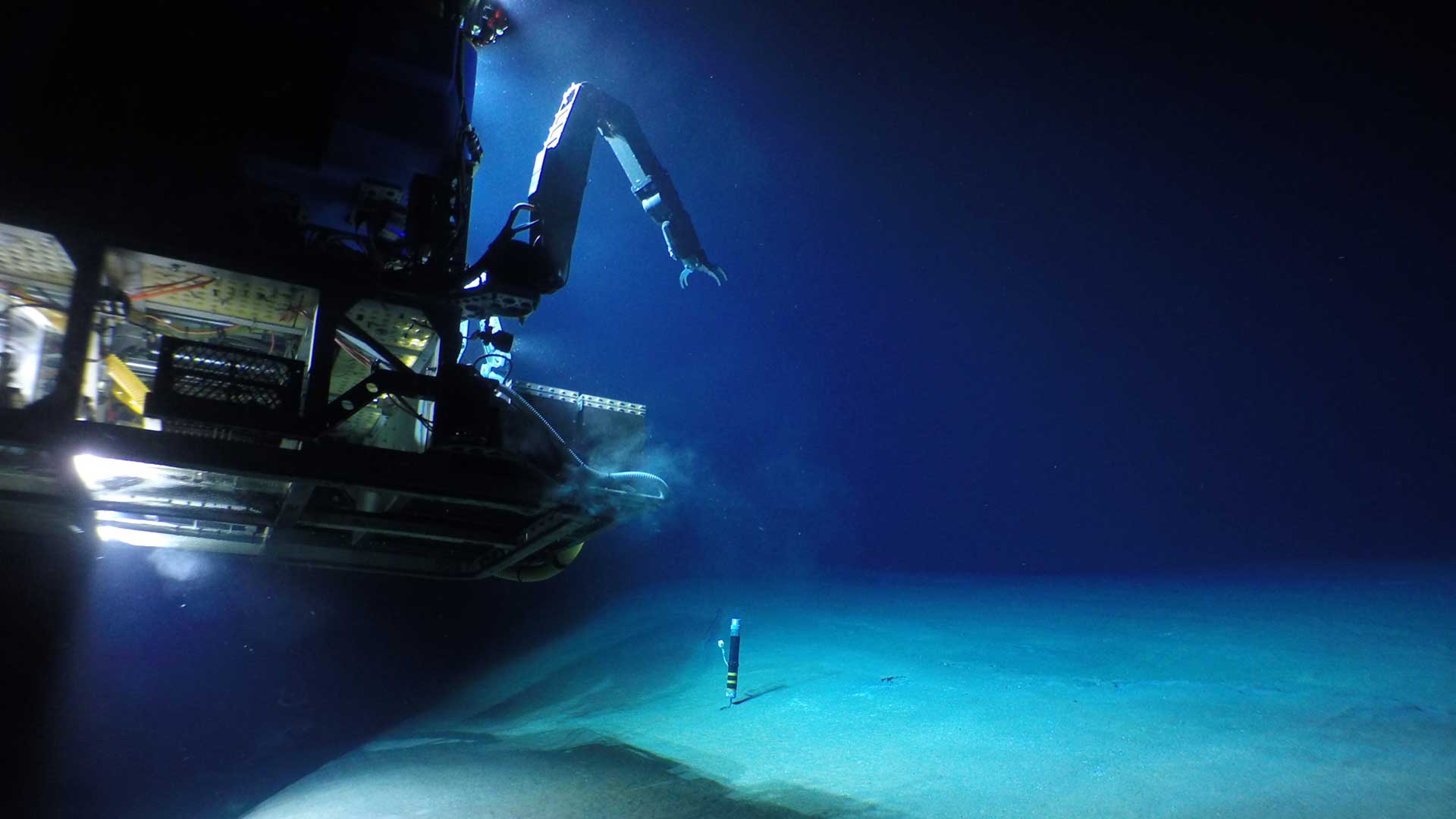
AUV Mesobot operating underwater. (Photo by Evan Kovacs, Marine Imaging Technologies, LLC © Woods Hole Oceanographic Institution)
The largest migration event happens every day in the ocean, with billions of creatures migrating up and down through the ocean’s twilight zone. Animals like crustaceans, small fish, and squid swim each night into more productive surface waters, where they can escape visual predators, and travel back to deeper depths at dawn. This biological pattern, known as diel vertical migration, circulates biomass, carbon, and biodiversity, linking surface and deeper waters.
But Molecular Ecologist and Project Lead Annette Govindarajan suspected this pattern might be different at Vailulu’u, the only active volcano in the Samoan Archipelago. Volcanic activity can fuel microbial growth and create new food sources at depth without sunlight. If animals can feed deeper down, without traveling all the way to the surface, then the timing, distance, and even the cast of migrators could shift. Govindarajan thinks this could potentially promote higher productivity in the overlying waters.
“Anecdotally, people think there is elevated biodiversity in the waters above Vailulu’u. There have been frequent sightings of marine mammals, and it is thought to be a good fishing area,” Govindarajan said.
To figure out how volcanic activity influences the daily migrations of marine life, Govindarajan’s team worked with engineers Dana Yoerger and Eric Hayden to deploy the yellow and black colored Mesobot during one of two back-to-back expeditions on the E/V Nautilus to explore the region. Mesobot carried new autonomous environmental DNA (eDNA) samplers to filter water for genetic traces of animals. Like a forensics approach, eDNA enables biodiversity detection from fragments of pieces that animals shed, like sloughed off cells, fecal pellets, and gametes, as well as single-celled microorganisms.
The standard way to sample eDNA is to collect from Niskin bottles and then manually filter the water once the bottles were back on the ship. “You have to be really careful about not contaminating your samples,” said Govindarajan. The new sampler’s high-flow-rate pumps run large volumes of water while Mesobot voyages through the water column. “The large volumes of filtered seawater will help us detect more biodiversity, especially as eDNA is dilute in the deep sea," Govindarajan said of Mesobot’s sampling.
3. Nereid Under Ice (NUI)
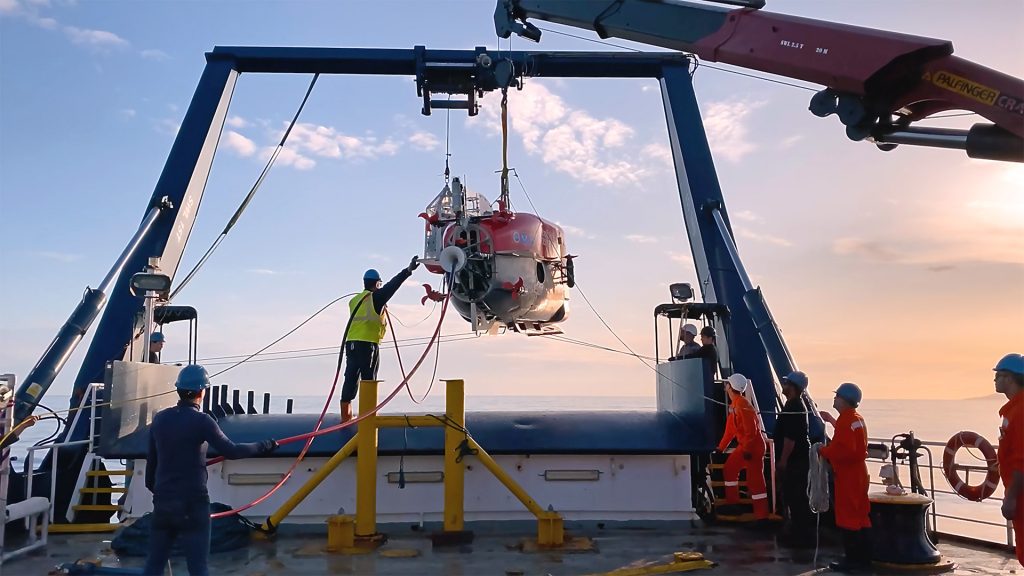
The expedition team and crew prepare to deploy Nereid Under Ice (NUI) into the sea outside of Santorini, Greece. (Image courtesy of Mike Toillion, NASA Astrobiology)
At Kolumbo, in the Aegean Sea, researchers took the question of how far an underwater robot can go into an active volcano a step further. In 2019, the hybrid robotic vehicle Nereid Under Ice (NUI) collected the first known autonomous sample using a robotic arm in the field. The vehicle has been key to collaborative exploration between robots and humans.
Collecting an autonomous sample was only one challenge NUI had to overcome to complete its mission at Kolumbo. The pilots had to pay attention to the current’s direction, “like keeping the wind in your face,” to see through billows of sediment, described Senior Engineer Mike Jakuba. Then they had to find a solid surface to brace against with enough room for NUI’s robotic arms to maneuver.
Once they landed beside a hydrothermal vent, automated planners and controllers — developed by Gideon Billings, Matt Walter, Casey Machado, and Rich Camilli — helped NUI decide where to sample and maneuver. A hose-like canister attached to NUI’s arm began “slurping” the seafloor, vacuuming up fragile organisms. The collection helped scientists studying Kolumbo’s marine life in an environment seemingly hostile to all life.
High acidity and toxic chemicals like hydrogen sulfide stream from Kolumbo’s vents. Yet NUI’s cameras revealed anemones rising from flower-like stalks, spindly urchins, and velvety microbial mats. The communities of marine life have continued to inspire questions about whether other planets in our solar system might also harbor life.
One day, autonomous sampling techniques might get us closer to answering those questions on other planets. In the meantime, scientists and engineers are still working to translate human piloting decisions into machine judgment. A 2023 expedition in the high Arctic’s Aurora Vent Field, led by Chris German, collected data in another extreme environment. The work was funded in part by a NASA PSTAR grant to WHOI, with the Jet Propulsion Laboratory (JPL) as a partner — whose expertise in planetary exploration made them a natural collaborator. Andrew Branch, a Software Engineer at JPL, then analyzed some of the data to help determine what makes a good landing site from a human pilot’s perspective, and how to translate that into something the computer can work with.
As a hybrid vehicle, NUI’s design has been critical to pushing the limits of unmanned exploration. It can autonomously map the seafloor and navigate complex terrain, but inspection and intervention activities, such as sampling, still rely on a human pilot, Jakuba explained. One long-term goal is to translate the decision-making logic of experienced pilots into algorithms that can assist, and eventually automate, parts of that process.
With its fiber optic tether spooling out behind it, NUI maintains high-bandwidth communication while retaining mobility. That connection opens a door: giving the vehicle access to the internet and other artificial intelligence capabilities could help
scientists respond to what they are seeing as they find it — a way to take advantage of every precious minute in the deep sea.
“We can look at full autonomy as one end where we might want to go, but I don’t think that’s the only place that’s interesting,” said Jakuba.