
Critical Atlantic Ocean currents remained active during the last ice age, according to new study
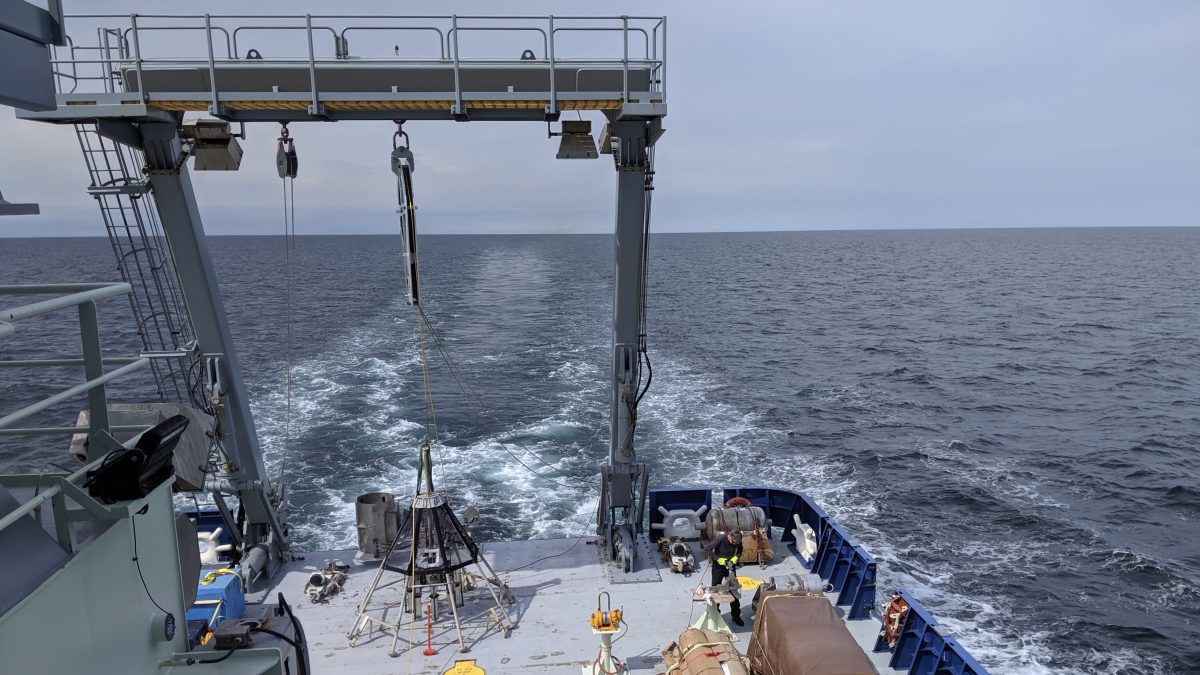 Sediment cores were collected from sites across the North Atlantic, including areas off the Bahamas, Bermuda, North and South Carolina, and Iceland. (Photo by Alice Carter-Champion)
 January 22, 2026
Woods Hole, Mass. (January 22, 2026) -- A powerful system of Atlantic Ocean currents continued to transport warm, salty water northwards during the last ice age despite extensive ice sheets covering much of the Northern Hemisphere, according to new research led by scientists at Woods Hole Oceanographic Institution (WHOI) and the University College of London (UCL).
The study published in Nature shows that deep ocean water in the North Atlantic was much warmer during the last ice age than scientists once believed. This deep water, known as North Atlantic Deep Water (NADW), is an important part of the Atlantic Meridional Overturning Circulation (AMOC) that helps regulate Earth’s climate. Even at the coldest point of the last ice age, about 19,000 to 23,000 years ago, the deep waters of the North Atlantic were only about 1.8°C colder than they are today, not close to freezing as previously assumed. These waters also filled roughly the same depths as they do now, extending from about 1 to 4 kilometers below the ocean surface.
The international research team includes WHOI Emeritus Research Scholar Lloyd Keigwin, whose decades of research on ice-age ocean circulation helped place the new findings into a broader historical and climatic context.
These results challenge the long-held view that Atlantic circulation weakened significantly during the coldest phase of the last ice age, with deep water formation becoming shallow and sluggish. Instead, the findings suggest that relatively warm and salty NADW continued to form and flow, keeping the ocean’s climate “engine” running even under extreme glacial conditions.
Importantly, the reconstructed ocean conditions closely match those simulated by leading climate models, strengthening confidence in their ability to project future changes in ocean circulation under our changing climate.
“We were amazed to find that the deep Atlantic stayed relatively warm and salty during one of Earth’s coldest periods,” said Jack Wharton of UCL, Postdoctoral Research Fellow and lead author of the study. “Taken together, our data show that the ocean’s circulation system remained resilient even under extreme climate stress. The same models that correctly capture this past behavior also warn that these currents are vulnerable to weakening as the planet warms, with potentially dramatic consequences.”
To reconstruct deep-ocean conditions during the Last Glacial Maximum, researchers analyzed microscopic fossil shells preserved in sediments on the ocean floor. These organisms, called foraminifera, record the temperature and chemical composition of the seawater where they live.
Sediment cores were collected from sites across the North Atlantic, including areas off the Bahamas, Bermuda, North and South Carolina, and Iceland, from depths between 1.5 and 5 kilometers. Chemical signals preserved in the fossil shells allowed the team to reconstruct deep-water temperatures and salinity, as well as oxygen isotope ratios that trace the origin of the waters.
The data show that deep waters in the Northwest Atlantic can be traced back to surface waters in the subtropics, passing through the subpolar North Atlantic and Nordic Seas; clear evidence that large-scale heat transport through the ocean persisted during the ice age.
“For a long time, it was assumed that the deep Atlantic during the last ice age was close to freezing and less vigorous than today,” explained Keigwin. “These new measurements show that the deep ocean remained connected to the surface and actively involved in transporting heat and salt around the planet, even under extreme glacial conditions.”
Keigwin’s expeditions that collected many of the sediment cores and his pioneering use of foraminiferal chemistry to reconstruct past ocean circulation contributed to interpreting these temperature and isotopic signals and their implications for large-scale Atlantic circulation.
According to David Thornalley, a co-author on the study and Professor of Geography at UCL, “The microfossils recovered from the ocean floor show that deep waters in the North Atlantic were far from freezing. By examining sites across the basin, we can demonstrate that warm, salty surface waters continued to sink and form North Atlantic Deep Water that reached similar depths to today.”
The Atlantic Meridional Overturning Circulation plays a crucial role in regulating Earth’s climate by transporting heat northwards from the tropics. As surface waters cool in the North Atlantic, they sink and flow southwards at depth as North Atlantic Deep Water, forming a global-scale circulation system.
While the new findings show that this system remained active during the last ice age, climate models project that ongoing warming could weaken the AMOC in the future. Warmer, fresher surface waters are less dense and less able to sink, potentially slowing the circulation and reducing heat transport to Europe and North Africa.
Model projections suggest that a major slowdown of the AMOC could lead to sharply colder conditions in Europe, reduced arable land, and disruptions to African monsoon systems.
Co-author Professor Mark Maslin, at UCL, said, “This research improves our understanding of how ocean circulation responds to major climate shifts. Many of our best climate models indicate that Atlantic circulation is likely to weaken under future warming, which would have a destabilizing impact on the climate of Europe and North Africa.”
The research was supported by the Natural Environment Research Council (NERC), the Leverhulme Trust, the European Union’s Horizon Europe program, and the US National Science Foundation (NSF), with collaboration from Utrecht University, the University of Colorado Boulder, and Woods Hole Oceanographic Institution.
###
About Woods Hole Oceanographic Institution
The Woods Hole Oceanographic Institution is a private, non-profit organization on Cape Cod, Massachusetts, dedicated to marine research, engineering, and higher education. Established in 1930, its primary mission is to understand the ocean and its interaction with the Earth as a whole, and to communicate an understanding of the ocean’s role in the changing global environment. Top scientists, engineers, and students collaborate on more than 800 concurrent projects worldwide—both above and below the waves—pushing the boundaries of knowledge and possibility.