Nafanua, Eel City, and the Crater of Death
A small but fast-growing volcano appears inside the crater of a mammoth underwater volcano off Samoa
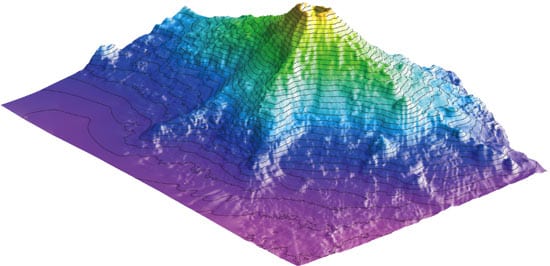
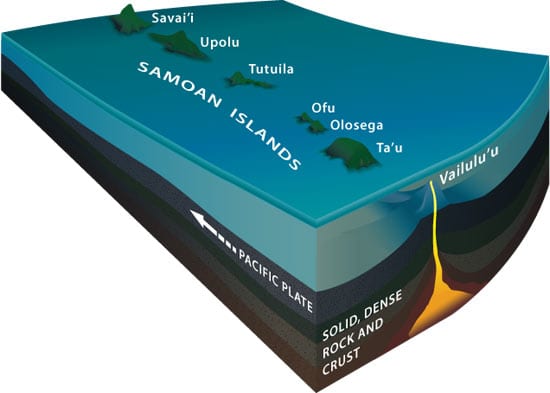
In 1999, WHOI geochemist Stan Hart was co-chief scientist of a joint WHOI-Scripps Institution of Oceanography expedition that discovered and mapped Vailulu’u—an active volcano rising 4,360 meters (14,300 feet) from the seafloor of the Pacific Ocean. Resembling Mount Fuji, Vailulu’u sits atop a hot spot, fueled by magma erupting from the mantle. The hot spot will eventually build the volcano high enough to become the next island in the Samoan chain.
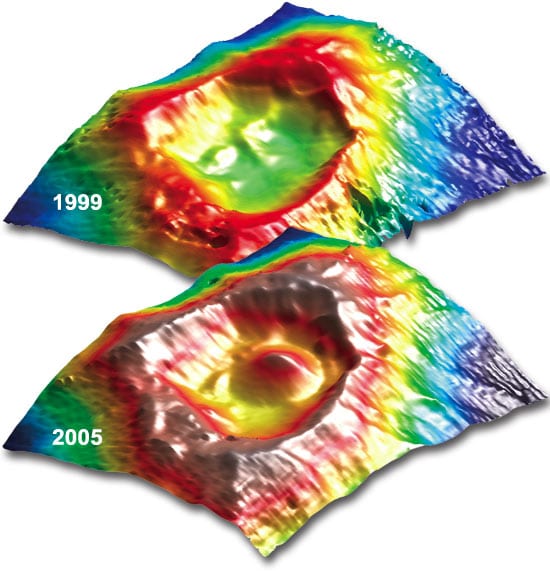
In April 2005, Hart and international colleagues returned to Vailulu’u to make more astonishing discoveries. They found a dome-shaped volcanic cone—growing inside Vailulu’u’s milewide caldera—that didn’t exist when the scientists last visited in 2001. This new volcano, named Nafanua after the ferocious Samoan goddess of war, stood 300 meters (1,000 feet) high.
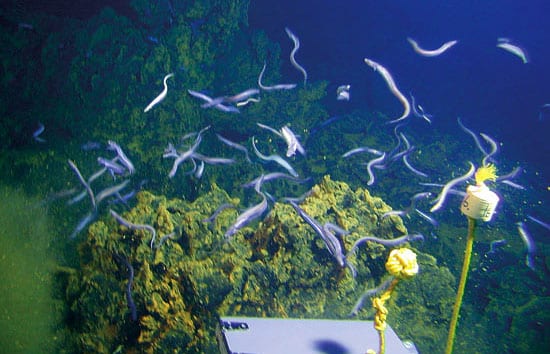
Diving in the National Oceanic and Atmospheric Administration’s submersible Pisces V, scientists explored the turbid waters surrounding Nafanua, where vigorous venting of hot, mineral-rich fluids creates a volcanic “fog.” The area was covered with thick yellow mats of microbes that thrive on chemicals spewing from volcanic hydrothermal vents. Some areas were filled with large bubbles, fizzing like seltzer.
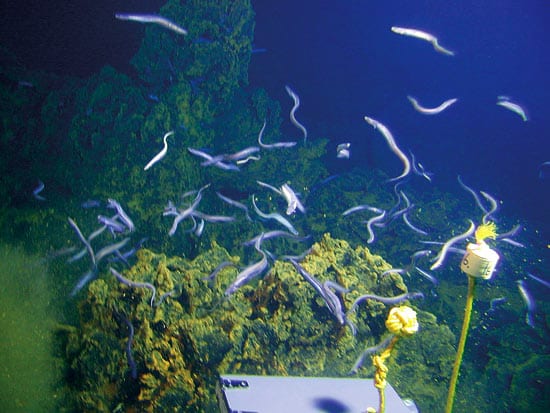
The scientists also found hundreds of greenish-white eels, up to a foot long, which emerged from rock caves and crevices and swarmed around cavernous rock pillars. The scientists named this novel hydrothermal community “Eel City.” In contrast, the scientists also found a possibly toxic area that was devoid of life at the bottom of Vailulu’u’s crater, which they dubbed the “Crater of Death.”
The research was funded by the National Oceanic and Atmospheric Administration, the National Science Foundation, the Australian Research Council, and the WHOI Deep Ocean Exploration Institute.
Slideshow