Rescue Mission on the Seafloor
Could Jason recover instruments stuck to the seafloor by newly erupted lava?
The two earthquake-monitoring instruments—each the size and weight of a small refrigerator—were glued to the ocean bottom by erupting lava that had flowed and hardened around them. If scientists could pry them loose, the payoff could be huge.
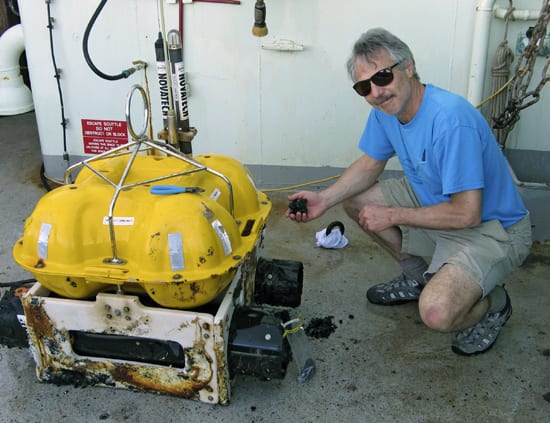
The instruments, called ocean-bottom seismometers (or OBSs for short), appear rather bulky, but they are designed for a sensitive job. Sitting on the seafloor, they convert ground motions—from the tiniest flutters to major earthquakes—into electrical signals that are digitally recorded. These particular seismometers, stuck 1.6 miles (2,500 meters) deep on the Pacific ocean floor, may also have also been stuck at a particular moment in time, recording something scientists rarely have a chance to pinpoint: the precise timing of an undersea volcanic eruption.
Seafloor eruptions happen daily along a 40,000-mile-long volcanic mountain chain called the mid-ocean ridge that encircles the Earth. Fresh lava frequently intrudes into the ocean crust beneath the ridge and erupts to pave and repave the planet with new crust and reshape the face of the planet.
But scientists can’t see this fundamental process through miles of water (as they can by observing volcanoes on land) to learn exactly how this type of volcanism occurs in the cold, liquid environment under enormous pressure at the bottom of the sea.
Did the eruption happen all at once or over a longer time period? Seismic spikes—recorded on Jan. 22, 2006, by two other seismometers that were not engulfed in lava and recovered a year ago—suggest the former. But geologists and chemists, using fluid temperature records and rock samples from the eruption site to date the lava flows, believed the eruptions occurred over several months in late 2005 into early 2006.
“It’s a good, old-fashioned, friendly science debate,” said marine geophysicist Maya Tolstoy from the Lamont-Doherty Earth Observatory of Columbia University. “We have two types of data, saying two different things. The recovery of the instruments could resolve the issue.”
The seismometers survived the eruption because the temperature of water in the deep ocean is nearly freezing—about 35°F (2°C). This rapidly quenches hot lava as it emerges from the seafloor.
“You couldn’t throw an instrument like this into a lava flow on land and expect it to survive!” Tolstoy noted.
In the hands of Jason
In 2005, scientists deployed a dozen OBSs over a few square miles of seafloor on the East Pacific Rise, part of the mid-ocean ridge located about 450 miles south of Acapulco, Mexico. Each was numbered (“OBS 201” to “OBS 212”), and each was equipped with a sound source that chirped in the dark depths to help researchers locate them.
Researchers returned in April 2006, thinking they would simply recover the instruments and send down others. Instead they realized an eruption had occurred. They quickly found and recovered the four seismometers not engulfed in lava, two with useable data. Five others, from which they received no signals, were presumed buried in lava and lost.
That meant three remained on the seafloor with potentially useful data.
Two months later, scientists returned and found two of them, OBS 206 and OBS 210, partially buried in the lava flow. They tried to nudge and pull them loose using a camera-equipped sled towed by a cable behind their ship—without success. Freeing them from the lava flow called for the dexterity of the WHOI-operated robotic vehicle Jason.
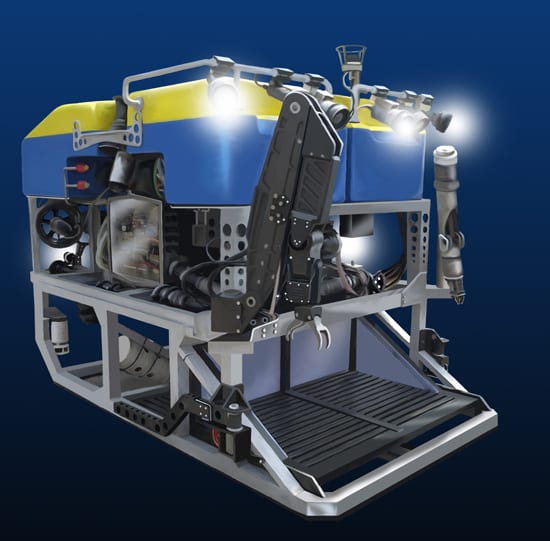
The 1,200-pound vehicle is controlled through a 6-mile-long tether that delivers video from the seafloor up to pilots and scientists who sit in a command center on the ship and watch the live action below on a half dozen television screens. The tether also transmits commands from the pilots back to Jason, along with electrical power to operate two mechanical arms with metal claws.
In April 2007, researchers returned with Jason, hoping its mechanical hands (and pilots) could extricate the instruments, without further damaging them, or having them float away.
Where are you, OBS 212?
Finding OBS 212, however, was not straightforward. Researchers had a good idea of where they had left it in 2005, but they knew that the erupting lava flow had likely moved the instrument.
“When we landed at the site of OBS 212, it was nowhere to be seen,” said Adam Soule, a volcanologist at WHOI. They made some “spaghetti tracks,” with no luck, and then became more systematic. The pilots controlling Jason started running parallel lines about 130 feet (40 meters) long, like a lawnmower moving in a careful pattern over grass.
“We ran this sort of survey for about two hours and were quite discouraged that we hadn’t found the OBS,” Soule said. They considered giving up, but one of the pilots suggested using acoustic transducers on the ship to zero in on the instrument.
The transducers transmitted sound, in the form of high-pitched “pings” at specific frequencies, to receivers on the OBS, asking it to reply. By analyzing the time it took for the pings to reach and return from the instrument, the pilots and scientists were able to home in on the OBS. When the pings’ travel time between ship and instrument became shorter, they knew they were getting closer.
“Finally, off in the distance I saw four faint lights in the water, oriented in a square pattern,” Soule said. “Manmade objects tend to really jump out at you on the seafloor.” The lights turned out to be strips of reflective tape on the corners of the instruments’ yellow, plastic enclosures.
“It was fortunate that the top of the instrument was pointed toward us, or we would have never seen this pattern, and it would have taken much more time to find,” Soule said.
A two-fisted rescue
Once OBS 212 was located, “the devil was in the details when trying to get it out,” said WHOI marine geologist Dan Fornari. “We had to see how it was situated in the lava flow. Then we had to figure out how to remove it.”
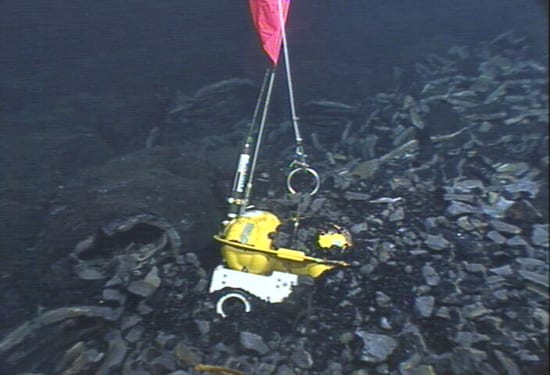
Typically both of Jason’s robotic arms are controlled remotely by one pilot. But in this case, the two pilots on the job, Tito Collasius and Bob Waters, decided that the situation called for a tag-team effort. One of their first tasks was removing large chunks of lava stuck to the back and sides of the instrument, which had glued it to the seafloor.
“One guy used one arm to knock off chunks of lava,” Collasius said. “The other guy was working to attach a float” —made from a snap hook and scrap chunks of syntactic foam found on the ship—“in case the instrument broke free and tried to float away.”
Within 45 minutes, the instrument was free and rising to the sea surface, where ship’s crew located it floating near the ship and recovered it (see “Jason to the Rescue“).
Waiting and hoping
OBS 206 and OBS 210 had different stories, one sweet, one sour.
OBS 206 was wedged into the lava flow and partly buried, Fornari said. A large scorch mark was clearly visible. Jason secured it with a float and wiggled it from the lava. Within 30 minutes, the instrument was on the ship.
OBS 210, however, was stuck too tightly between collapsed lava flows. “We worked for several hours trying to break … the lava crusts around it and digging out the rubble, to no avail,” Fornari said.“After digging and pulling it as best we could without damaging the vehicle, we determined it was not going to come out. But we gave it our best shot.”
When the ship docked in San Diego on April 27, Fornari ferried the two recovered instruments to the Scripps Institution of Oceanography.
Engineers will spend the weeks ahead determining if they can recover any data, which could speak volumes about the volcanic processes occurring at the mid-ocean ridge and how they shape our planet. Tolstoy was optimistic about finding some data.
“Even though the instruments are pretty singed-looking in places,” she said, “the damage is quite minimal given what they went through.”
The 2007 expedition to the East Pacific Rise on R/V Atlantis (Cruise AT15-17, with Chief Scientist Emily Klein of Duke University) was supported by the National Science Foundation Ridge 2000 Program.
Slideshow