Unraveling the Tapestry of Ocean Crust
Scientists follow a trail of clues to reveal the magmatic trickles and bursts that create the seafloor
Estimated reading time: 12 minutes
Most people know that oceans cover about 70 percent of Earth’s surface. Fewer people realize that the crust beneath oceans and continents is fundamentally different. Why this is so remains a mystery that scientists are still trying to solve.
Oceanic crust is generally composed of dark-colored rocks called basalt and gabbro. It is thinner and denser than continental crust, which is made of light-colored rocks called andesite and granite. The low density of continental crust causes it to “float” high atop the viscous mantle, forming dry land. Conversely, dense oceanic crust does not “float” as high—forming lower-lying ocean basins. As oceanic crust cools, it becomes denser and ultimately sinks back into the mantle under its own weight after about 200 million years.
Earth’s continental crust, on the other hand, is up to 4 billion years old, and it is thought to be the product of geologic recycling processes far more complicated than those that create ocean crust. If we can decode and read the relatively simple story of how oceanic crust is formed, we may someday be able to decipher the more complex record of how the continents developed.
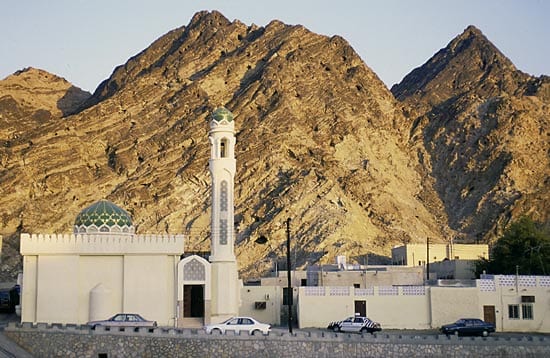
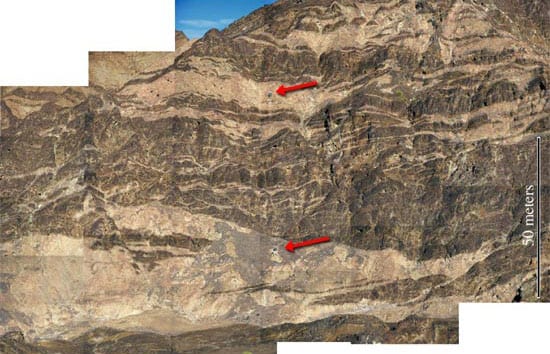
In a few places on Earth, blocks of oceanic crust (called ophiolites) have been thrust onto the continents, giving scientists the unusual chance to get a firsthand look at rock formations that were once beneath the seafloor. The largest ophiolite is in Oman near the Persian Gulf. (Photo by Peter Kelemen, Woods Hole Oceanographic Institution )
Sounding out seafloor structure
Because most oceanic crust is hidden from view beneath many kilometers of water, our research must be conducted “remotely,” often using acoustic techniques. Sound—emanating from an earthquake, an explosion, or a relatively benign source known as an airgun—travels through different rocks at different speeds. Geophysicists infer the basic geologic structure of underlying rocks by measuring the time it takes for sound to travel from one source to many different receivers, or from many sources to a single receiver.
In the oceans, this technique has yielded a simple picture of a basaltic, layered crust about 7 kilometers (4.3 miles) thick, underlain by the mantle. Rock samples obtained via dredging, submersible operations, and drilling confirm that the top of the oceanic crust, where it is not obscured by sediments, is composed of basaltic lava that originates in the mantle.
At the dawn of the modern theory of plate tectonics in the 1960s, geologists and geophysicists realized that the entire oceanic crust was created from basaltic lava along linear chains of seafloor volcanoes known as mid-ocean ridges, or spreading ridges. Seafloor spreading carries older oceanic crust away from the ridges over tens of millions of years, until it cools, becomes denser, and “falls” back into the mantle in areas known as subduction zones.
Seafloor clues in the desert
In a few places on Earth, blocks of oceanic crust, called “ophiolites,” have been thrust, relatively intact, onto the continents during collisions between tectonic plates. Tilting and subsequent erosion allow scientists to walk through a section that once extended 25 kilometers (15 miles) into Earth’s interior. The largest and best exposed of these, the Oman ophiolite near the Persian Gulf, comprises about ten blocks that together cover roughly the same area as Massachusetts.
The great extent of these ophiolites, once deep beneath the seafloor but now exposed, provides a comprehensive view of the internal geometry of oceanic plates that is unmatched by any sampling or imaging technique at sea. Like pot shards covered with hieroglyphics, ophiolites open a window onto an ancient, largely vanished world, and provide a rare avenue for systematic investigation.
In the late 1960s and early 1970s, geologists and geophysicists observed similarities between the layered structure of oceanic crust, as interpreted from sound velocities, and the layering in ophiolites. A thin, upper layer in oceanic crust (with low sound velocities) corresponds to a layer of sediments and lava flows in ophiolites. A deeper layer (with faster sound velocities) corresponds to an ophiolite layer of “gabbro,” which formed when molten basalt solidified beneath Earth’s surface. In both oceanic crust and ophiolites, the gabbro layer is underlain by the mantle, which extends thousands of kilometers down to Earth’s core.
A striking feature of well-exposed ophiolites is a continuous layer of “sheeted dikes,” which lies between the lava and the gabbro. These are tabular rock formations, about a meter wide, created by periodic bursts of molten rock. The dikes stand side-by-side, like soldiers in formation, each dike adjacent to neighboring dikes, or sometimes leaning or intruding into them.
This recurring structural pattern occurs because all oceanic crust is newly created at spreading mid-ocean ridges on a kind of continuous conveyor belt: Each dike, in a simple view, forms directly at the center of a ridge. It then spreads out from the ridge center, as another dike forms behind it, in an ongoing process that creates the continuous layer observed in ophiolites. Nothing like that happens in continental crust, where new dikes more randomly intrude older rock.
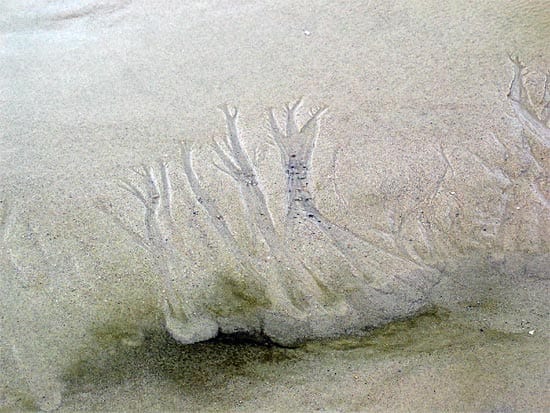
By studying how water flows on a beach, scientists can make parallels with the flow of magma beneath the seafloor. On a beach, small water channels flowing downhill erode sand in front of them and coalesce into one larger channel. But when the slope decreases downstream, the flow slows down. Sand grains that were carried in suspension begin to become deposited, creating a barrier that block the flow. Smaller channels begin to diverge again. (Peter Kelemen.)
Going with the flow
During the 1970s and 1980s, geophysicists and geologists strove to understand how basaltic lava forms beneath spreading ridges. They theorized that because the oceanic plates pull apart at the surface, new material must rise to fill the gap. As the material rises, the pressure that helps keep it solid decreases. This allows hot mantle rocks to partially melt and produce basaltic liquid. This so-called “melt” is less dense than surrounding solids, and so it buoyantly rises to the surface to form the crust.
However, this theory raises as many questions as it answers. From lava compositions, we know that from an enormous volume of mantle rock, only small amounts of rock partially melt to create oceanic crust. Melt forms in micron-size pores along the boundaries of innumerable crystal grains across a mantle region that is 100 to 200 kilometers wide and 100 kilometers deep. From this vast region, however, the melt somehow is focused into only a 5-kilometer-wide zone at the spreading ridge. How is lava channeled from tiny pores in a broad region of melting into a narrow region where it forms new oceanic crust topped by massive lava flows?
My colleagues in exploring this mystery, working in various combinations, have included Greg Hirth, Nobu Shimizu, and Jack Whitehead at Woods Hole Oceanographic Institution (WHOI), Marc Spiegelman of the Lamont-Doherty Earth Observatory, French geologists Adolphe Nicolas and Françoise Boudier, Massachusetts Institute of Technology graduate student Vincent Salters, and MIT/WHOI Joint Program students Einat Aharonov, Mike Braun, Ken Koga, and Jun Kornaga. Our research has been funded by the U.S. National Science Foundation, the WHOI Interdisciplinary and Independent Study Award program, and the Adams Chair at WHOI.
We have shown that melt travels through the mantle in porous channels, similar to channels filled with gravel that provide permeable pathways through clay-rich soil. Melt rising through the hot mantle can partially dissolve minerals around them and gradually enlarge the pores along the boundaries between individual crystal grains. This, in turn, creates a favorable pathway through which more melt can flow—in a positive feedback loop that spontaneously creates channels that focus the flow.
Small channels formed in this fashion coalesce to form larger channels, in a network analogous to a river drainage system. The number and size of melt flow channels we observe in the mantle section of ophiolites supports these theories.
Melt lenses and periodic bursts
New questions arose. If melt flows through the mantle in micron-scale pores along the boundaries of crystal grains, where does it accumulate to form massive lava flows at spreading ridges? And, if porous flow is a continuous, gradual process, what causes the periodic bursts of molten rock that create new dikes?
Once again, the Oman ophiolite provided clues. Embedded in the shallowest mantle rocks, Nicolas and Boudier found small formations of gabbro, called sills. Chemical analyses of these sills indicated that they crystallized from the same melt that formed gabbro, sheeted dikes, and lava flows in the crust. In addition, the gabbro, dikes, and lava flows all had an identical, distinctive pattern of alternating bands of dark and light minerals.
It seemed to us that the entire gabbro layer in the Oman ophiolite crust, from uppermost mantle to the surface, could have formed when melt material periodically collected in relatively small pools that subsequently crystallized into solid “melt lenses.” Over time, a myriad of these melt lenses accumulates—embedded within each other and stacked atop each other or side by side—to produce gabbro’s rocky, banded fabric.
Clogged pores build up pressure
Why would melt lenses first appear in the uppermost mantle, immediately beneath the base of the crust? We propose that such lenses form where melt, approaching the seafloor, begins to cool. Melt rising through the hot mantle can dissolve minerals surrounding it to create pore spaces, but cooling melt will begin to crystallize and clog pores.
Two scenarios are possible: When the supply of melt from below is low, conduits become narrower. The melt is forced outward around impermeable barriers, migrating via diffuse porous flow along crystal grain boundaries throughout surrounding rock.
But when melt supply is large, as it is immediately beneath a spreading ridge, buoyant melt accumulates beneath impermeable barriers and creates excess pressure. Eventually, the melt bursts through the barriers and creates a melt-filled fracture that intrudes the overlying crust. If the fracture propagated high enough in the crust, it would form a sheeted dike, and if it reached even higher, it would spill out onto the seafloor and feed a lava flow.
In this cycle of buildup and release, minerals alternately crystallize and melt under conditions of higher and lower pressure. At relatively high pressure, much less of the light-colored mineral (plagioclase) is formed, compared to darker-colored minerals. At lower pressure, the proportion of plagioclase is larger. Thus, periodic pressure changes result in the light-and-dark banding observed in ophiolite gabbros.
Paths of most resistance
Working from geological evidence in ophiolites, together with physical and chemical theory, we hypothesize that there are two distinct ways to transport melt that forms oceanic crust. Within the melting region in the mantle, melt can dissolve minerals and create additional pore space. As a result, continuous, high-porosity conduits form a coalescing drainage network that focuses melt transport to the spreading ridge.
At shallow levels beneath the ridge, cooling melt begins to crystallize, clogging pore space along crystal grain boundaries. As a result, flow becomes diffuse, melt accumulates beneath impermeable barriers. Pressure builds up until the melt periodically bursts through overlying barriers, and melt-filled fractures are injected into overlying rocks to feed dikes and lava flows. Together, these processes form a highly organized system that consistently produces new oceanic crust with a regular structure along spreading ridges.
In our ongoing research, we are more rigorously testing theories about how porous conduits form in the mantle. We seek to understand in more detail how melt lenses form beneath spreading ridges. And we want to figure out the factors that determine why and when diking and eruption events occur.
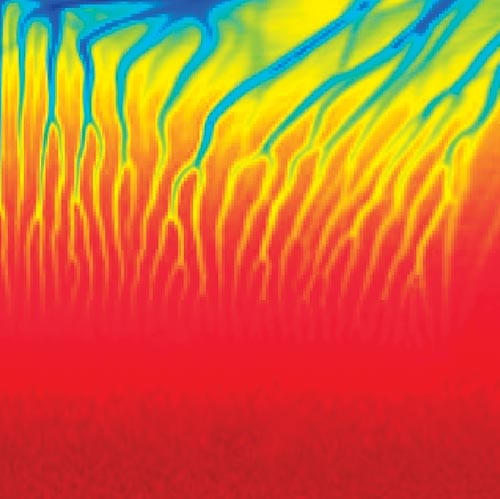
A computer model simulating the location of channels formed by localized melt flow in the mantle provides this picture: The melt dissolves minerals in rock minerals to form small porous channels that subsequently coalesce into larger ones. Similar flow patterns may be at work in other natural systems. (Marc Spiegelman/Lamont-Doherty.)
Exploring a universal pattern of fluid flow
There are intriguing parallels between the mechanisms that lead to the creation of seafloor and to erosion on Earth’s surface.
Consider water flowing over a sandy surface. Where the slope is steep enough (but not too steep), water begins to move sand grains downward and form channels. As the channels grow, water flows faster, leading to more vigorous erosion of sand at the leading edge of the flow. An analogous process occurs beneath the seafloor, as rising, hot melt dissolves minerals in rocks to form porous channels.
When the slope decreases downstream in an erosional system, water begins to deposit sand grains that were carried in suspension. The deposited grains begin to construct barriers that block flow and force it to diverge away from the main channel. Water accumulates behind these barriers to form temporary lakes. These lakes periodically overflow the old channel and create transient, new pathways, which in turn are clogged and abandoned. A delta or alluvial fan forms.
Analogous processes occur beneath the seafloor as rising melt cools, precipitates crystals that block pore spaces, causes flow to diverge and accumulate, and periodically bursts through impermeable barriers to form dikes and fractures.
Optimizing fluid flow
What lies behind these apparent fundamental similarities between fluid transport during erosion on Earth’s surface and melt transport in the mantle?
Basically, where energy is available for fluid to create new pathways—via physical erosion or chemical dissolution—drainage networks evolve from relatively inefficient, slow moving, diffuse flow to faster, focused, steady flow in well-defined channels. Where energy is lost—via a decrease in slope angle in erosion or a decrease in temperature of melt—the drainage network becomes inefficient and disorganized, with quick shifts in flow rate and location.
Scientists working on the evolution of river drainage systems propose that erosion tends to produce an “optimal” drainage network that maximizes flow velocity and minimizes loss of energy via friction. This is an intriguing idea, offering the vision of a systematic, “thermodynamic” theory of drainage morphology. (It is also controversial theory, since river drainages inherit much of their complicated structure from the prior geologic history of a watershed.)
It is difficult to use ophiolites to explore a themodynamic theory of drainage morphology for mantle melt transport mechanisms—because ophiolites constitute a “frozen” system. So I began to look elsewhere for an active fluid transport system that developed channels within an initially diffuse flow pattern.
Finally, I realized that erosional channels form twice a day as the tide falls on beaches all over Cape Cod. Cautiously, Dan Rothman, a geophysicist at MIT, and I are learning about beach erosion and making observations on channel formation. We hope to determine whether the evolving channel network gradually approaches an “optimal” geometry that allows water to flow over the beach surface with minimal frictional energy loss.