The Hunt for 18° Water
Oceanographers examine “mode waters” that save the signals of past winters
Terry Joyce is looking for Val Worthington’s water.
In 1959, Woods Hole oceanographer Valentine Worthington gave a name and identity to a long-observed but poorly understood phenomenon of the North Atlantic Ocean. Analyzing data from as far back as the H.M.S. Challenger expedition of the 1870s, Valentine described how the interior of the Sargasso Sea contained distinct parcels of water with remarkably constant salinity, density, and temperature—roughly 18°C (64° F). To Worthington, the appropriate name for this quirky mass was simple and straightforward: 18° water.
In the early 1970s, Worthington persuaded colleagues and funding agencies to mount an expedition to study 18° water. He saw connections between these peculiar water masses and the circulation of the entire North Atlantic, as well as the weather above it. But when he finally went to sea in 1974 and 1975, he couldn’t find what he was looking for.
Researchers now know that 18° water is produced by a critical energy transfer between warm Gulf Stream water and the cold winter atmosphere. Unfortunately for Worthington, he went to sea in the midst of a warm winter, an ebb time in the assembly line of production of 18° water.
Decades later, his successors in the Physical Oceanography Department at Woods Hole Oceanographic Institution and from eight other oceanographic institutions have launched a far-reaching program to examine the formation and evolution of Worthington’s famous water and how it might influence North Atlantic climate. The CLIVAR Mode Water Dynamics Experiment (CLIMODE) began its own series of expeditions in November 2005, and this time researchers seem to be finding what their predecessor was looking for.
An oceanic layer cake
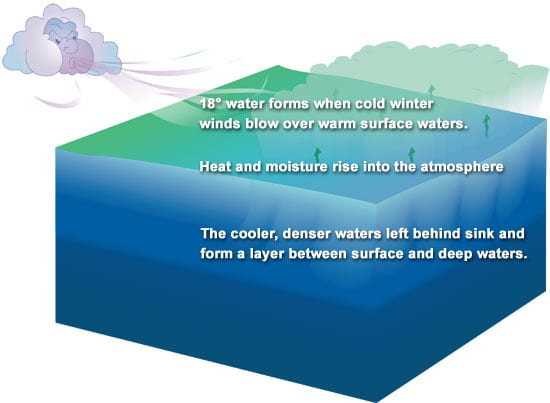
During winter, chilly winds blow from the Arctic and North American interiors out to sea, where the warm Gulf Stream rides east over the Sargasso Sea. The cool, dry winds pull heat and moisture from the Stream and carry them off to Europe and North Africa. The cooler, salty water left behind forms a layer on top of the ocean that can extend 1,300 feet (400 meters) deep.
Spring and summer heat eventually warms the surface again, but the chilled waters formed in winter do not dissipate. They are denser than warm waters, so they sink—not to the seafloor, but to the middle of the sea. This layer of water hangs suspended between warm surface waters and even colder deep waters, wedged like butter cream in the midst of a layer cake.
Oceanographers call 18° water and other water masses like it “mode water,” a term for a mass of water that has homogeneous temperature and other characteristics. Mode waters are like pools within the deeper and wider pool of world oceans, and they form in the middle latitudes all over the world. (The Kuroshio Current in the northwest Pacific and the Agulhas Current in the southwest Indian Ocean are also famous for mode-water creation.) Once they form and sink, layers of mode water remain relatively intact for several years and are swept around by the ocean’s circulation.
As Worthington wrote in 1959, “the 18° water is of more than usual interest” because it can often be found hundreds of miles to the south and west of where it is formed, “in places where the winter surface temperature is far higher than 18° and there is no possibility of it being formed locally.” In fact, Worthington’s 18° water can be found as far south as the Caribbean.
Terry Joyce, a WHOI senior scientist who worked down the hall from Worthington for many years, said 18° water is a bit like a memory bank for North Atlantic climate: It freezes a memory of conditions from the winter when it was formed and carries around the ocean.
“At the end of each winter season, the Sargasso Sea puts this water away as if it were going to a safe deposit box, storing it away for sometime later,” Joyce said. Researchers believe this stored water can later influence and regulate how quickly or slowly the ocean and atmosphere can change in future seasons. After migrating to warmer climes or drifting back to the Gulf Stream, it eventually mixes with and tempers warmer surface waters.
Hoping for bad weather
The CLIMODE team of investigators is doing everything it can to chronicle and understand the water that so excited their predecessor. They have so many questions.
- How much heat is gained, lost, and stored in the ocean-atmosphere exchange that creates 18° water? How high into air and deep below the ocean surface does this interaction reach?
- Where does 18° water go after it forms? How does it move horizontally through the ocean?
- How big are these wedges of water, and how do they affect other elements of ocean circulation?
- What role does sinking mode water play in sequestering carbon dioxide, nutrients, and heat from the surface in the ocean depths, and how does that affect climate and marine life from year to year?
From 2005 through 2007, the CLIMODE team will spend 107 days at sea, crisscrossing the Gulf Stream by ship and spreading instruments all over it. The project, funded by the National Science Foundation, is a mix of satellite-based observations, ship-based observations led by Joyce, and computer modeling led by John Marshall of the Massachusetts Institute of Technology.
The first two cruises—19 days in November 2005 and 14 days in January 2006 on the WHOI-operated research vessels Oceanus and Atlantis—were typical of what is to come. Joyce and colleagues from the Scripps Institution of Oceanography lowered conductivity-temperature-depth (CTD) samplers and water-sampling bottles into the sea dozens of times to characterize the ingredients, dimensions, flows, and properties of the 18° layer.
WHOI researchers Dave Fratantoni and John Lund and NOAA scientist Rick Lumpkin cast surface drifters and special bobbing floats that can drift horizontally and vertically with the water as it sinks, meanders, and sometimes gets stirred up into circularly spinning currents called eddies (see “The Oceans Have Their Own Weather Systems”).
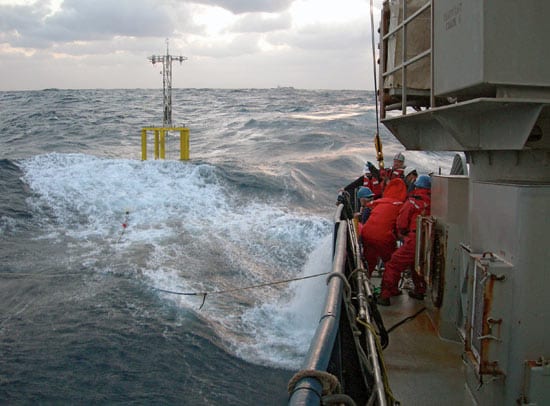
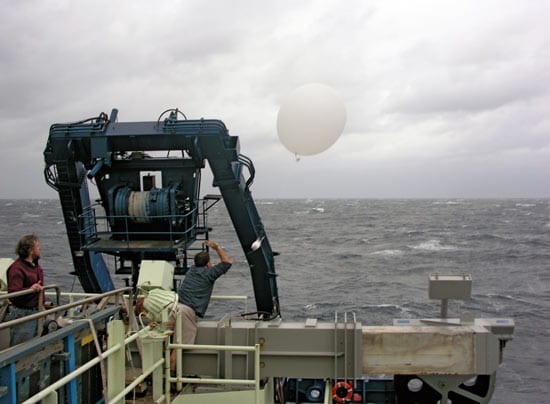
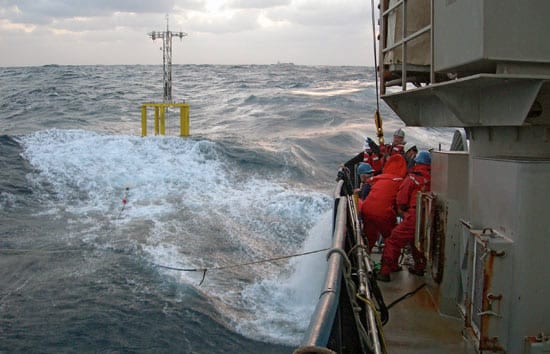
To measure the interaction between sea and sky, WHOI’s Bob Weller and the University of Connecticut’s Jim Edson deployed a moored weather buoy and 30 instrumented weather balloons. A specialized buoy was released by Edson and WHOI oceanographer John Toole to drift with the Gulf Stream; it was then recaptured after simultaneously measuring conditions above and below the ocean’s surface.
All the while, the researchers were hoping for 35- to 40-knot winds and 5°C (40°F) air temperatures that could cool and churn the sea enough to start the mode-water assembly line. Nature did not disappoint this winter, and the CLIMODE team is hoping for cold, windy conditions when it goes back to sea for another six weeks next winter.
Worthington would be pleased.
The National Science Foundation provided funding for CLIMODE. The five-year program includes researchers from Woods Hole Oceanographic Institution, the University of Connecticut, Florida State University, Massachusetts Institute of Technology, the University of Washington, Duke University, the University of Miami, Oregon State University, and the Scripps Institution of Oceanography.
Slideshow