Is noise from coastal construction affecting the American lobster?
By Kiran Johnson | March 23, 2026
The life of American lobster (Homarus americanus) is shaped by a web of interconnected variables. These crustaceans navigate the ocean floor, scavenging for food, searching for mates and hunting for shelter from predators like large fish — and human fishers. Now, as the ocean becomes increasingly industrialized, another challenge has arisen: noise pollution.
As the ocean warms, lobsters have been moving farther offshore where the water is cooler — and where a growing number of wind farms are being built. These include two fully operational offshore wind farms in New England waters, Block Island Wind Farm and South Fork Wind, as well as others at various stages of development along the East Coast.
Sounds from the construction and operation of these wind farms introduce a new source of noise into a rich underwater soundscape composed of dolphin whistles, fish calls, and physical sounds from wind, waves and rain. Much of it occurs at the same low frequencies that lobsters were recently shown to be capable of detecting. Precisely how commotion from this coastal construction affects the health and behavior of lobsters has been a mystery to scientists.
“It’s not just a question of, ‘Does this particular sound annoy lobsters?’” said Andria Salas, a marine ecologist at WHOI. “In the wild, you have so many factors at play.”
In 2023 Salas and WHOI Associate Scientist Aran Mooney received funding from the NOAA Sea Grant American Lobster Initiative to better understand the physical and chemical changes affecting the American lobster.
Mooney’s team wants to determine whether the sounds associated with wind farm construction can influence a lobster’s physiology and fitness, or if they’re simply a mild disturbance among all the other stressors in a lobster’s life.
To find out, Salas and Mooney are collaborating with the Rhode Island-based Commercial Fisheries Research Foundation (CFRF), a private nonprofit established by commercial fishermen to conduct collaborative fisheries research and education projects. Mooney’s project dovetails with an existing research survey that lobster fishers with CFRF have been conducting since 2021. Participants used “ventless” traps, to prevent lobsters that are below the legal minimum catch size from escaping. These traps allow scientists to capture lobsters from a wider range of sizes and life stages, which they can use to assess the population’s abundance.
“The surveys help us understand how things are changing, but not necessarily why things are changing,” said Mike Long, a senior research biologist at CFRF. “This project with WHOI really gets at the why, and specifically looks at the impacts that sound has on lobsters.”
For some of the program's fishers, studies like Mooney's have brought welcome clarity to a growing list of concerns surrounding the impacts of offshore wind.
“I have my own visual observations,” said Rhode Island lobster boat captain, Brian Thibeault. “I would like to see [them] verified with actual science.”
Thibeault has been a professional fisher for 41 years. To him, the impact of wind farms is one of the most urgent questions facing the commercial fishing industry right now.
Working with CFRF on projects like Salas and Mooney’s helps Thibeault and other fishers get answers about how these infrastructure projects will affect their livelihoods and local fish populations.
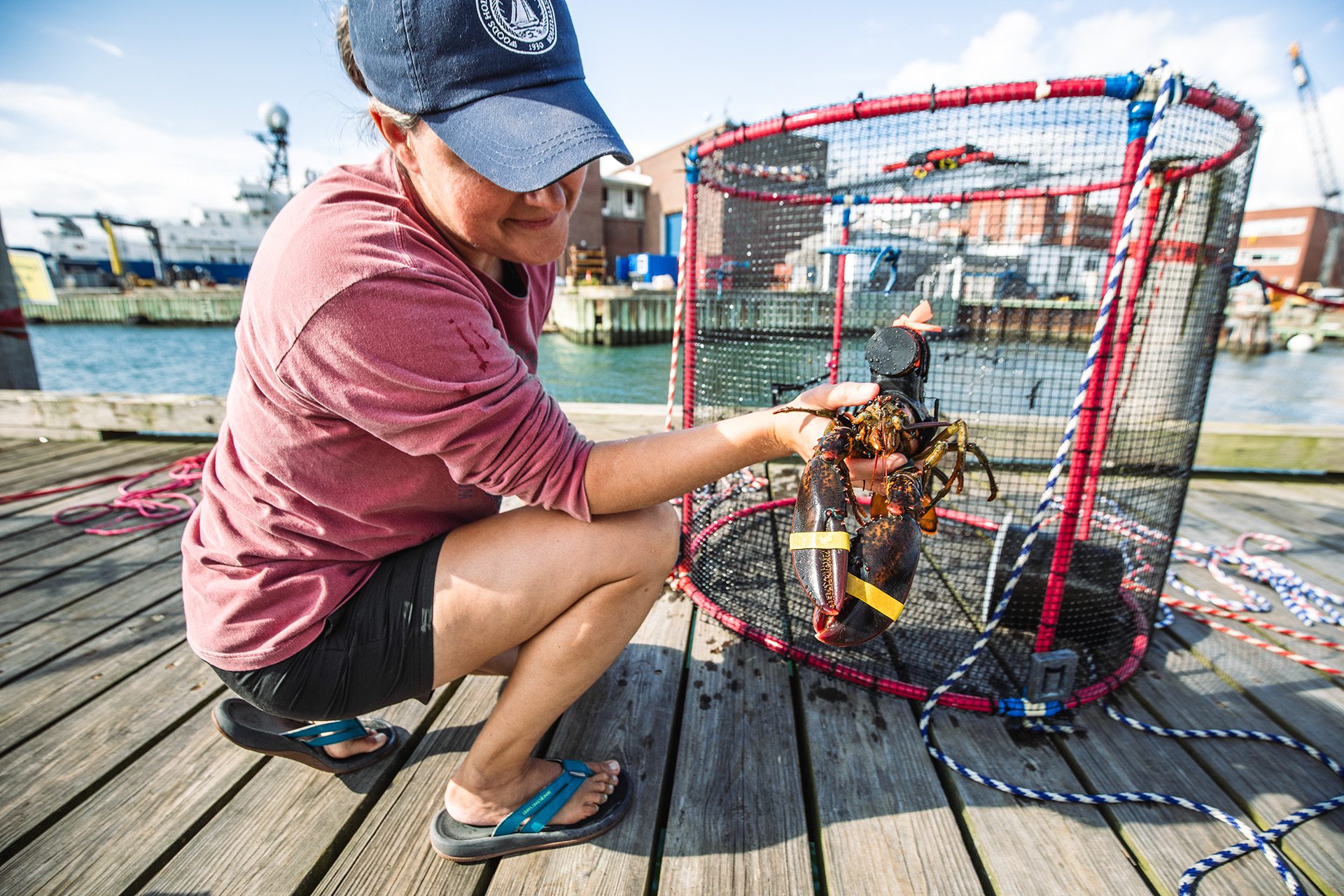
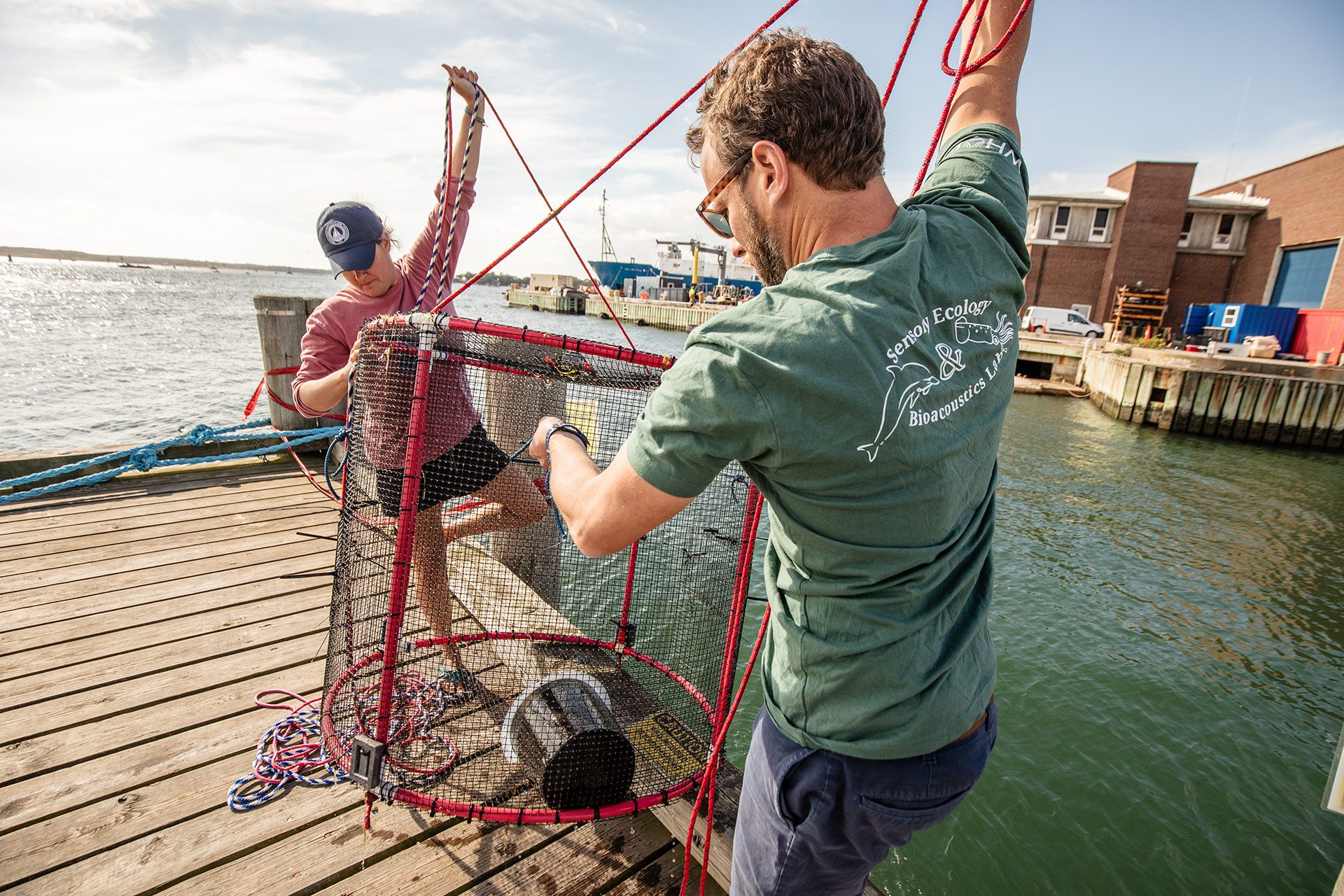
For their joint project with CFRF, Salas and Mooney provided fishers with data collection instruments called SoundTraps that they would install in lobster traps. These instruments record ambient sound across miles of ocean. They consist of a microphone attached to an acoustic recorder programmed to record on a schedule.
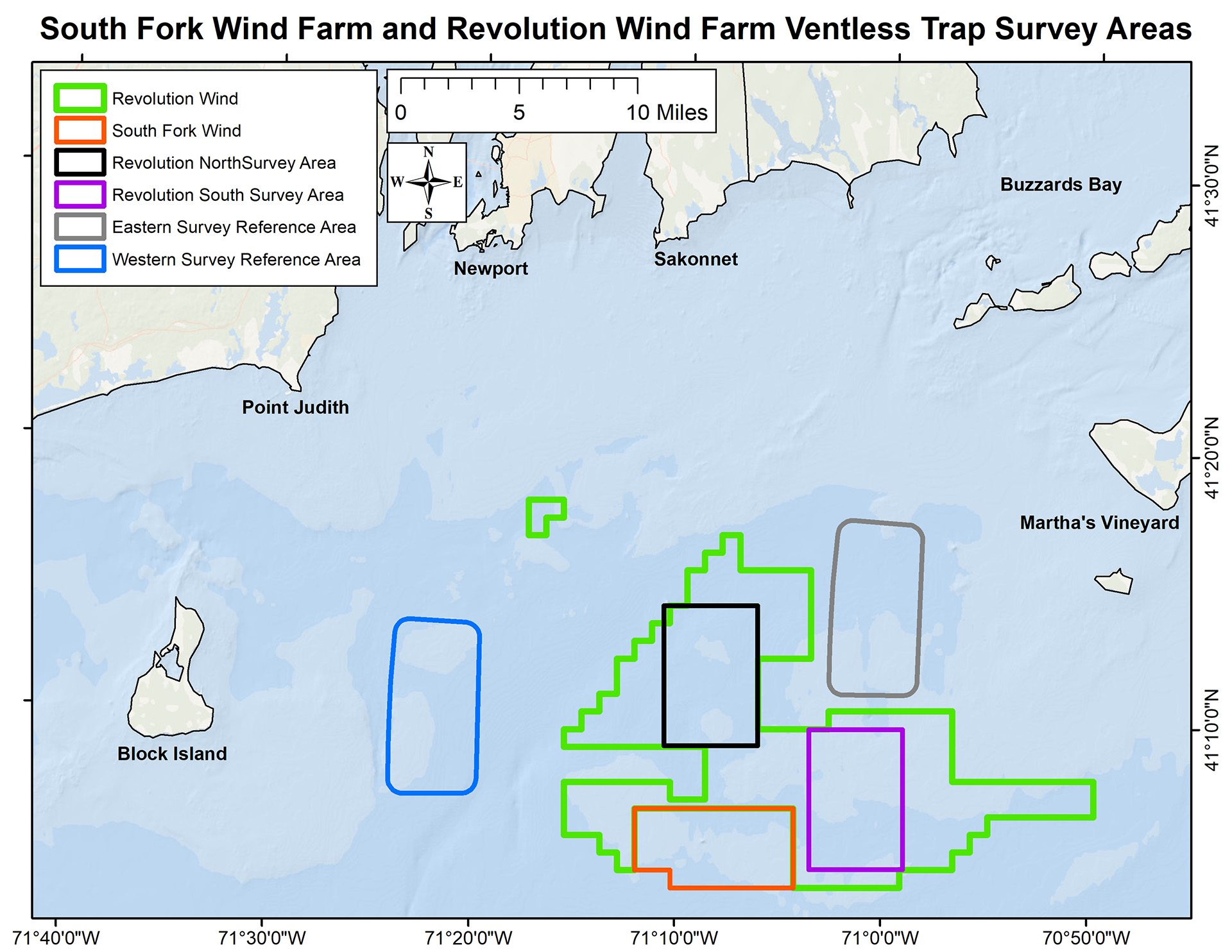
Fishers drop their traps at survey sites at varying distances from wind farm sites, one already operational (South Fork) and one that is under construction (Revolution Wind). They also deploy traps at sites farther from the wind farms to get a baseline reading for ocean sound. The traps remain on the seafloor for about 10 days each month, then they are retrieved and returned to WHOI, where Salas downloads and analyzes the recordings.
“To have the participating fishermen’s gear going out regularly, on a schedule, and coming back — we wouldn't be able to get that data otherwise,” said Salas.
Analysis of this massive, complex soundscape dataset — over 500 cumululative recording days — takes months to complete. To identify sources of noise pollution, the computer program calculates amplitude (or volume) over specific frequency bands and time intervals, focusing on the lower frequencies that are most likely to affect lobsters.
Initial analyses have identified several categories of noise pollution in the seafloor soundscape, including “continuous” noise such as engines from passing vessels, mechanical noises from the wind farm, and “impulsive” sounds like pile-driving strikes. Some sounds are more localized, like a boat passing over a single SoundTrap, whereas others propagate over long distances and can be detected simultaneously across multiple recording locations.
Salas has also been conducting experiments where she plays boat noise for lobsters in a lab. She needed to develop an instrument that could measure whether the sound causes lobsters stress (and if so, how much),
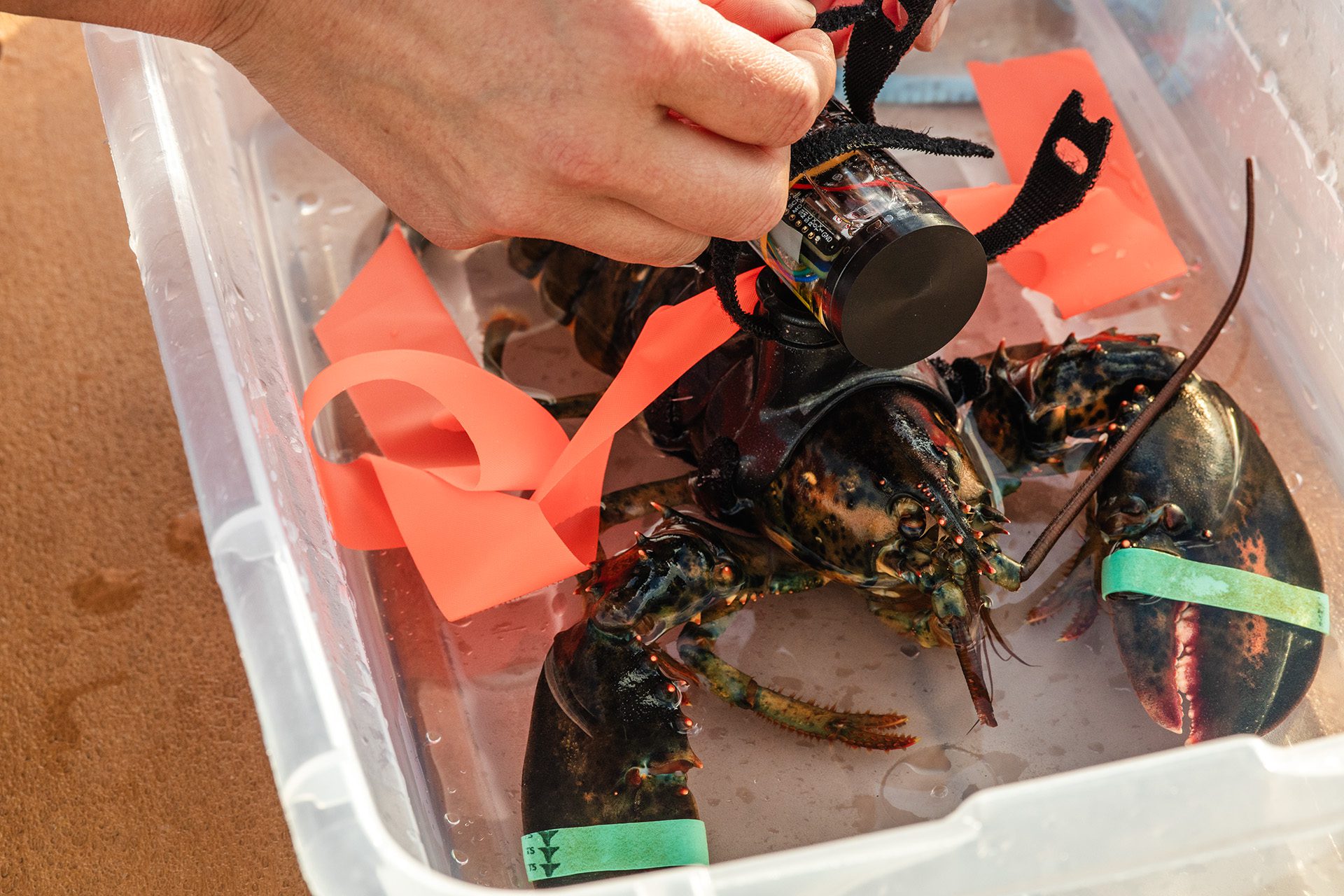
“Our lab worked with Brian Kelly and other engineers at WHOI’s Autonomous Vehicles and Advanced Technologies (AVAST) center to improve an existing design,” Salas said. “Together, we created an instrument with smaller electronics set inside custom housing to measure the lobster’s heart rate, temperature, light, and the animal’s movement and compass heading in response to sounds.”
Using a snorkel mouthpiece and some Velcro, Salas fashioned a saddle that holds the electronics neatly on the lobsters’ shells. She jokingly refers to the instrument as the “lobster Fitbit.”
Controlling for all variables is challenging. Salas and Mooney carefully designed a schedule to expose lobsters to boat noise, taking into consideration the crustaceans’ nocturnal lifestyle, physiological differences between males and females, and the stress the animals experience from being handled. (It takes a lobster about 12 hours to process the hormones that result from the handling and tagging process and drive up its heart rate.)
“We put the lobsters in the tank the afternoon before the test. At noon the next day, we play the amplified boat noise for the first time,” said Salas.
During the experiment, Salas ramps up the sound for 20 seconds to simulate an approaching boat, plays the boat noise for 10 minutes, and then fades it out over 20 seconds. The lobsters then have an hour of ambient noise in the tank to acclimate. This sequence is conducted three times; Salas monitors the lobster’s response to the sound level. The repetition allows scientists to test if the lobsters will eventually get used to the new sound.
Salas doesn’t visually observe the lobsters’ response to the sound exposure — the tank is dark to eliminate visual stressors — but an accelerometer on the “Fitbit” strapped around the lobsters captures their movement in the tank. Movement and heart rate data are key measurements that could indicate a response to the sound, and whether a certain amplitude is a momentary stressor or if it induces long-term stress.
In addition to exposing lobsters to vessel sounds, the Mooney Lab is also measuring the animals’ responses to the repeated bangs caused by pile driving.
“The hope is to be able to put into context the sound levels from the lab and field experiments,” Salas said. “We can measure [lobsters’] behavior, look at how their heart responds to these known amplitudes, and then ask [whether] we see those amplitudes in the field, and is there a chance that those same stress responses might be occurring in the field?”
Ultimately, Salas will look to the data collected by the SoundTraps to provide insights into the sounds that lobsters experience near wind farms in the wild.
“Obviously, this is a controlled experiment,” said Salas. The same lobster may respond differently in a lab environment than it would in its burrow in the ocean.
Before publishing the results of this experiment earlier this year, Salas and Long presented some preliminary findings from the experiment at meetings with fishers. They have a shared interest in answering the question of how wind farm development affects lobster populations.
The fishers’ local knowledge about gear placement, the underwater landscape, and how and where to place traps adds another layer of value to the study.
“Someone was going to go out there and collect data,” said Mark Sweitzer, another lobster boat captain working with the CFRF. “It makes sense to have guys like me be the people who do it.”