One of the Greatest Volcanic Shows on Earth
Inside a crater, a scientist seeks clues to the formation of the vast Deccan Traps
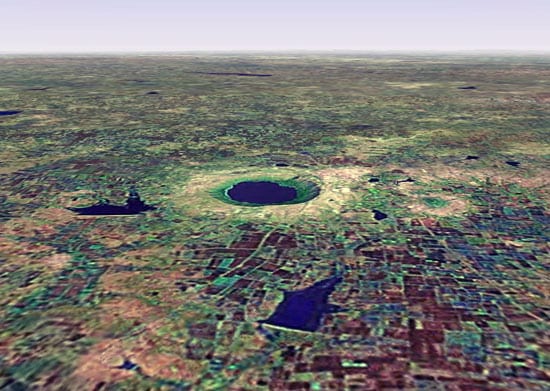
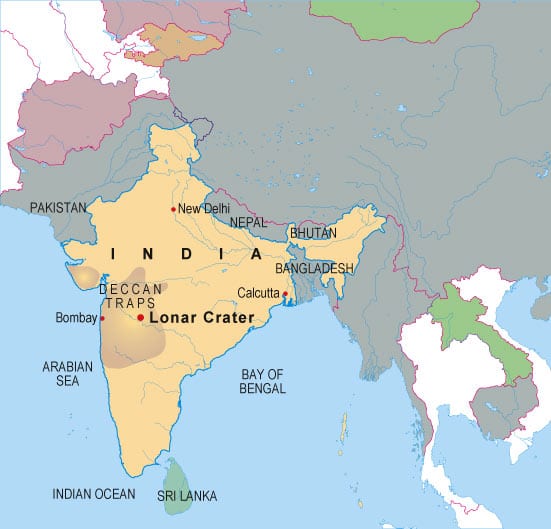
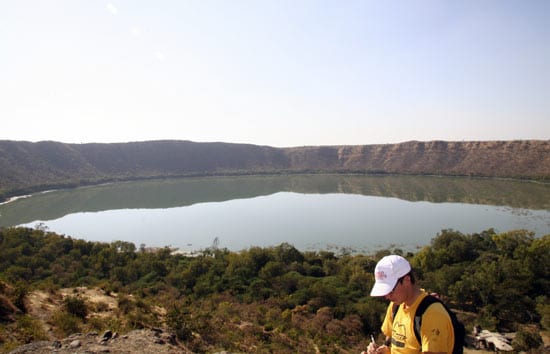
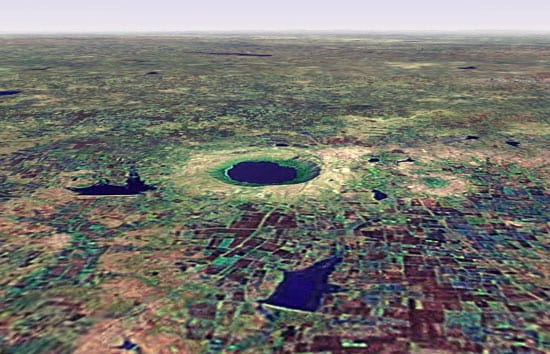
About 50,000 years ago, a huge meteorite smacked into our planet, gouging a hole more than a mile wide and 790 feet deep in India. Of the roughly 150 known meteorite impact sites on Earth, Lonar Crater is the only one that hit in an area layered with volcanic rock—a massive plateau of ancient lava flows called the Deccan Traps.
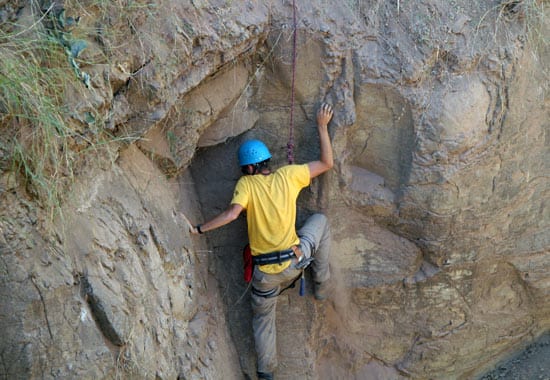
That makes Lonar Crater a unique and relatively convenient place for earth scientists to study how meteors scar the volcanic surfaces of other crater-dented planets, such as Mars. In January 2006, Adam Soule, a volcanologist at Woods Hole Oceanographic Institution, joined researchers from Harvard, MIT, and Princeton on a nine-day expedition to map and study Lonar Crater.
But while his colleagues compared the landscapes of the crater and Mars, Soule focused on Earth history. He looked for clues to learn how the Deccan Traps formed. He is also investigating whether the dinosaurs’ extinction was caused by the massive volcanic eruptions that created the Deccan Traps—rather than, or perhaps in addition to, another larger asteroid that collided with Earth 65 million years ago.
At about that time, one of the greatest episodes of volcanism in Earth history occurred in what is now western India. Huge eruptions of lava flooded onto Earth’s surface, coating and recoating more than a million square miles, like layers of paint, to form a vast terraced plateau.
Even after eroding over millions of years, the Deccan Traps are still 1 1/2 miles thick and cover 200,000 square miles (518,000 square kilometers), roughly the size of the states of Washington and Oregon combined. The eruptions that created the Deccan Traps would have released huge quantities of particulates and heat-trapping greenhouse gases—carbon dioxide, sulfur dioxide, and water vapor—that could have caused catastrophic global climate changes.
The key scientific debate, Soule said, is whether the Deccan Trap lava flows erupted too fast for the Earth to absorb the excess gases, or whether they erupted much more slowly as lava does today on a much smaller scale in Hawaii, for example.
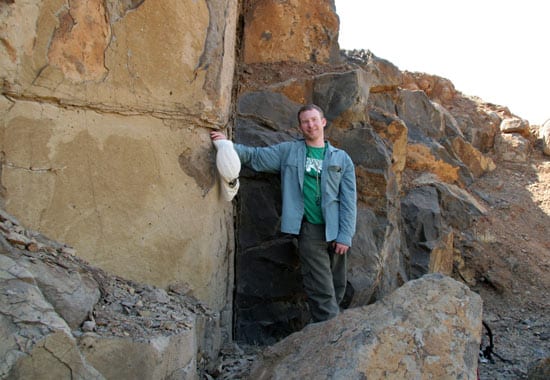
The Lonar Crater meteorite drove deeply into the Deccan Traps, giving Soule access to ancient lava layers that might provide answers. He returned to Woods Hole with about 100 pounds of rock samples, which he’ll slice and examine under a microscope. By looking at variations in their textures, Soule hopes to determine if they erupted gradually, or more quickly to hasten the dinosaurs’ extinction.
Soule’s research is supported by the WHOI Geology and Geophysics Department and the Mars Fundamental Research Program at NASA.
So what happened to the meteorite?
Except for a giant hole in the ground, nothing remains of the huge space rock that crashed into India approximately 50,000 years ago. “Many terrestrial craters don’t preserve a geochemical record of the projectile because most of the projectile is vaporized and the traces are quickly eroded,” said Sarah T. Stewart-Mukhopadhyay, a planetary scientist at Harvard University and the lead scientist on the expedition to Lonar Crater.
She estimates that the meteorite was traveling about 20 kilometers (12 miles) per second when it hit the Earth. Before it vaporized, she estimates that it measured 164 to196 feet (50 to 60 meters) in diameter. That’s about 30 times bigger than a Volkswagen Beetle.
Slideshow