These seabirds fly toward cyclones,
not away from them
New GPS tracking on petrels reveals a surprising survival strategy hidden in the eye of the storm
By Molly Tsongas | September 14, 2026
Night falls on Bugio Island, a windswept volcanic outpost in Portugal's remote Madeira archipelago. Waves crash hundreds of feet below steep cliffs where fewer than 200 pairs of the rare Desertas petrel nest in burrows hidden among the rocks.
For WHOI scientist Francesco Ventura, postdoctoral investigator in physical oceanography, reaching the birds requires careful footing. Guided only by a headlamp, he navigates the rocky terrain in darkness. As he quietly approaches the nesting burrows, he catches the unmistakable musky scent of seabirds.
Ventura reaches into a nest and carefully lifts a petrel from its burrow. The bird feels surprisingly soft and delicate in his hands, its slate-gray feathers concealing long and powerful wings. After a quick health check, he fits each bird with a tiny GPS tracker weighing little more than six paper clips.
Ventura returns the birds to their nests and backs away into the night.
Weeks later, the petrels return to their nests, and Ventura retrieves the GPS devices. Back in the lab, he downloads the data, which recorded each bird's location every couple of hours, offering a rare glimpse into the secret lives of these elusive seabirds.
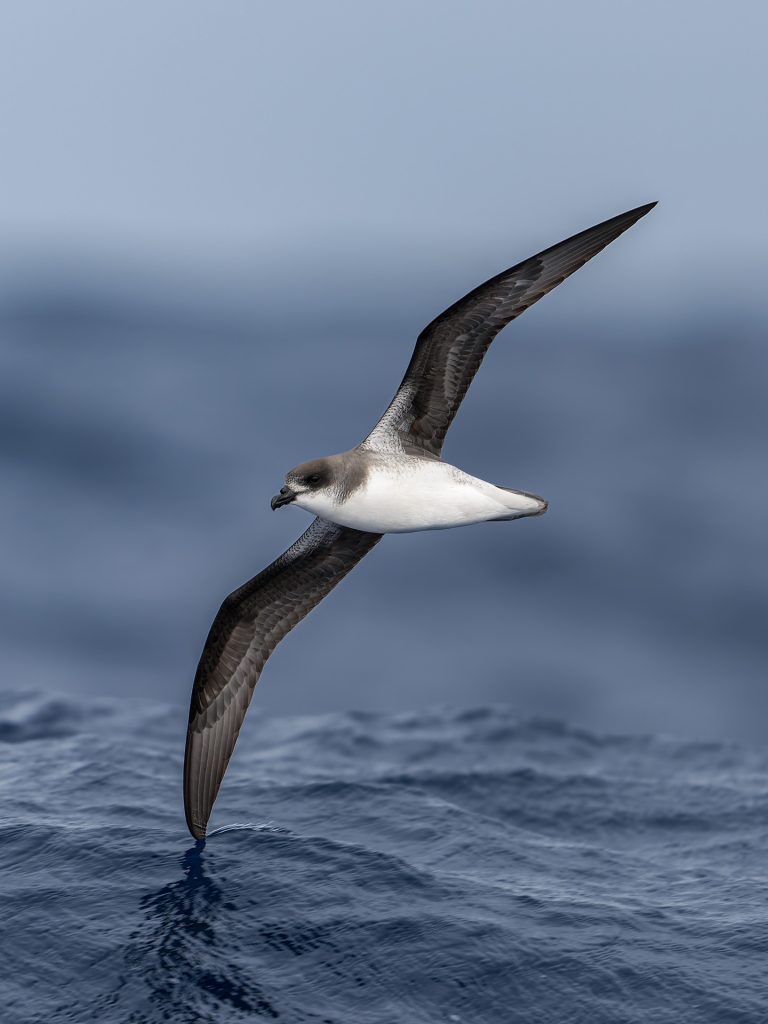
A Desertas petrel (Pterodroma deserta) glides over turbulent seas. (Photo by © Kirk Zufelt)
The devices revealed journeys that were more extraordinary than anyone expected.
Each breeding season, these pigeon-sized seabirds leave their cliffside nests and launch into the vast Atlantic Ocean. The data showed that they disappear for weeks at a time, traveling at least 5,000 miles in search of food—the equivalent of a round-trip flight between Boston and San Francisco. When they return, they relieve their mate, who has remained behind incubating a single egg.
To sustain energy for these long-distance trips, Desertas petrels are designed like high-performance gliders. Instead of constantly flapping their wings, which would deplete their energy within hours, they can travel thousands of miles by soaring on the ocean windscapes, expending virtually no more energy than they would while resting on their nests.
The GPS tracks had already revealed an extraordinary feat of navigation. Yet the mileage wasn't what astonished the scientists most.
When the researchers overlaid the birds' flight paths with hurricane data, the maps looked wrong.
Ventura checked them again. Zoomed in. Triple-checked the data. It couldn't be.
The petrels had flown directly toward the cyclones, chasing them for days.
"When we saw the data, we nearly fell off our chairs," Ventura said. "This is the first time we have observed this behavior."
A cyclone can generate winds exceeding 157 miles per hour—strong enough to uproot trees, damage buildings, and churn the ocean into mountains of water. Birds typically avoid such dangerous conditions. But in this case, the birds had encountered 100 mph winds and waves up to 8 meters (26 feet) high. Incredibly, none of the petrels were harmed, and none abandoned their nests.
But why would petrels take such a risk?
The answer lies hundreds of feet beneath the surface.
Desertas petrels feed on small fish, squid, and crustaceans that spend daylight hours in the ocean's twilight zone, 660 to 3,300 feet (200 to 1,000 meters) below the surface. Because the birds cannot dive that deep, much of this prey is normally out of reach.
A cyclone changes the equation.
"The cyclones could present a highly valuable foraging opportunity for Desertas petrels. Storms could churn up mesopelagic prey from deep within the water column, giving the seabirds an easy meal at the surface," Ventura explained.
As the storm rages, it mixes cooler, nutrient-rich waters upward and triggers bursts of biological productivity.
"The cyclonic winds can cause a divergence in the upper layer that moves cooler, deeper water toward the surface," explained WHOI physical oceanographer Philip Richardson.
The result is an all-you-can-eat seafood buffet for the seabirds.
"As we've now discovered, Desertas petrels follow hurricanes where prey have accumulated closer to the surface in the wakes of the storms," said WHOI physical oceanographer Caroline Ummenhofer. "This study provides valuable insights into the resilience and foraging strategies of pelagic seabirds in the face of extreme weather events."
But these seabirds were not finished surprising WHOI scientists. Thousands of miles away, another group of storm petrels was revealing a different secret.
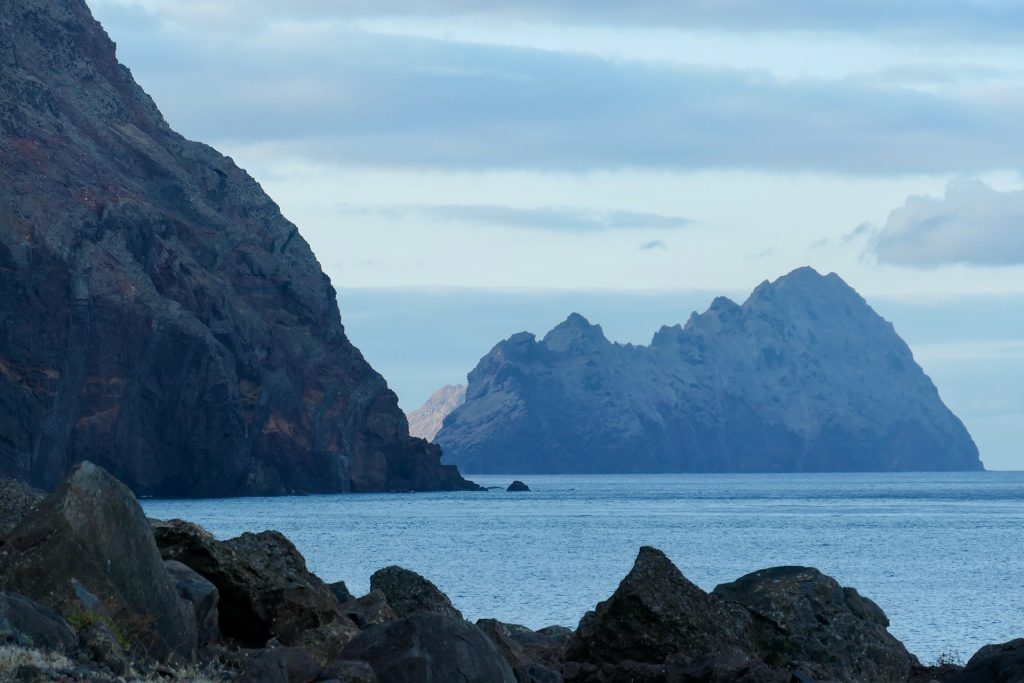
The rocky coastline of Bugio Island, Portugal (Photo by Francesco Ventura)
Along the rugged coastline of Sardinia, WHOI researchers were studying Mediterranean storm petrels. Using ultra-light biologgers, they discovered something equally surprising: the birds consistently chose to fly in crosswinds rather than riding the more energy-efficient tailwinds.
At first glance, the behavior seemed exhausting. Why would the storm petrels repeatedly angle across the wind?
Scientists theorized that the birds may be using their extraordinary sense of smell to navigate. By flying across scent plumes rather than directly downwind, they can gather more information about where food is concentrated across the vast ocean.
"It's striking how well the birds know how to exploit the large-scale wind conditions over the North Atlantic for their travels," Ummenhofer said.
For researchers willing to scramble across remote cliffs and follow tiny birds into the heart of hurricanes, these discoveries are transforming our understanding of how petrels navigate life on the open ocean.
This research was supported by NASA grant 80NSSC25K7836 and the Postdoctoral Scholar Program at Woods Hole Oceanographic Institution, with funding from the John E. Sawyer Fund and the John H. Steele Endowment, awarded to Francesco Ventura.
Overview
Tiny GPS trackers and biologgers revealed that petrels take far riskier and stranger paths across the ocean than scientists expected, with some birds chasing hurricanes for food and others deliberately flying against efficient winds to sniff out prey, according to research WHOI conducted off Madeira and Sardinia.
Key takeaways
-
Using GPS trackers, WHOI scientist Francesco Ventura found that Desertas petrels fly over 5,000 miles per foraging trip and deliberately chase cyclones for days, flying through 100 mph winds and 26-foot waves without harm.
- Cyclones churn up nutrient-rich deep water and push mesopelagic prey (normally 660–3,300 feet down) closer to the surface, giving petrels access to food they otherwise couldn't reach.
-
Separately, researchers studying Mediterranean storm petrels in Sardinia found the birds favor energy-costly crosswinds over tailwinds, likely to cross through scent plumes and better locate food using smell.
-
Together, the findings — from two different petrel species in two ocean regions — are reshaping scientists' understanding of how seabirds navigate and exploit extreme weather and wind patterns to survive on the open ocean.