A mummy, a myth, and the Titanic
A 1986 handwritten letter to Bob Ballard revisits one of the Titanic disaster’s strangest myths
Estimated reading time: 2 minutes
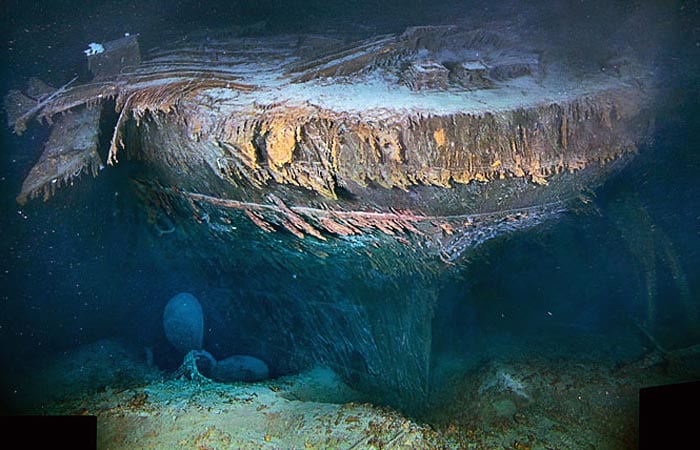
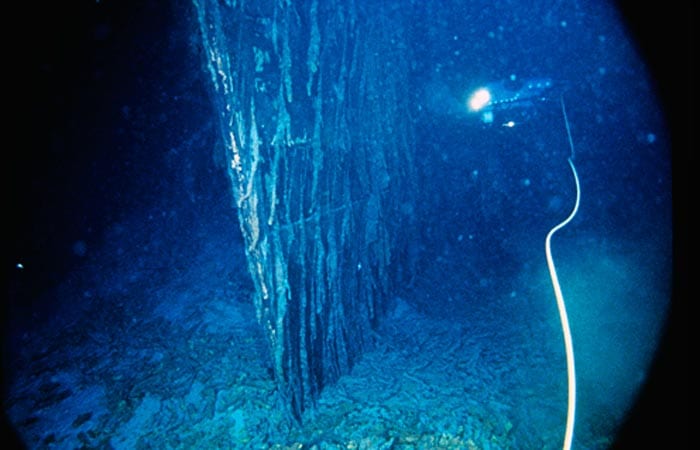
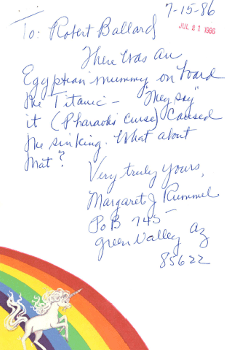
In July 1986, about a year after Bob Ballard and his team found the RMS Titanic on the ocean floor some 370 miles (600 km) southeast of Newfoundland, Canada, a woman named Margaret Rummel from Green Valley, Arizona, penned a letter to the oceanographer. In large blue cursive letters she wrote, “There was an Egyptian mummy on board the Titanic—they say it (Pharoah’s Curse) caused the sinking. What about that?”
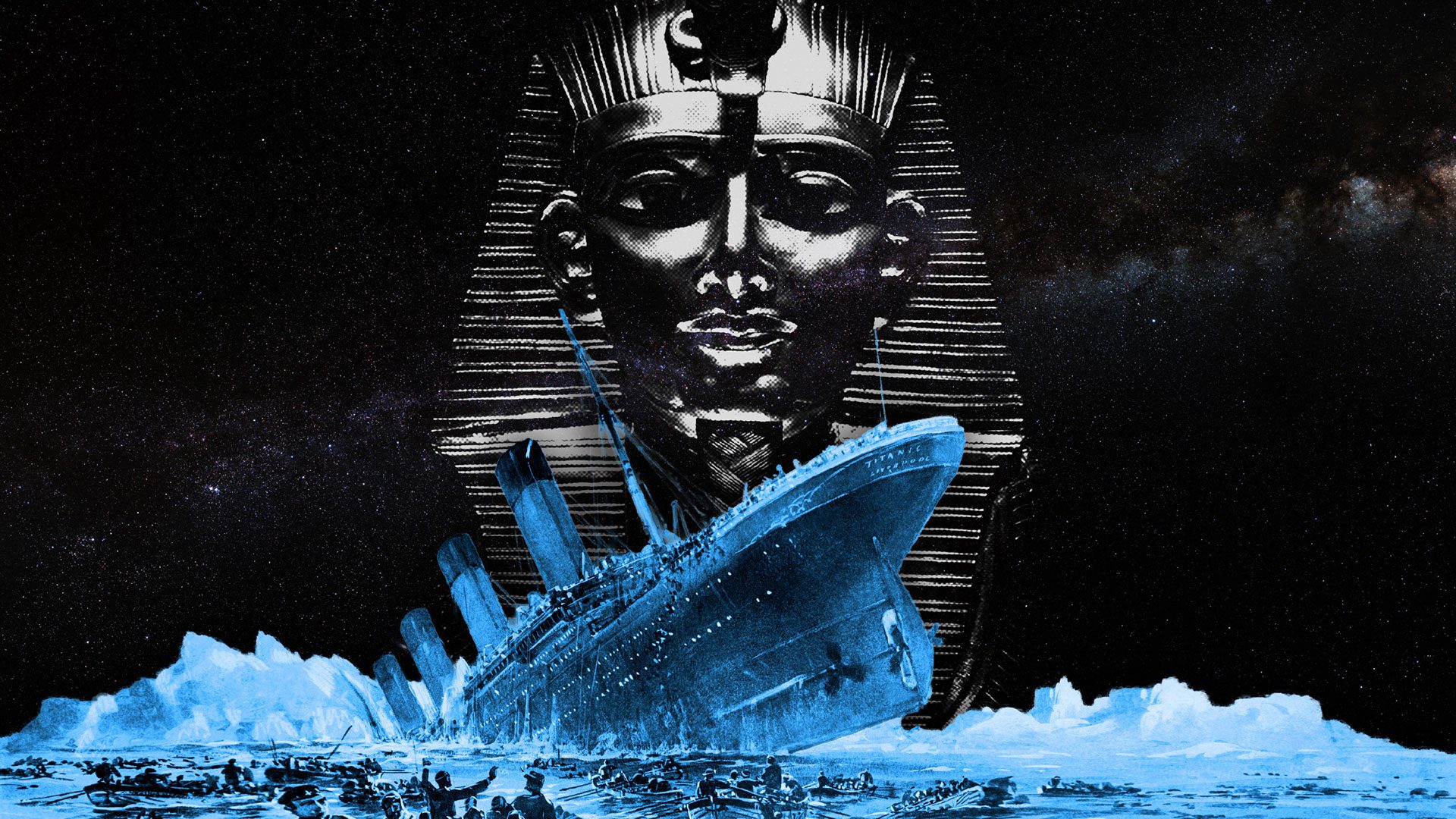
The note, written on a sheet of rainbow unicorn stationary, related to an absurd claim made in a May 1912 Washington Post story that an ancient curse had doomed the “unsinkable” ship. The story, entitled “Ghost of The Titanic: Vengeance of Hoodoo Mummy Followed Man Who Wrote Its History,” posed a few eyebrow-raising questions right out of the gate: “Was the avenging spirit of an Egyptian priestess who died in the holy city of Thebes 1600 years before the birth of Christ present upon the Titanic, pursuing with immortal malevolence those who had desecrated her tomb and her memory? Did the curse pronounced 3,500 years ago by the storied Nile upon all who should insult her bones have power to rush down the centuries into the age of wireless telegraphy and the waters of the New World?”
 This was long before fake news as we know it today. And while folkloric myths of Egyptian curses were nothing new, it was among the most unusual takes on the sinking of the Titanic. Yet it was also a time when Egyptomania was taking hold in the western world and sparking the imagination of audiences who couldn’t get enough of ancient Egyptian culture.
The story went on to explain how the curse was tied to a mummy case—not an actual mummy, mind you—that dates back to Egypt’s late period (around 664-332 BCE) and was, and still is, housed at the British Museum in central London. It recounts a series of mysterious deaths, accidents, and financial ruin said to have struck people who owned, transported, photographed, researched, or even wrote about the mummy case. This included William T. Stead, a journalist who reportedly spent part of Titanic’s final evening spinning a chilling tale of the “unlucky mummy” and its lethal powers just hours before going down with the ship.
Rummel had likely seen stories about the longstanding myth and wanted Ballard’s first-hand take on it. But what she likely hadn’t seen before sending the letter was a report from the Titanic Historical Society in 1985, which stated that there had been no record of any ancient Egyptian artifacts on board in the full Titanic cargo listing.
Of course, it was all just one big ghost story. Yet Ballard still took the time to respond back to Rummel, something that WHOI Director of Research Data and Library Services Ashley Jester said was not uncommon. "He took the time to reply to nearly every letter he received about the Titanic, no matter how wild the claims or questions. I think he felt a lot of responsibility to the public in terms of making sure that everyone who was curious could learn more," she said.
In Ballard’s response letter, which is stored at the WHOI Data Library and Archives, he let Rummel down easy. He wrote, “Dear Ms. Rummel, I think the story of the Egyptian mummy, through some Pharaoh’s curse, causing the Titanic to sink, is fascinating but unlikely. All evidence points to a much less romantic but more pragmatic cause—the famous iceberg. Sincerely, Dr. Robert Ballard”