The unseen toll of war on science
As the changing climate accelerates the spread of toxic algal blooms in the Arctic, the Russia–Ukraine war is cutting off critical international collaboration needed to understand and protect vulnerable ecosystems and communities.
Estimated reading time: 3 minutes
The Pacific Arctic is undergoing rapid change. Warming air and ocean waters have led to less sea ice in the northern Bering Sea, Bering Strait, and the Chukchi and Beaufort Seas. Because of the predominantly northward flow through Bering Strait, organisms from the Bering Sea are spreading into the Arctic, leading to harmful algal blooms (HABs) that present a growing threat to people and ecosystems. HAB species were documented in the Alaskan Arctic as early as the mid-20th century, but recent evidence shows that their occurrence and impacts are now far more widespread and severe. Unfortunately, the Russia-Ukraine War, which initially began in 2014 before the full-scale invasion phase in 2022, is interfering with our ability to study the full extent of these changes.
Of the many organisms that may spread into warming Arctic waters, few present such significant threats to human and ecosystem health as the dinoflagellate Alexandrium catenella, which produces a biotoxin that leads to a condition known as paralytic shellfish poisoning. Human effects can include numbness, paralysis, and potentially death.
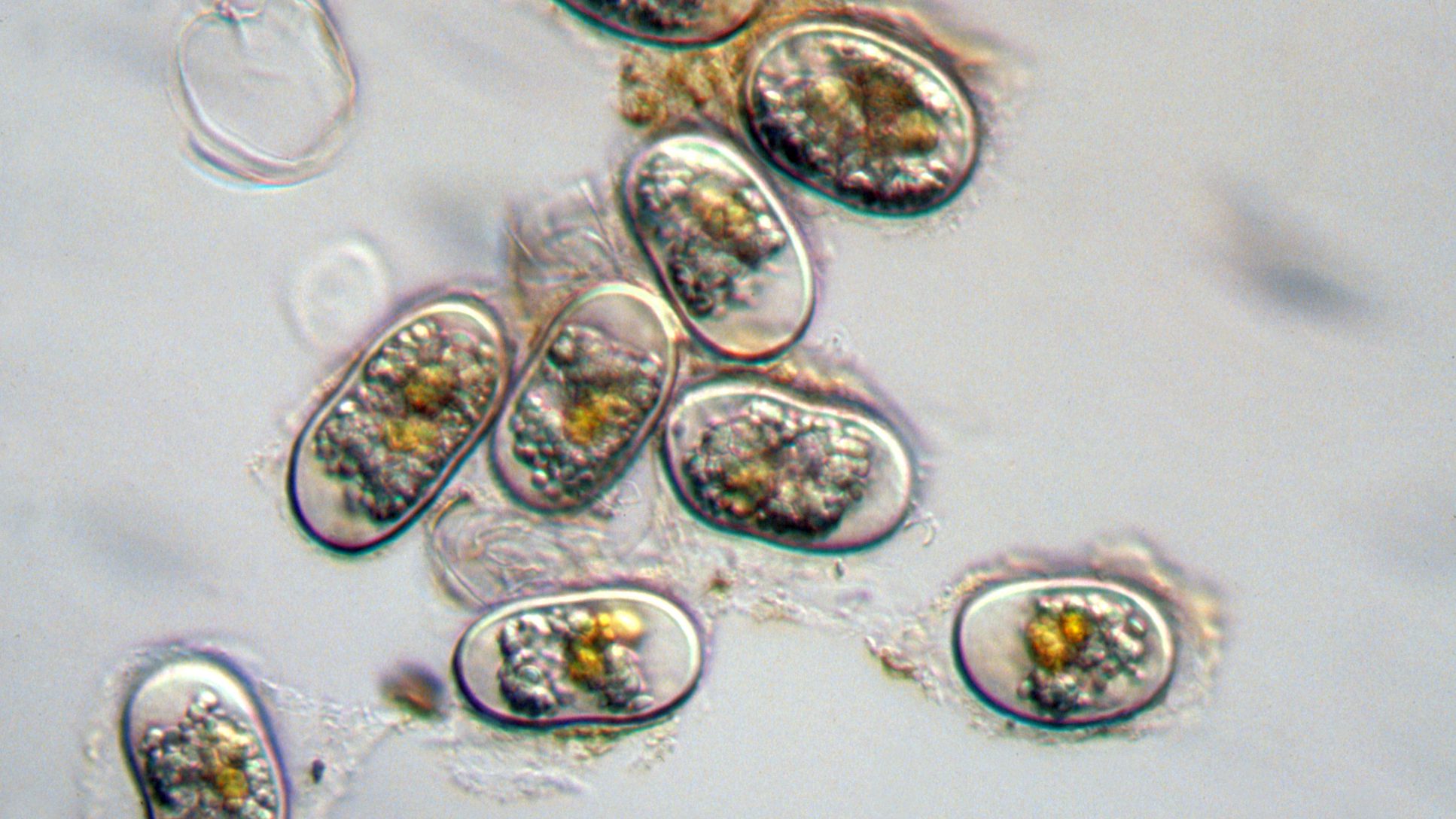
WHOI senior scientist Bob Pickart and I have been investigating Alexandrium blooms in the northern Bering Sea and beyond. We have identified an extraordinarily large and dense “seed bed” of Alexandrium cysts — the largest ever reported in the world. Cysts are dormant cells that accumulate in bottom sediments and eventually hatch, leading to blooms in surface waters.
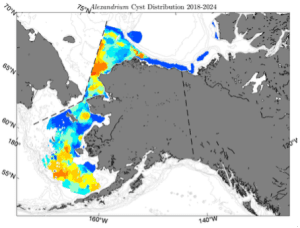
Map showing the distribution and abundance of Alexandrium cysts (warmer colors are high cyst concentrations). The dashed line shows the boundary between Russia and the US waters.
We’ve also found that massive, highly toxic blooms are repeatedly moving through the Bering Strait into the Chukchi and Beaufort Seas. Where exactly these blooms come from remains uncertain, but evidence suggests that they might originate in the Gulf of Anadyr in Russian waters.
One of the things that makes it hard to study the distribution of these blooms and cysts is the treaty line that separates U.S. and Russian waters. Although algae doesn’t recognize national borders and the Alexandrium population clearly extends beyond our current measurements, we cannot sample west of this boundary.
Luckily there’s a way to fill these gaps through the National Park Service’s Beringia Shared Heritage Program. Beringia is the name of the prehistoric land bridge that once connected Siberia and Alaska, allowing plants, animals, and early humans to migrate between Asia and North America. This program brings researchers from the U.S. and Russia together to preserve and study the natural and cultural history of this region.
Plans were in place for my Russian collaborators to travel to my laboratory at WHOI. They would bring sediment and water samples collected from Russian waters that we could analyze and use to train workers for future study. We also planned student training and exchanges, along with outreach activities, to share our findings with communities on both sides of the Bering Strait.
Then came the Russia-Ukraine conflict, which completely halted planned cooperation and exchange with my Russian colleagues. Apart from a single early Zoom call, there has been no further contact. I fear that more communication could endanger my colleagues, and the lack of overtures from them suggests that this is indeed the case. Meanwhile, massive toxic blooms continue to move through the region, almost certainly affecting communities in the western Bering Sea and Chukotka as they do those along the Alaska coast.
There are many reasons to hope for an end to the war, but scientifically and socially, there is much to be gained from renewed exchanges with our Russian counterparts.
About the author
Donald M. Anderson is an Emeritus Research Scholar in the Biology Department of the Woods Hole Oceanographic Institution, where he also serves as Director of the Cooperative Institute for the North Atlantic Region (CINAR). He also serves as the Director of the US National Office for Harmful Algal Blooms, located at WHOI. He earned a bachelor’s degree in mechanical engineering and a doctoral degree in aquatic sciences from the Civil Engineering Department of the Massachusetts Institute of Technology. He accepted a postdoctoral position at WHOI in 1978 and joined the staff as an Assistant Scientist in 1979. He recently retired from his Senior Scientist position, and is now emeritus.