Run Deep, But Not Silent
A new tagging device lets scientists 'go along for the ride' into the underwater world of whales
Whales are among the most elusive animals that humans have ever hunted. Pursuing whales across the seas and centuries, whalers made careful observations of whale behavior whenever and wherever they surfaced. But sperm whales, for example, spend about 95 percent of their time beneath the waves. Studying five percent of their behavior was enough to learn how to kill them, but it has taught us very little about how they live.
But now, for the first time in history, we can accompany a whale on its dive, hear what it hears, and observe its normal, natural, previously hidden behavior in the depths. Working closely together, scientists and engineers have created an innovative new device—the digital acoustic recording tag, or D-tag. It attaches to a living whale and records nearly everything that happens on its dives, without disturbing the animal.
On land, behavioral scientists spend years carefully observing animals such as wolves, lions, or chimpanzees to build up a detailed record of how they behave in response to social or environmental circumstances. Often the researchers remain hidden, or they acclimate the wild animals to their presence, before they can trust that their observations reflect natural behavior.
We cannot do that with whales. We can’t be unobtrusive, because boats can’t be hidden. And we can’t observe whales for long, because most of the time, we can’t see them at all. Scientists have had no practical way to follow along on a sperm whale’s epic dives, 600 to 1,200 meters down into the cold, dark depths, on their all-consuming mission to search for enough food to keep their massive bodies fueled. Until now.
Pioneering whale studies
Whales live in a world of sound, not of sight. Like bats, they send out and receive sound signals and are guided through the sea by what they hear—using both sounds reflected back from objects and sounds made by other whales. Sound is the currency of their lives; they rely on it for knowing where the bottom is, for finding food, and for communicating with each other.
Researchers also use sound for locating whales. Nearly 50 years ago, biologist William Schevill and physical oceanographer Valentine Worthington at Woods Hole Oceanographic Institution were the first to record the sounds of sperm whales, using underwater devices called hydrophones. WHOI biologist William Watkins made enormous advances in identifying which sounds are made by which species of marine mammal.
So careful were these pioneering scientists’ methods that we still use their results 45 years later. They still represent some of the best data sets available, accurately measuring and attributing sounds to the different whales that made them, and I have avoided many wrong turns by being attuned to this resource.
With hydrophones, scientists could listen to sounds in the sea and begin to know where, what kind, and how many whales there are in an area. But what whales were doing below the surface has remained hidden.
The D-tag’s origin and evolution
Ecologists place tags on a variety of animals to track their movements, and they have tagged marine animals, too: whales, dolphins, seals, turtles, and even a great white shark. Such tags record depths a few times each minute and can only transmit data when near or at the surface, giving scientists a record of only the tagged animal’s location and depth over time.
I came to WHOI originally to develop a small tag for captive dolphins that would light up when a dolphin made a sound, allowing us to tell which individual made which sound. It worked well for captive dolphins, but I had not considered using it in the wild. In the early 1990s, a graduate student at the University of Guelph named Andrew Westgate developed the first tag that could be used on wild porpoises to record time and depths of their dives. Unlike earlier tags used on seals, it was not on a collar, but temporarily attached to the porpoise. It was designed to fall off the animal and be recovered by researchers who could then download the data.
His success led me to pursue an archiving tag for wild whales, which would have a greater capacity to measure behavior and sound. WHOI engineer Mark Johnson began to build a tag that would record not only times and depths, but also any sounds in the water—both the whale’s sounds and sounds in the whale’s environment. Over the last five years he has refined the D-tag into a remarkable device that attaches to a whale with suction cups and stays on during a dive, while not disturbing the animal—a critical consideration if you want to observe normal behavior. (See “Playing Tag with Whales.“)
The D-tag records and stores what the animal is doing and what its environment is like. Beyond time, depths, and sounds, the tag records temperatures in the environment surrounding the whale; and the whale’s pitch, roll, speed, and direction. It measures this information 50 times a second.
After up to 12 hours and multiple dives, the tag releases its suction automatically, floats, and sends out a radio signal so we can recover it aboard ship. So much data is recorded about the whale’s dive that it can take three hours to download.
Applying the tag
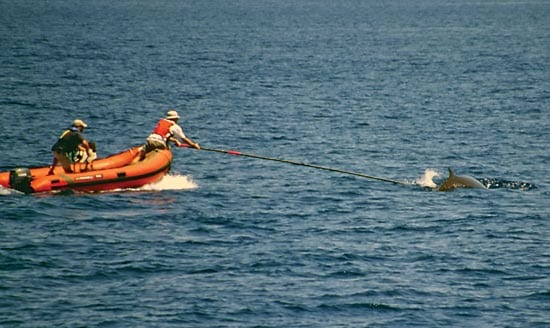
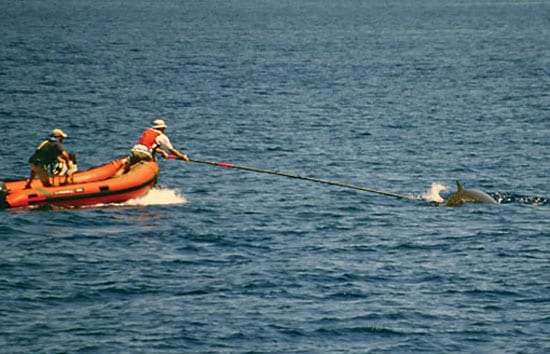
The success of the tag depends on being able to attach it to a whale, of course, and that depended on having a way to reach a sperm whale from a small boat, while keeping some distance away. While working with North Atlantic right whales, WHOI biologist Michael Moore and engineer Richard Arthur developed a cantilevered, 40-foot, carbon-fiber pole, which researchers in small boats can use to deliver sedatives, ultrasonic transducers for sigmoidoscopies, or a suction tag to a whale at the surface.
Without this invention, we couldn’t tag the whales. Even with it, it’s still a difficult process that requires luck, patience, decent weather, and some measure of fortitude. We find ourselves in tiny boats, trying to sneak up on large and often intractable wild animals to stick something on them with a long pole, during the small fraction of time they are at the surface. Any one of our “subjects” could swim away from us or dive at any time. The work is exciting on many levels.
What whales say and hear
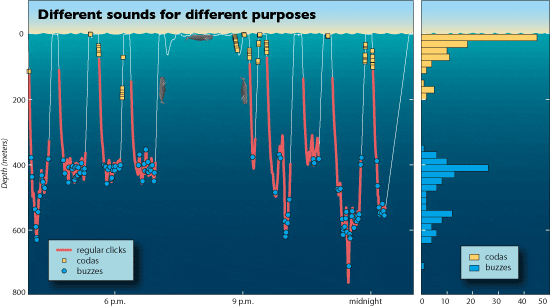
Like us, whales use different sounds for different purposes. Data from the D-tag show us that sperm whales don’t waste time or energy in travel. They spend very little time at the surface, dive nearly straight down to very deep water, then spend quite a bit of time at this “foraging depth,” hunting for food, before coming nearly straight up again to the surface.
When whales begin a dive to find and capture prey, they start producing sounds called “regular clicks” roughly once per second, at depths of several hundred meters. They use the regular clicks, it seems, to orient themselves; for most regular clicks, the tag records sound echoes reflecting from both the ocean’s water surface and the bottom.
Sperm whales also seem to use regular clicks as a sonar to find patches of prey. But as they close in on their prey (mostly squid), they rapidly accelerate their click rate into a sound we call a “buzz,” which seems to be used to locate the prey precisely enough to capture it.
Whales also use sound to communicate with each other. The D-tag has revealed that they make rhythmic patterns of clicks called “codas” not only when they are near the surface, but also during the start of their descents and the end of their ascents, when they interact with one another during their dives. We have tagged two to three sperm whales at the same time and have discovered, after downloading data from the recovered tags, that the whales dove in synchrony, on similar dive tracks to the same depth. They maintained a steady distance between each other, apparently by listening to each other’s regular clicks.
Using the D-tag on a smaller toothed whale called a beaked whale, Mark Johnson and WHOI biologist Peter Madsen, working in my lab, have been able, for the first time, to record and hear not only the sounds a whale makes when foraging, but also the echoes reflecting off the prey, returning to the whale, and recorded by the tag. The tags have even captured the sound of prey being captured.
Noise pollution
Whales also hear, and react to, sound from other sources, including boat engines, military sonar, or airguns used to explore for oil and gas beneath the seafloor. We don’t yet know the exact range of frequencies they hear, but the D-tag will allow us to investigate whales’ responses to different ambient sounds. Ongoing studies on whale ear anatomy by Darlene Ketten at WHOI can give information on what frequency range they are likely to hear (See “How to See What Whales Hear.”) There is growing concern that human-generated sound may interfere with the whales’ navigation, feeding, communication, and lives.
During a sperm whale cruise that happened to coincide with the invasion of Grenada, Bill Watkins and I found that sperm whales become silent when exposed to sonar sounds, and when exposed to airguns, they have reduced rates of buzzes associated with catching prey. We don’t know yet how much of an interruption of their normal feeding this can cause, or the possible ramifications it may have on reducing the energy available for their growth and reproduction. The D-tag can tell us what happens on multiple dives of a single animal and also lets us compare dives of many different animals, so that we can build up a library of a population’s behaviors.
The future of this work is immensely exciting. We will be able to learn what whales have known for eons—what their lives are like. We hope it will also help to protect them from unintended impacts of seagoing humans.
Slideshow