Dead Corals Do Tell Tales
Growing a little each day, coral skeletons keep a daily archive of past ocean temperatures
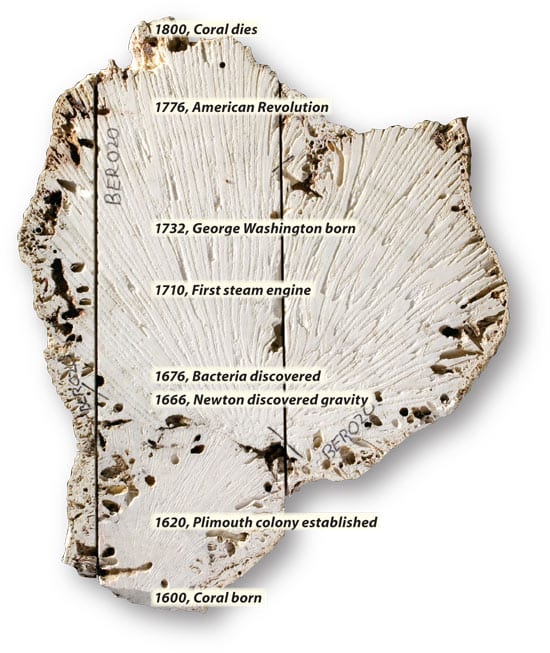
Sometime around the beginning of the 17th century, a tiny drifting larva found the perfect piece of real estate to settle down, on the shallow seafloor off the island of Bermuda. It sprouted tentacles to catch prey, revealing itself as a coral polyp, and a few days later, the small flower-shaped animal began to build a hard exterior skeleton. The polyp grew and divided, eventually multiplying into a colony of thousands, with the round shape and convoluted surface of a brain coral. By the time it died around 1800, it looked like a boulder and weighed more than 1,000 pounds.
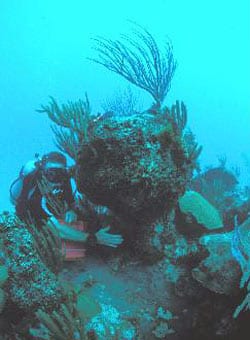
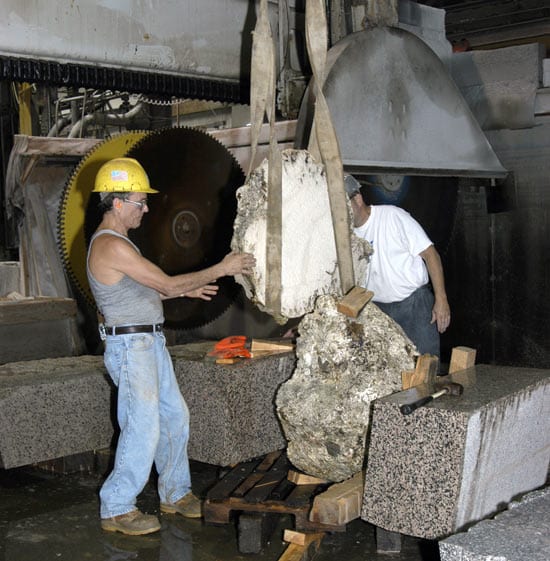
Two centuries later, Ross Jones (a biologist at the Bermuda Biological Station for Research) and I found this massive, well-preserved coral while scuba diving off Bermuda. It was just what we were looking for: a coral with a past. If it were big enough and dead for long enough, it would have lived through a considerable part the Little Ice Age, an era between 1350 and 1850 when Earth’s climate was very different from today’s.
During this period, unforgiving cold gripped the North Atlantic region. Europe and eastern North America endured cool summers and severe winters. Rivers froze and glaciers advanced over land that is ice-free today. The times were marked by persistent crop failures, famine, disease, and mass migrations. The Norse, for example, abruptly abandoned their settlements in Greenland.
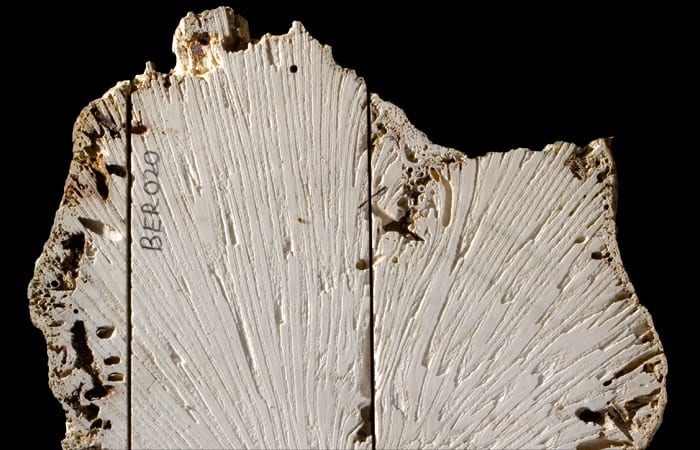
Meanwhile off Bermuda, each individual polyp in our coral was accreting (growing) skeleton, in daily increments that built up into seasonal and annual layers, similar to tree rings. In corals, the chemistry of their skeletons varies slightly but measurably as the temperature of the waters do. So the skeleton of this long-lived coral offered a continuous record of ocean temperatures and environmental conditions off Bermuda throughout much of the Little Ice Age, a pre-industrial era for which no instrumental records exist.
Records closeted in skeletons
The Bermuda brain coral, Diploria sp., was covered with marine organisms that had attached and burrowed into its surface. When we cleared off the algae, sponges, burrowing worms, starfish, and soft corals, we found that the coral’s surface was eroded—but inside, the skeleton remained intact. The cover of this ancient “book” was damaged, but its contents were unspoiled.
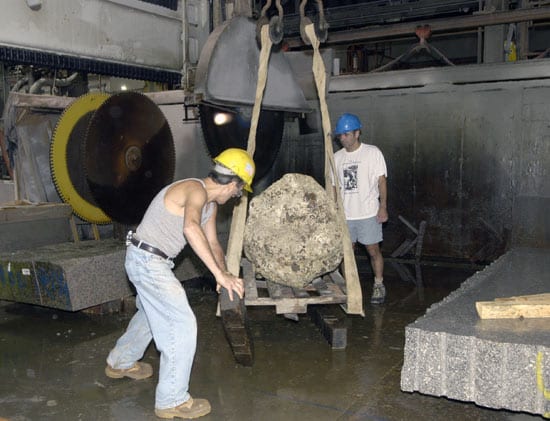
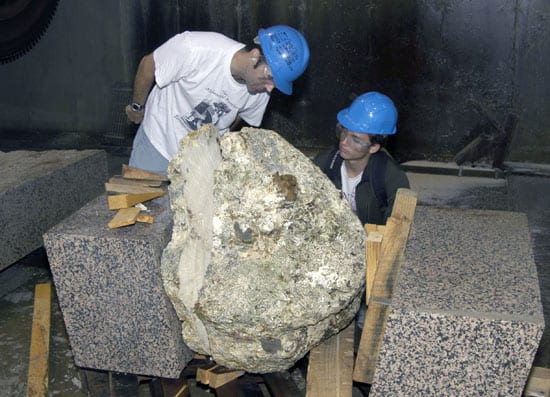
We recovered the dead coral from the seafloor and sent it back to Woods Hole Oceanographic Institution. By using a new laser mass spectrometer technique we developed for very fine-scale sampling of coral, we aim to do the equivalent of reading the coral “book” page by page: to get a week-to-week, perhaps even a day-by-day, account of ocean temperatures over past centuries.
That would give climate scientists better records to understand the ocean-atmosphere interactions that generate periodic, short-term climate shifts such as El Niño and the North Atlantic Oscillation, for example, or abrupt, longer ones, such as the Little Ice Age. And understanding the oceans’ past behavior offers insights into how corals and the climate might change as fossil fuel burning and other human activities increase carbon dioxide levels in the atmosphere.
Until now, we have had few good records of ocean temperatures just before industrial activity began. Paleoclimatologists can infer past ocean temperatures over long, thousand-year timescales by analyzing the chemical composition of sediments that accumulate on the seafloor over millennia. But in sediments, it is hard to resolve a record of short-term and recent changes. Long-dead corals can provide that record, and they also remain intact, unlike sedimentary layers, which are often disturbed by animal movements or currents.
Translating chemistry into temperatures
Corals’ skeletons are made of aragonite, a form of calcium carbonate—the same substance marble, limestone, chalk, and clamshells are made of. To grow their skeletons, corals accrete tiny “seed” crystals at night underneath their tissue; during the day, long aragonite crystals self-assemble on those seeds from the calcium and carbonate in seawater, just as snow crystals form around tiny ice crystals.
But seawater contains trace amounts of other elements such as strontium (Sr), magnesium (Mg), and barium (Ba), which become incorporated into the growing aragonite crystals. These give scientists a handy thermometer.
Here’s how it works: The relative proportions of minor, or trace elements (Sr, Mg, and Ba) versus the major element (calcium) that are incorporated into aragonite as it grows depend on the temperature of the seawater. Once coral skeletons form, their composition does not change—not even over centuries. By sampling coral skeleton layers and measuring their trace element-to-calcium ratios, we can derive a chronology of ocean temperature, in locations where the corals lived.
Nanoscale sampling
For years, WHOI Senior Scientist Stan Hart had been using an instrument called an ion microprobe, which measures small amounts of isotopes in samples, to determine the composition of rocks. “Why not use this instrument for paleoceanography in corals?” he suggested. And so, with funding from the WHOI Ocean and Climate Change Institute, we developed microscale analytical techniques for coral skeletons.
The difficulty is in getting sufficiently small-scale samples. Previously, we could only analyze samples in bulk. That was kind of like putting the ancient book in a blender, chapter by chapter, and getting an average account of the plot’s progress.
Another WHOI colleague, biologist Simon Thorrold, began to use a laser to take nanoscale samples (called “laser ablation”) of calcium carbonate in fish ear bones, whose isotopic composition he analyzed in an ion mass spectrometer. With funding from the WHOI Ocean Life Institute, Thorrold and I put the two techniques together and developed a new laser mass spectrometer technique for sampling coral.
The technique lets us analyze samples at distances only 60 micrometers (0.002 inches) apart within the skeleton, equivalent to just a week’s growth. That is like reading the book line by line, or word by word. Already, by analyzing daily growth layers, we have found that corals are sensitive to tidal and lunar cycles. The chemical compositions of their skeletons change abruptly with each new and full moon.
Analyzing chemical composition, we found that the seawater during our huge brain coral’s life was about 1.5o C (2.7o F) colder than it is today, yet the coral grew faster than the corals there now, thriving in the coldest period of the Little Ice Age. We think water temperatures now are higher than optimal for these corals.
What does that mean for this coral’s progeny—the brain corals off Bermuda today and tomorrow? If they see much warmer temperatures, due to global warming, will they be able to thrive and live long lives also?
Slideshow