3 questions with Cam Braun
Marine biologist Camrin Braun explains why the world's largest fish visit waters off Cape Cod—and what their epic migrations reveal about a changing ocean
Estimated reading time: 2 minutes

WHOI marine ecologist Camrin Braun. (Photo by Daniel Hentz, © Woods Hole Oceanographic Institution)
Dr. Camrin Braun studies how large marine animals move through the ocean and how changing ocean conditions influence where they go. By combining satellite tracking, ocean observations, fisheries data, and computer models, he works to better understand the behavior of sharks and other apex predators, and the ecosystems they depend on.
Braun has studied whale sharks since 2010 as a WHOI Summer Student Fellow, and has tagged them in the Red Sea and across the Atlantic Ocean. His research has revealed how these far-ranging animals connect distant parts of the ocean—from the tropics to Cape Cod—and is helping scientists improve conservation and fisheries management in a rapidly changing ocean.
Q: How did you originally discover whale sharks off Cape Cod?
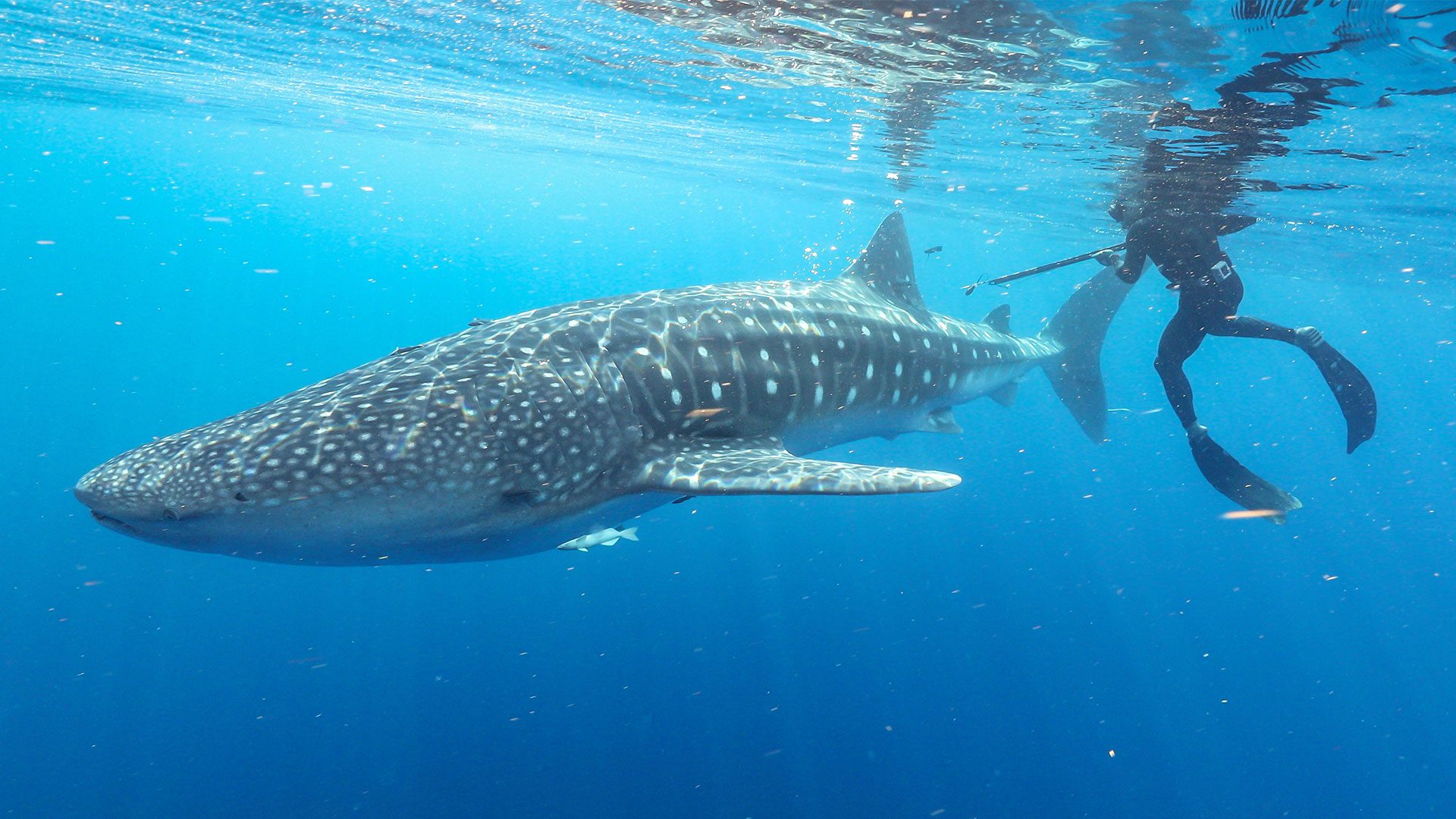
We didn’t find them ourselves. A couple local guys who like to fish and dive offshore approached us and said, “Did you know there are whale sharks here?” That was a huge surprise. Whale sharks are typically associated with tropical waters, and here they were in our backyard. What’s especially unique is that we’re seeing large, mature adults, something most other global hotspots don’t typically have.
Q: Why are adult whale sharks found in colder waters like Cape Cod?
They actually occur primarily in our offshore waters where the Gulf Stream brings warm tropical water to our region. So while it seems like an unlikely place to have whale sharks right here in Massachusetts, we actually have warm, crystal-clear water about 80-100 miles off our coast that hosts a whole suite of species we think of as tropical.
Q: What have you learned from long-term satellite tagging of these sharks?
After spending the summer offshore from Cape Cod, whale sharks leave in the fall and travel thousands of miles—into the Gulf of Mexico and the Caribbean, spending the winter in tropical waters. These migrations connect distant ecosystems. It also tells us that conservation can’t happen within just one country. These animals don’t recognize borders, so management has to be an international collaboration.
Q: Whale sharks appear to move pretty slow. How do they manage such long migrations?
The videos are deceiving. They are so big that they look like they’re moving slowly but it’s actually quite difficult to keep up with them in the water at their slowest speed, and if they kick it up a notch, a human swimmer doesn’t stand a chance. Mostly, they move steadily and can glide downward through the water column, conserving energy—similar to how a glider aircraft works. By alternating gliding descents with active swimming upward, they can easily travel 3,000 to 4,000 miles one way during a single migration.