Turning motion into power: Wave energy converters for sustainable ocean monitoring
Collaborative research between the Ocean Observatories Initiative and 3newable LLC is testing how compact wave energy converters and UV systems perform under real ocean conditions
Estimated reading time: 4 minutes
In the rapidly evolving world of ocean technology, wave energy is emerging as a promising pathway toward resilient, low-maintenance ocean observation systems. Julie Fouquet, CEO of 3newable LLC, and her team have been developing an innovative wave energy converter (WEC) that is designed to provide reliable, small-scale power for ocean observing platforms. They have also created an ultraviolet (UV) illuminator designed to reduce biofouling on sensitive instruments.
Following a recent deployment at the U.S. National Science Foundation Ocean Observatories Initiative’s (OOI) Coastal Endurance Array, Fouquet sat down to discuss the evolution of the project, lessons learned from at-sea testing, and her vision for renewable ocean power in the years ahead.
From concept to deployment
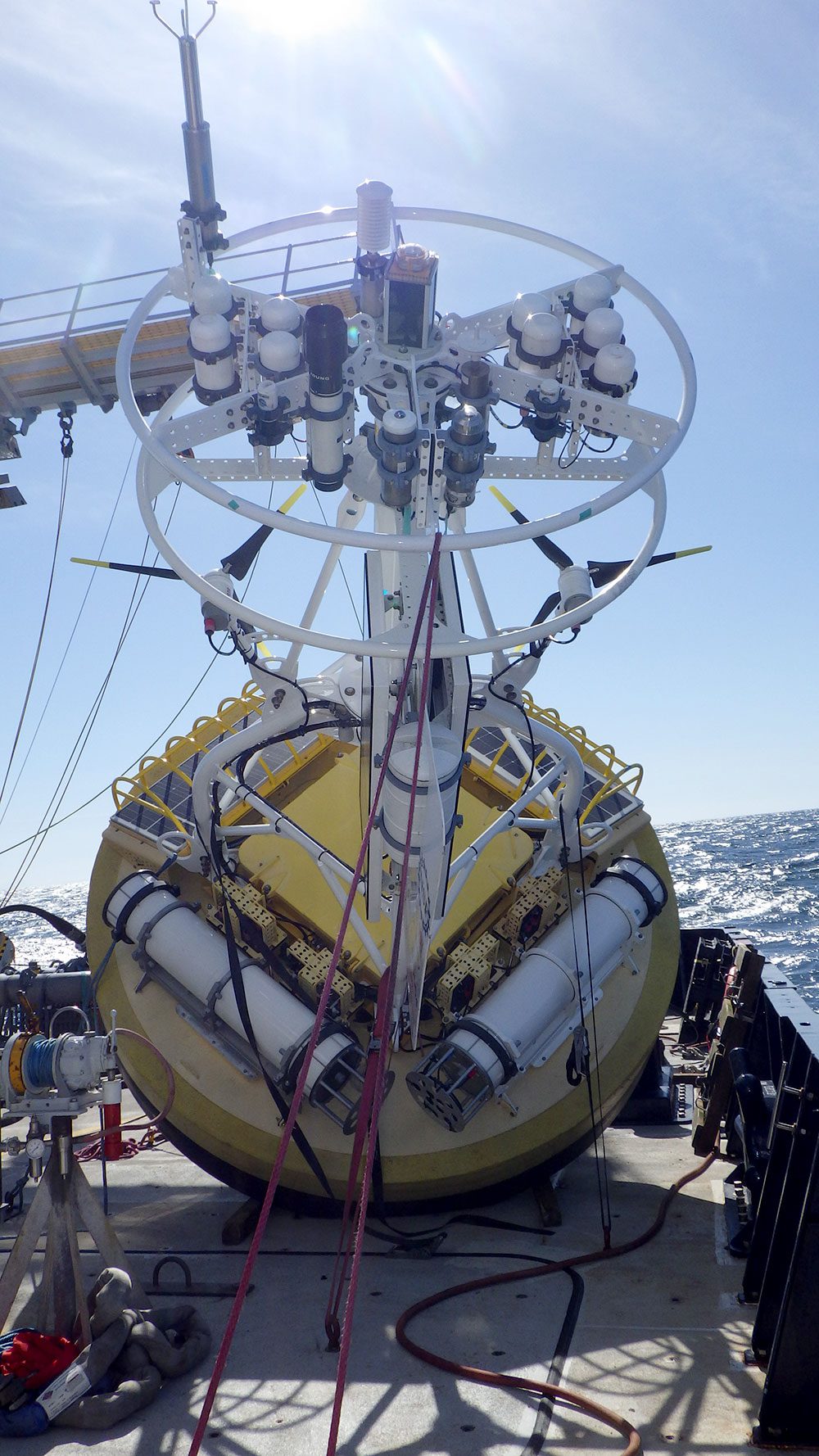
Two perpendicularly mounted WECs enable wave energy capture from all directions (Photo courtesy of U.S. National Science Foundation's Ocean Observatories Initiative, Endurance Team)
The WEC project has gone through several iterations, including an early effort to test at OOI’s Pioneer New England Shelf Array. But logistical hurdles and the eventual relocation of the Pioneer Array prompted a pivot toward OOI’s Endurance Array, where Jonathan Fram, co-principal investigator and project manager for the Endurance Array, was eager to support the UV-illumination component of the work.
That transition, which began in 2021, set the stage for 3newable’s first field deployment in the fall of 2023, followed by a second deployment in the spring of 2025. The Endurance Array offered a flexible testbed and an engaged team ready to collaborate on mechanical integration, biofouling mitigation, and performance monitoring.
The WEC isn’t trying to compete with large-scale offshore energy systems that have the capacity to power whole cities or regions. Instead, it’s built to deliver steady, modest power for sensors and low-draw electronics. It can produce up to 50% efficiency in laboratory conditions, but real-world deployments, output is expected to be lower—about 7–8 watts per WEC, averaged over a year. It has a fully sealed mechanical design that prevents saltwater from getting in, and a direct-drive electromagnetic engine that allows it to operate more efficiently than many conventional designs.
The WEC uses a rack and pinion mechanism to convert buoy tilting motion into rotational power. While the concept is straightforward, optimizing this system in real wave conditions demands careful tuning and specialized control algorithms. Wave-energy technologies come in many forms, from large flaps and heaving-buoy systems to fully self-powered platforms—with so many disparate approaches, nothing close to a “standard” design has emerged.
Given the wide range of wave-energy converter designs in the field, real-world deployments at the Endurance Array have been especially valuable in showing how the WEC’s sealed, compact approach behaves in operational conditions.
Solving a costly challenge: Biofouling
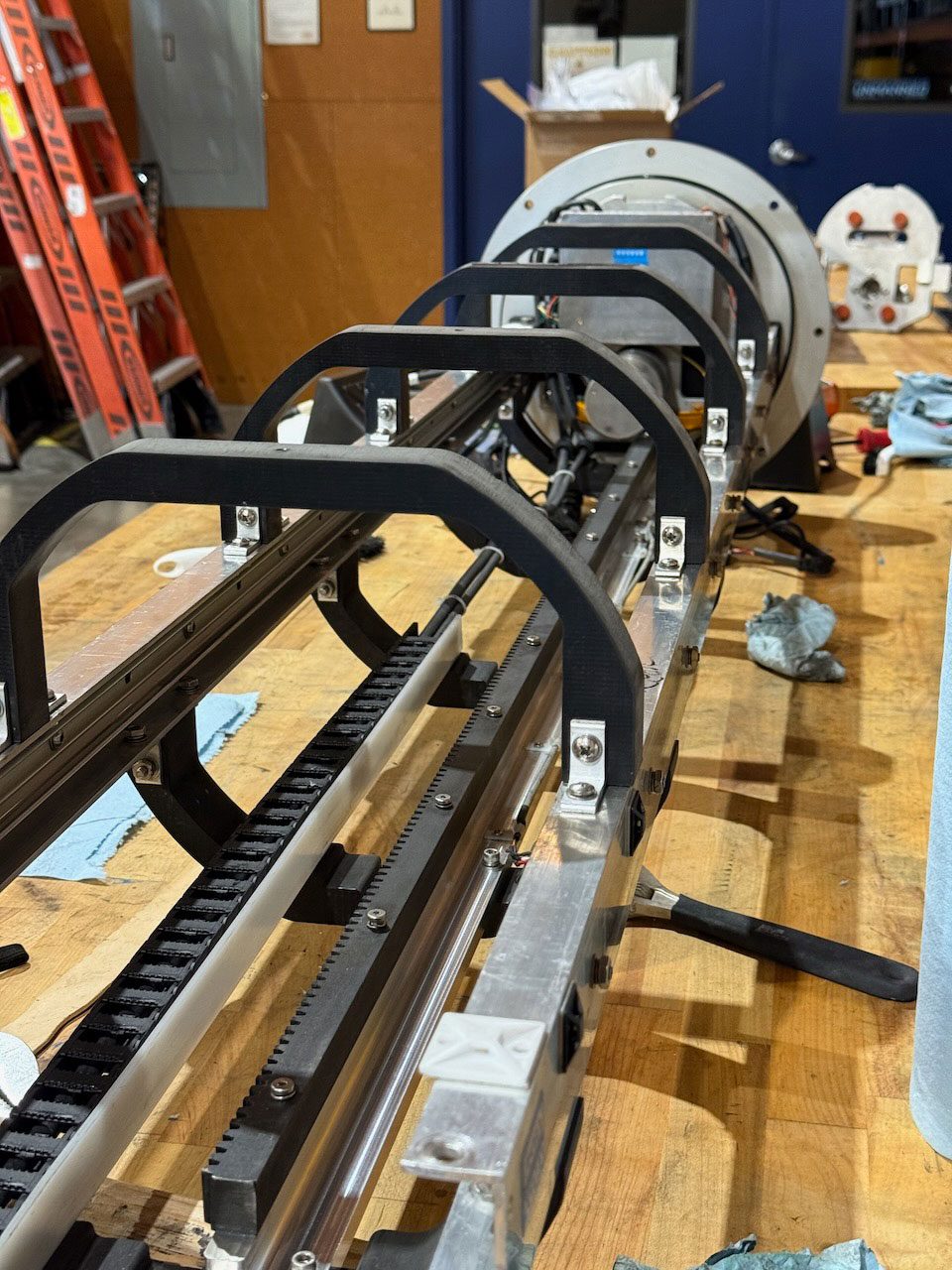
Wave energy converter chassis after recovery at OOI-OSU. (Photo by Julie Fouquet, © 3newable LLC)
One of OOI’s ongoing challenges is biofouling, or the accumulation of barnacles, algae, and sludge over time. Biofouling can shorten sensor deployments, degrade data quality, and drive-up servicing costs. Wide-angle UV emitters have been used to limit biofouling on some instruments, but they aren’t well-suited to the long, narrow shape of the sensors used to measure salinity. Fouquet’s team developed a UV beam illuminator to keep the conductivity cell interior of a salinity sensor clean and that can be powered by a battery, which can be recharged at sea by the WEC.
In recent tests, the UV system slightly outperformed the chemical biocides that have traditionally been used to suppress microbial growth, offering a non-toxic alternative to manage biofouling. The UV illuminator has become one of the project’s most promising offshoots—it has the potential to reduce maintenance cycle frequencies across a range of ocean observing platforms.
Testing the WEC at sea
Sea trials are essential in determining how well these new technologies will work in the field. “We challenge our equipment in the lab, but the ocean is the ultimate test environment,” said Fouquet. “Every deployment teaches us something new about the design, about the conditions, and about how to make our equipment truly practical.”
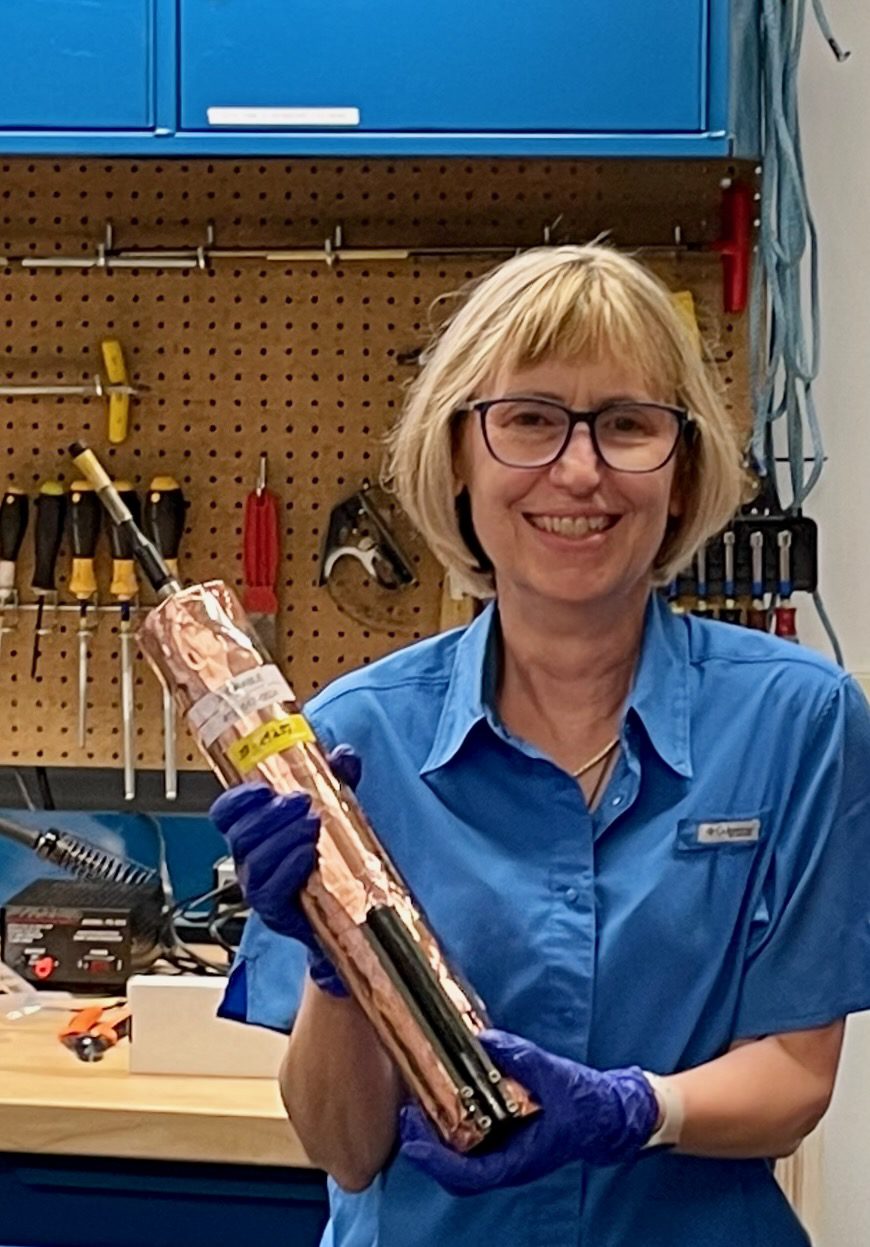
Julie Fouquet holds a copper tape-wrapped conductivity-temperature sensor before installing it at OSU. (Photo by 3newable intern Karl Nordhoff, California State University Maritime Academy)
During a recent deployment, the WEC achieved a 24/7 average generated power of 4 watts and net power of 0.91 watts over a week and a half, even in relatively low energy conditions. In addition to measuring how much power the WEC generated, the team identified engineering priorities including better lubrication, wave-specific tuning, and control system modifications that will help maximize output in variable seas.
Funding realities and looking forward
Changes to federal funding priorities have created major delays and uncertainties. Fouquet expressed concern that many renewable energy innovators face similar hurdles, particularly smaller companies that work on niche technologies.
Still, the long-term vision remains clear: “Expand the role of renewables within ocean observations and reduce the frequency of service voyages so that observing systems can sustain themselves with minimal intervention,” said Fouquet.
3newable hopes to continue refining both the WEC and the UV illuminator, exploring new deployment opportunities and working with OOI to strengthen ocean observing infrastructure through clean, efficient power.
See announcement on NSF OOI descoping.