
News Releases
Researchers from WHOI and MBL Receive $1.2 Million Grant for Collaborative Salt-Marsh Study
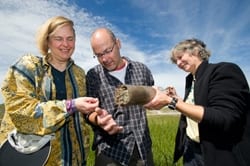
Scientists from the Marine Biological Laboratory (MBL) and the Woods Hole Oceanographic Institution (WHOI) were recently awarded a $1.2 million collaborative grant from the National Science Foundation (NSF) for studies on the role of sulfur-oxidizing bacteria in salt marsh nitrogen and carbon cycling. The fieldwork will be conducted at the Plum Island Ecosystem Long-Term Ecological Research (LTER) site on the North Shore of Boston.
Read MoreNew Coral Dating Method Hints at Possible Future Sea-Level Changes
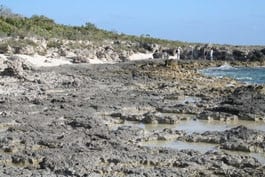
New evidence of sea-level oscillations during a warm period that started about 125,000 years ago raises the possibility of a similar scenario if the planet continues its more recent warming trend, says a research team led by the Woods Hole Oceanographic Institution (WHOI).
Read MoreStudy Assesses Nations’ Vulnerabilities to Reduced Mollusk Harvests from Ocean Acidification
Changes in ocean chemistry due to increased carbon dioxide (CO2) emissions are expected to damage shellfish populations around the world, but some nations will feel the impacts much sooner and more intensely than others, according to a study by scientists at Woods Hole Oceanographic Institution (WHOI).
Read MoreWHOI Study Reports Microbes Consumed Oil in Gulf Slick at Unexpected Rates
In the first published study to explain the role of microbes in breaking down the oil slick on the surface of the Gulf of Mexico, Woods Hole Oceanographic Institution (WHOI) researchers have come up with answers that represent both surprisingly good news and a head-scratching mystery.
Read MoreIdentical Virus, Host Populations Can Prevail for Centuries, WHOI Researcher Reports
A Woods Hole Oceanographic Institution (WHOI) scientist, analyzing ancient plankton DNA signatures in sediments of the Black Sea, has found for the first time that the same genetic populations of a virus and its algal host can persist and coexist for centuries. The findings have implications for the ecological significance of viruses in shaping algae ecosystems in the ocean, and perhaps fresh water as well.
Read MoreWHOI Study Sheds Light on Tunicate Evolution
Woods Hole Oceanographic Institution (WHOI) researchers have filled an important gap in the study of tunicate evolution by genetically sequencing 40 new specimens of thaliaceans, a gelatinous type of tunicate. Their study was featured on the cover of the June issue of the Journal of Plankton Research.
Read MorePrey-tell: Why Right Whales Linger in the Gulf of Maine
WHOIÃÂs Mark Baumgartner finds that the location, the length of stay, and perhaps the very abundance of the whales may be dependent on an interesting vertical migration pattern by the copepods on which the whales feed. It seems to be a case, he said, of ÃÂhow the behavior of the prey influences the behavior of the whales.ÃÂ
Read MoreHal Caswell Wins Humboldt Research Award

Hal Caswell, a senior scientist in the Biology Department at Woods Hole Oceanographic Institution (WHOI), was awarded a 2010 Humboldt Research Award by the Alexander von Humboldt Foundation in Bonn,…
Read MoreWhat Lives in the Sea?
The Census of Marine Life, a ten-year project to catalog all life in the sea, discovered more than 6,000 new species during its “decade of discovery,” scientists reported as they…
Read MoreThe Salp: Nature’s Near-Perfect Little Engine Just Got Better
What if trains, planes, and automobiles all were powered simply by the air through which they move? Moreover, what if their exhaust and byproducts helped the environment?
Well, such an energy-efficient, self-propelling mechanism already exists in nature. The salp, a smallish, barrel-shaped organism that resembles a kind of streamlined jellyfish, gets everything it needs from the ocean waters to feed and propel itself. And, scientists believe its waste material may actually help remove carbon dioxide (CO2) from the upper ocean and the atmosphere.
Expedition to Mid-Cayman Rise Identifies Unusual Variety of Deep Sea Vents
deep-sea hydrothermal vents Mid-Cayman Rise Woods Hole Oceanographic Institution (WHOI) Proceedings of the National Academy of Sciences NASA-funded search extreme environments origins and evolution life
Read MoreSharks sniff out their prey, one nostril at a time
It turns out the old saying is right — the nose really does know. And when it comes to sharks, the nostrils are particularly discriminating. Combined with the ability to…
Read MoreLong-Distance Larvae Speed to New Undersea Vent Homes
Working in a rare, ?natural seafloor laboratory? of hydrothermal vents that had just been rocked by a volcanic eruption, scientists from the Woods Hole Oceanographic Institution (WHOI) and other institutions have discovered what they believe is an undersea superhighway carrying tiny life forms unprecedented distances to inhabit the post-eruption site.
Read MoreNewly Discovered Fat Molecule: An Undersea Killer with an Upside
A chemical culprit responsible for the rapid, mysterious death of phytoplankton in the North Atlantic Ocean has been found by collaborating scientists at Rutgers University and the Woods Hole Oceanographic…
Read MoreMystery Solved: Marine Microbe Is Source of Rare Nutrient
A new study of microscopic marine microbes, called phytoplankton, by researchers at Woods Hole Oceanographic Institution (WHOI) and the University of South Carolina has solved a ten-year-old mystery about the…
Read MoreRising acidity levels could trigger shellfish revenue declines, job losses
Changes in ocean chemistry — a consequence of increased carbon dioxide (CO2) emissions from human industrial activity — could cause U.S. shellfish revenues to drop significantly in the next 50…
Read MoreSkip This Cocktail Party: Contaminants in Marine Mammals’ Brains
The most extensive study of pollutants in marine mammals’ brains reveals that these animals are exposed to a hazardous cocktail of pesticides such as DDTs and PCBs, as well as…
Read MoreWHOI Team Aids Center for Coastal Studies in Whale Disentanglement
On Monday, May 4, a team of researchers from the Woods Hole Oceanographic Institution (WHOI) was working in the Great South Channel 40 miles east-southeast of Chatham, Mass., when they…
Read MoreYou Don’t Call, You Don’t Write: Connectivity in Marine Fish Populations
Children of baby boomers aren’t the only ones who have taken to setting up home far from where their parents live. A new study published this week in the Proceedings…
Read MoreWarming Climate Impacts Base of Food Web in Western Antarctic Peninsula
A paper published this week in Science shows for the first time that the warming climate is changing the numbers and composition of phytoplankton—the base of the food web—along the…
Read MoreRight whale sedation enables disentanglement effort
On Friday, March 6, 2009, for the first time ever, a North Atlantic right whale that had been severely entangled in fishing gear, was administered a sedation mixture that made…
Read MoreAirborne pollutants can be toxic to marine algae
A newly published paper by ocean scientists shows that airborne particles off the continents can have deadly effect on some marine phytoplankton. The findings, published in the online early edition…
Read MorePhytoplankton Cell Membranes Challenge Fundamentals of Biochemistry
Get ready to send the biology textbooks back to the printer. In a new paper published in Nature, Benjamin Van Mooy, a geochemist with the Woods Hole Oceanographic Institution (WHOI),…
Read MoreEmperor Penguins March toward Extinction?
Popularized by the 2005 movie “March of the Penguins,” emperor penguins could be headed toward extinction in at least part of their range before the end of the century, according…
Read More